
Soy Sauce Export in the Edo Period
Introduction
The year 2000 marks the 400th anniversary since the first international exchange took place between the Netherlands and Japan.
In 1600, a Dutch ship, the Reefude, was washed ashore on the coastal region named Bingo (now Oita Prefecture), and this opened the way for commercial and cultural exchange between Japan and the Netherlands. In 1609, two Dutch trading ships visited Japan, and Ieyasu, the first Tokugawa shogun, authorized the establishment of a trading firm in Hirado by the Dutch merchants.
Thirty years later, the Edo Shogunate enforced the policy of national isolation and prohibited international trade with the exception of Hirado in Nagasaki, and with the ships of the Dutch East India Company and the Chinese Qing Dynasty.
The trading details of the Dutch ships during the isolation can be found in the Nagasaki Trading Firm Diary, the Nagasaki Trading Firm Journal, or in the annual report submitted to the 17-member executive committee in the Netherlands by the Consul-General/East India Council of the East India Company.
Recent studies of the records by Teijiro Yamawaki have revealed the true extent of trading between Japan and the Netherlands. Soy Sauce Export in the Edo Period ("Nodashi-shi Kenkyu, Vol.3"), a thesis by Mr. Yamawaki describes in details of soy sauce exports during the period of national isolation.
Kikkoman Corp. began manufacturing Kikkoman Soy Sauce in the Netherlands in October, 1997. It seems more than just a coincidence that the first soy sauce manufacturing plant in Europe was located in the Netherlands and that it was the Dutch people who introduced soy sauce, a symbol of Japanese food culture, for the first time to Europe.
In this exhibition, thanks to Mr. Yamawaki, Kikkoman Institute for International Food Culture has this great opportunity to introduce to you his unique research results. We would be honored if you would spend the time to learn more about soy sauce exports during the Edo Era.
Soy Sauce Export in the Edo Period -according to the “Nagasaki Trading Firm Journal”
During Japan’s Edo period (1603-1867), the Edo Shogunate enforced the country’s policy of national isolation, which prohibited both Japanese from going abroad and foreigners from visiting Japan. Only two countries, the Netherlands and China (Qing Dynasty), were the exceptions to this law, but they were permitted to trade only in the city of Nagasaki.
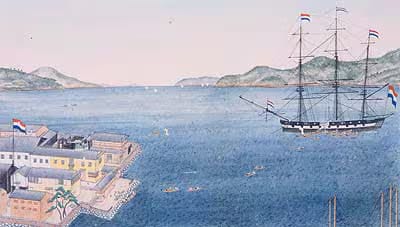
In 1636, the Shogun raised funds from 25 wealthy Nagasaki merchants for the construction of a small artificial island to be known as Dejima, in order to accommodate the arrival of Portuguese merchants, who were to be allowed access to Japan. Only three years later, however, the Shogunate announced its fifth isolation order, prohibiting Portuguese ships from coming to Japan; all Portuguese were deported, and Dejima was deserted.When a Dutch trading firm was relocated to Dejima from Hirado in 1641, Dejima began to function as a center for science and economics, and became a focal point for the European culture that flowed into Japan - and so it remained for the next 218 years.It had long been known that Japanese soy sauce was exported to Europe during the Edo period, as substantiated by records found in Le Encyclopedie,by Denis Diderot, published in France in 1765. Yet until recently, details concerning the amounts of such exports, the actual export routes and the soy sauce manufacturing sites remained unclear.Recent research has revealed new details concerning soy sauce export during that era. In this exhibition, Soy Sauce Export in the Edo Era, we feature information on trade activities and soy sauce exports during those years of national isolation,based on records found in the “Nagasaki Trading Firm Jounal”, prepared by the Nagasaki Trading Firm of the Dutch East India Company.
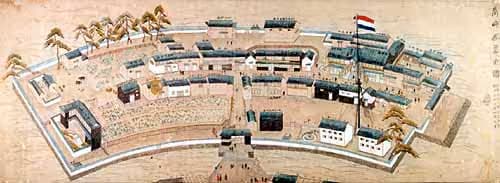
(Facalty of Economics Branch Nagasaki University Library)
Official Trade Freight and Private Trade Freight
There were 2 kinds of freights exported from Dejima. One was motokata nimotsu (official trade freight) and the other was waki nimotsu (private trade freight).
Motokata nimotsu, which also was called compania nimotsu, was the official freight dealt with directly by the Dutch East India Company. This is the freight recorded in the Nagasaki Trading Firm Journal.
The other freight, waki nimotsu (private trade freight), which was also called yakusha/sojya (staff/sailor) nimotsu referred to the items privately traded by the chief and the staff working at the Nagasaki Trading Firm, and Dutch sailors. In 1685, the Edo Shogunate set the limit for the total waki-ni torihiki (trading of waki nimotsu) at 400 kans (kan: weighing unit used at that time; a kan is equivalent to approximately 3.75kg), which was subsequently abolished in 1737. This does not mean that waki-ni torihiki began in 1685. The transaction of private freight had already started in the early period of Nagasaki Trading. Soy sauce was exported as both motokata nimotsu and waki nimotsu. The record shows that soy sauce was exported as motokata nimotsu for 145 years from 1647 to 1792, and as waki nimotsu until Japan's policy of national isolation was abolished in 1854.
Routes of Soy sauce Exports
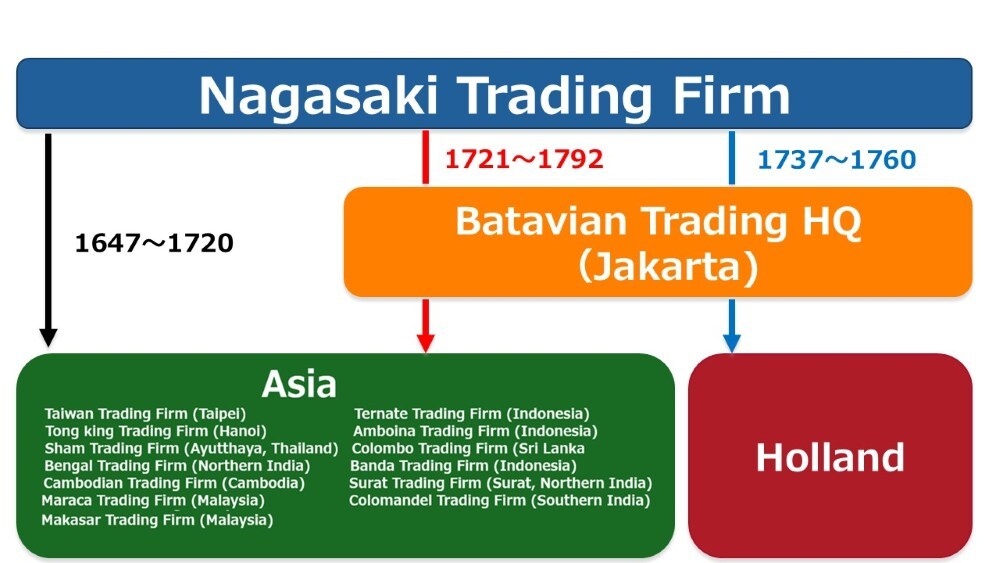
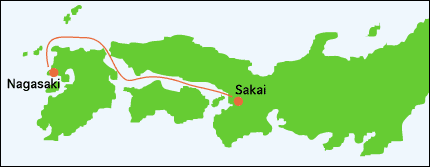
Soy sauce exported as motokata nimotsu began in 1647, and used the routes shown in the diagram, which were slightly altered depending on the year.
From 1647 to 1720, soy sauce was directly exported from Nagasaki Trading Firm to each regional trading firm in Asia, however, from 1721 to 1792, soy sauce was exported only to Batavia HQ where it was transferred to each regional trading firm.
Soy sauce export to the Netherlands continued for 24 years until 1760 using the route from Nagasaki to the Netherlands via Batavia.
Soy Sauce Export to Asian Countries
Each and every item exported from the Nagasaki Trading Firm is recorded in the “Nagasaki Trading Firm Journal”. The table below shows the quantity and the location of the first direct shipment of soy sauce as motokata nimotsu from Nagasaki Trading Firm to regional trading hubs in Asia.
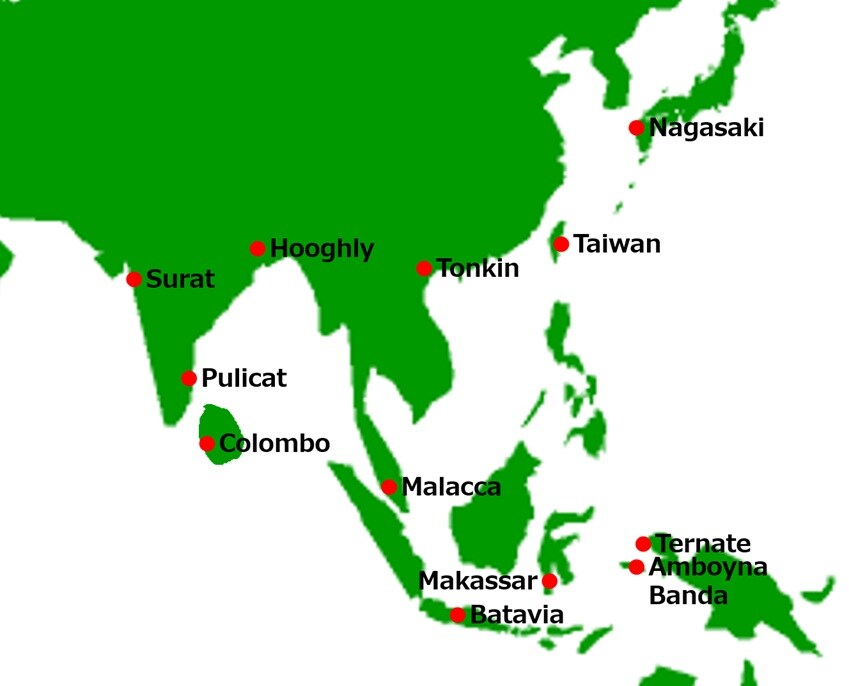
The map below shows the locations of the trading firms in Asia. It indicates that soy sauce was exported to the Moluccas in the East, as far West as the Western coast of India, and also to Jakarta and Sri Lanka in the South. The main consumers of soy sauce in these regions were kakyo (Chinese merchants abroad).
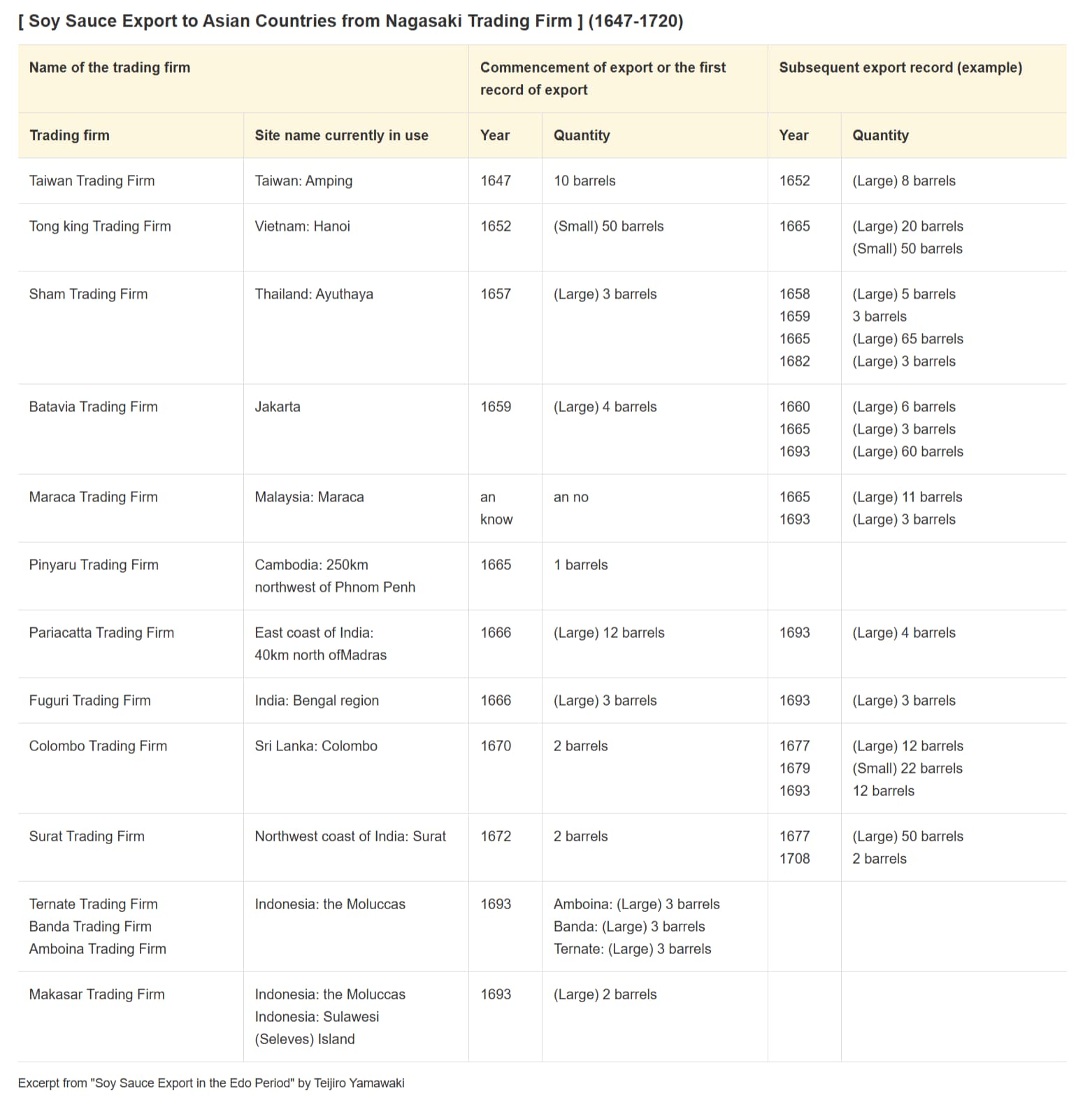
[ Soy Sauce Export to Asian Countries from Nagasaki Trading Firm ] (1647-1720)
Soy Sauce Export to Batavia HQ
The following table shows the amount of soy sauce exported from the Nagasaki Trading Firm to Batavia HQ during the 56 years from 1737 to 1792.
From 1737 to 1760, soy sauce was exported to Batavia, and from there an amount was transferred to the Netherlands, and some was distributed to other Dutch trading firms located in countries in Asia.
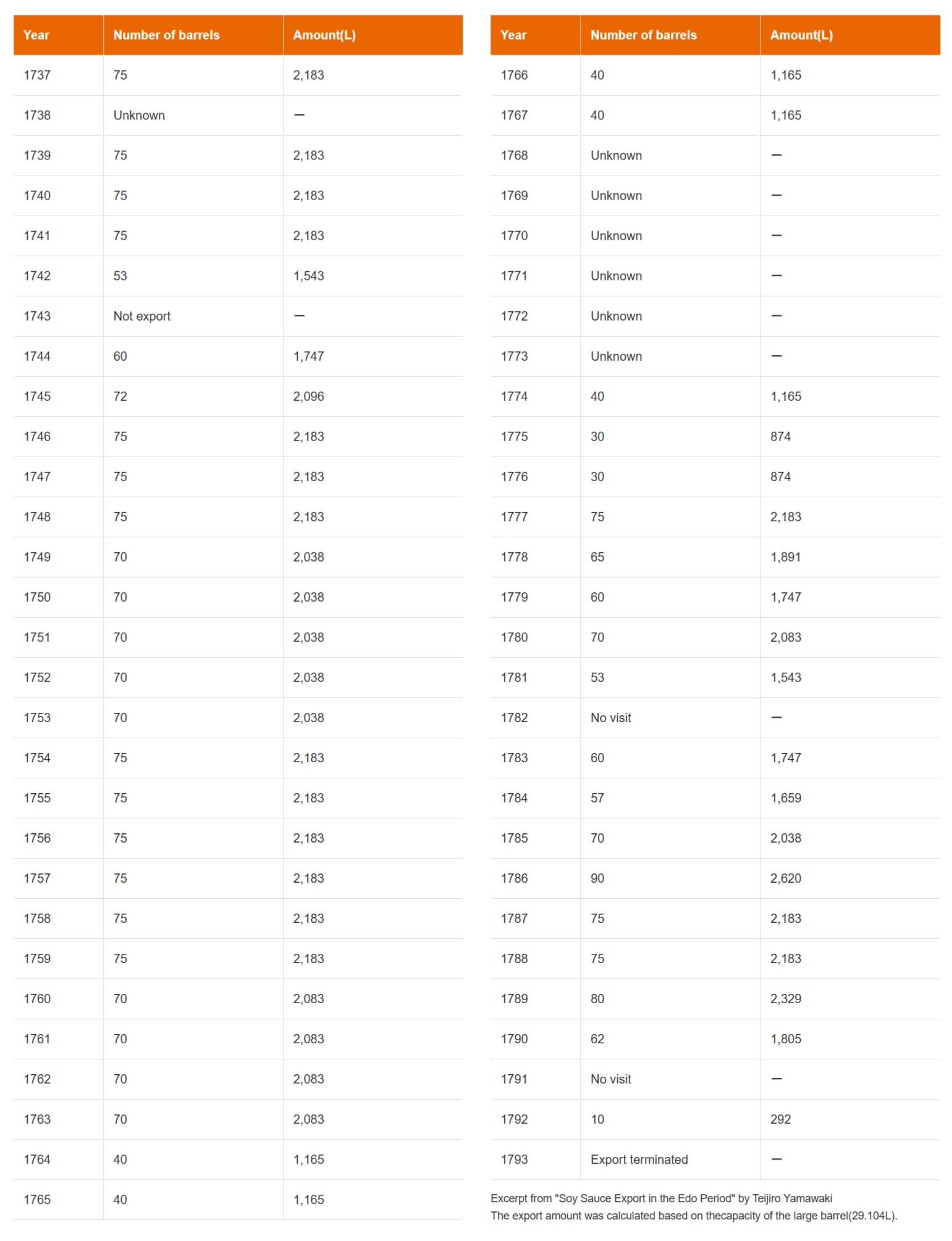
the amount of soy sauce exported from the Nagasaki Trading Firm to Batavia HQ during the 56 years from 1737 to 1792.
Soy Sauce Export to the Netherlands
According to the “Nagasaki Trading Firm Journal”, it was from 1737 to 1760 that soy sauce was exported to the Netherlands as motokata nimotsu.
During these 24 years, approximately 46 kilolitres of soy sauce were exported to Batavia HQ, and 15.6 kilolitres (about 1/3 of the total amount) were transferred to the Netherlands. This means that the annual average of soy sauce export (except 1742 and 1743) amounted to 707 litres. In addition, a substantial amount of soy sauce was presumably exported to the Netherlands as waki nimotsu.
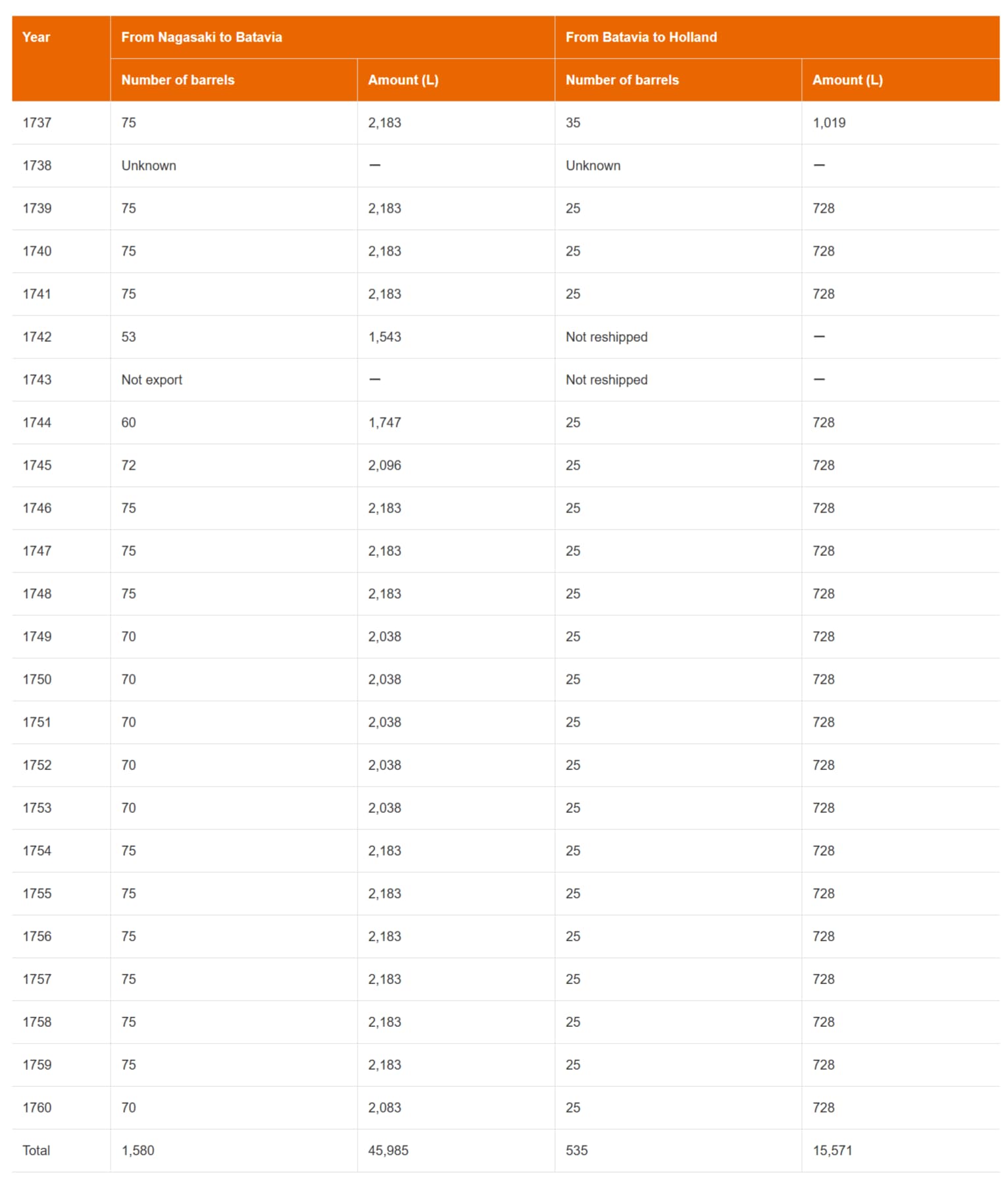
Excerpt from "Soy Sauce Export in the Edo Period" by Teijiro Yamawaki
The export amount was calculated based on the capacity of the large barrel (29.104L).
Comprador Soy Sauce Bottle (1)
The amount of soy sauce exports are recorded by the barrel in the “Nagasaki Trading Firm Journal”.
A close look at the records has revealed that there were 2 sizes of barrels used for soy sauce export. The capacity of the small barrel was half of that of the large barrel (approximately 29.104 litres).
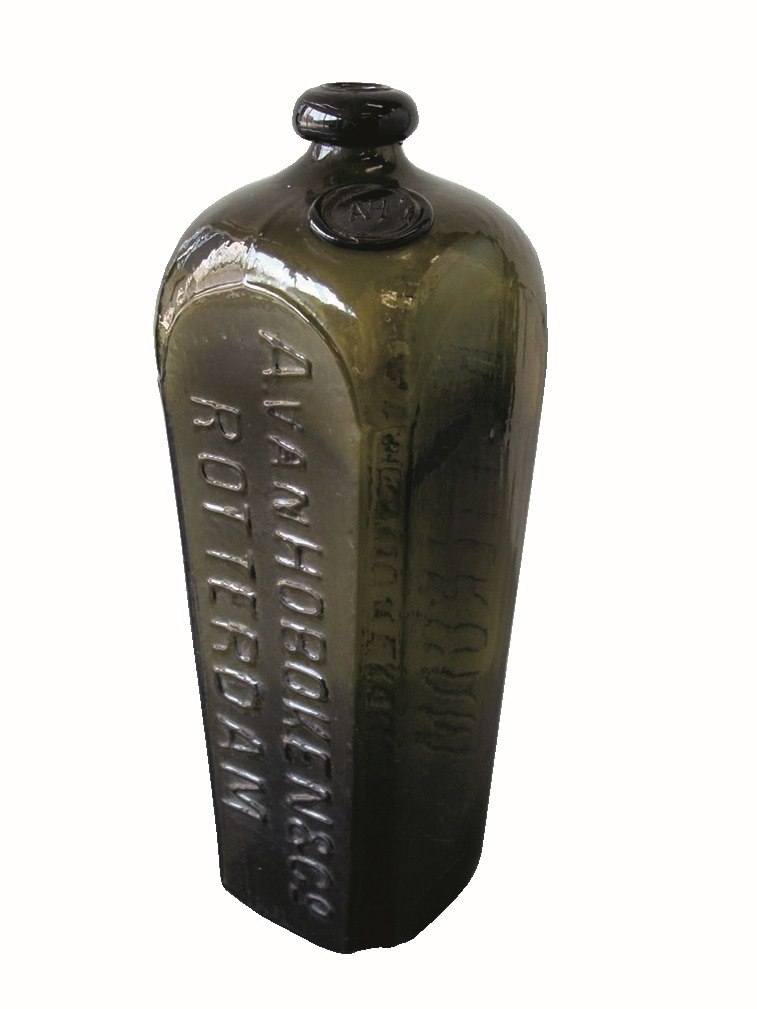
Soy sauce was, in fact, sometimes repackaged for exportation into a container called a comprador bottle.
Before comprador bottles, square glass bottles called kerder bottles were used. However, kerder bottles were replaced with pottery made in Imari or Hasami near Nagasaki, to cover the shortage of glass kerder bottles. They were then replaced with the pottery similar to the baked bottle currently used as sake bottles (tokkuri). The sake(rice wine) bottle-shaped comprador bottle's full name is the comprador soy sauce bottle, in order to distinguish the soy sauce bottle from comprador sake bottle. (Here, we refer to the comprador soy sauce bottle as comprador bottle.)
According to Mr. Yamawaki, a comprador bottle contained about 552 millilitres and 550 of them were used for the first time in 1790 for soy sauce export. These bottles of soy sauce are recorded as "sterilized soy sauce". Soy sauce exported as motokata nimotsu was discontinued in 1793. Eventually in 1799, the Dutch East India Company was dissolved. The Nagasaki Trading Firm subsequently came under the supervision of the East Indian Governor-General in Batavia, and soy sauce exports were resumed. At this time, the bottles were modelled after the ones used in 1790.
Comprador Soy Sauce Bottle (2)
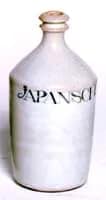
It was suggested by the late local historian, Mr. Masao Ichikawa, also a former notary in Amakusa, Nagasaki, that the comprador bottle took 2 different shapes.
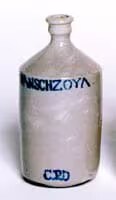
The comprador bottles are shaped like sake bottles and the letters, "JAPANSCHZOYA" or "JAPANSCHSOYA", are written on the shoulder. The early comprador bottles have handwritten letters on them and are grey/white porcelain.
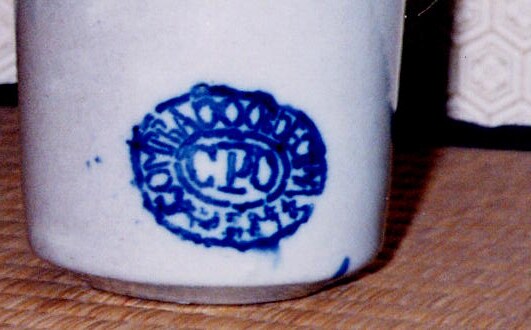
Late comprador bottles have "JAPANSCHZOYA" and "CPD" stamped. "CPD" is the monogram that came from "comprador". On the opposite side of the bottle, a circular or oval stamp in Western characters or in Kanji characters, referring to the Nagasaki Comprador Trading Company or the Nagasaki Comprador Store, is seen. According to Mr.Yamawaki, the term, "Trading company"came to be used in the Meiji Era.
This means that the late comprador bottle with the Kanji character stamp was used in the Meiji Era.
The capacity of comprador bottles differs from bottle to bottle. The capacity of one bottle exhibited in the Noda City Local Museum is 575 millilitres while that of another bottle is 460 millilitres “Comprador soy sauce and soy sauce produced in Tokatsu region” by Norio Tanaka. Based on the amount of soy sauce and the number of the bottles exported, Mr.Yamawaki assumes that a bottle contained approximately 522 millilitres.
For sake export, "JAPANSCHZAKY" is seen on the shoulder of the bottles of the same shape are used.
Soy Sauce Exported as Waki Nimotsu
Waki nimotsu, which was also called yakusha/soja (staffs/sailors) nimotsu, referred to the goods privately traded by the staff working at the Nagasaki Trading Firm or by Dutch sailors. Though it is a fact that soy sauce was exported as waki nimotsu, there is no record in the “Nagasaki Trading Firm Journal” and the accurate amount of soy sauce exported as waki nimotsu is, therefore, not known.
However, in the Chinese and Western Freight Log, it is recorded that soy sauce was exported as both motokata nimotsu and waki nimotsu by a total of four Dutch ships in 1711.
In the log, the amount of an item exported as motokata nimotsu and the amount as waki nimotsu are added together and recorded as a total. Moreover, soy sauce and Miso (soybean paste) were both recorded as "barrelled items" providing only the total number of the barrels traded. Therefore, it is necessary to categorize the items either as motokata nimotsu or waki nimotsu by cross-referencing with the “Nagasaki Trading Firm Journal”.
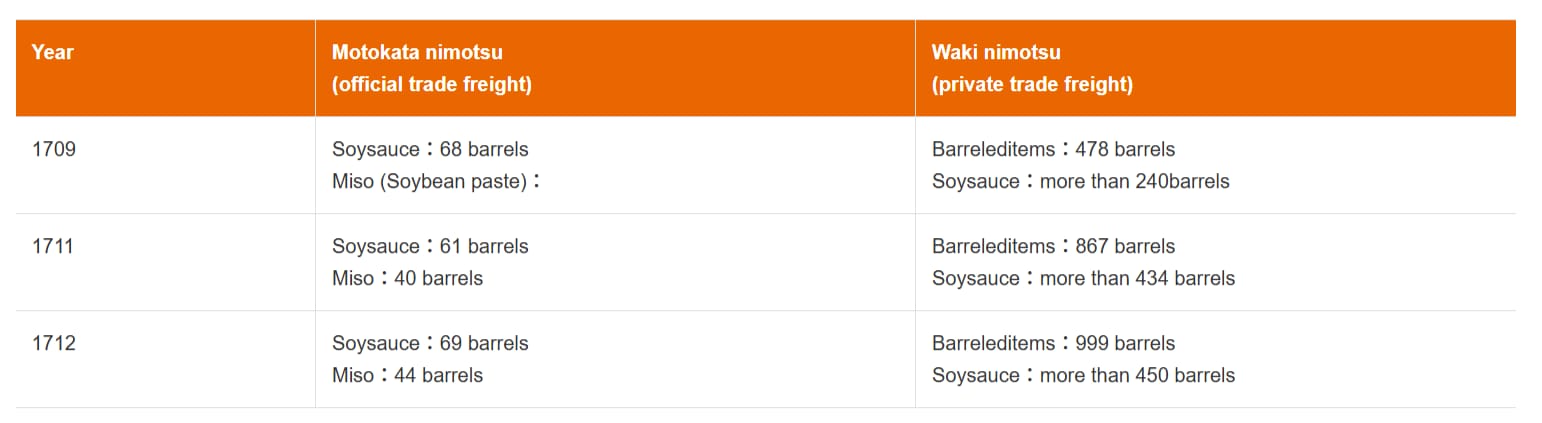
Based on the calculation, in 1711, 61 barrels of soy sauce (56 large barrels and 6 small barrels) as well as 40 barrels of Miso were exported as motokata nimotsu, whereas 867 barrels were exported as waki nimotsu. In the following year, 999 barrels of soy sauce and Miso were exported as waki nimotsu but unfortunately, it is impossible to know how many of them contained soy sauce.
According to Mr.Yamawaki, more than half of the barrelled waki nimotsu was soy sauce since the amount of Miso had never been larger than that of soy sauce. The table below shows the amount of soy sauce exports as motokata nimotsu and waki nimotsu in 1709, 1711 and 1712 calculated from the records in the “Nagasaki Trading Firm Journal” and Chinese and Western Freight Log.
Excerpt from Soy Sauce Export in the Edo Period by Teijiro Yamawaki
Soy Sauce Exported by Chinese Ships
Chinese ships also visited Nagasaki for trading during the Edo Era, yet the soy sauce exports were scarcely recorded and it is impossible to know the details.
However, there are records of soy sauce exported by Chinese ships in the Chinese and Western Freight Log, the “Batavia Castle Diary” and the “Nagasaki Trading Firm Journal”. It is noted in the “Batavia Castle Diary” that 20 barrels of soy sauce were shipped from Japan to Batavia on a Chinese ship on March 31, 1669, and this is the earliest record of soy sauce export. Some Chinese ships carried freights between Nagasaki and ports in China, while others carried freights between Batavia and Nagasaki.
This is why Chinese ships had freight names according to their destination or stopover ports.
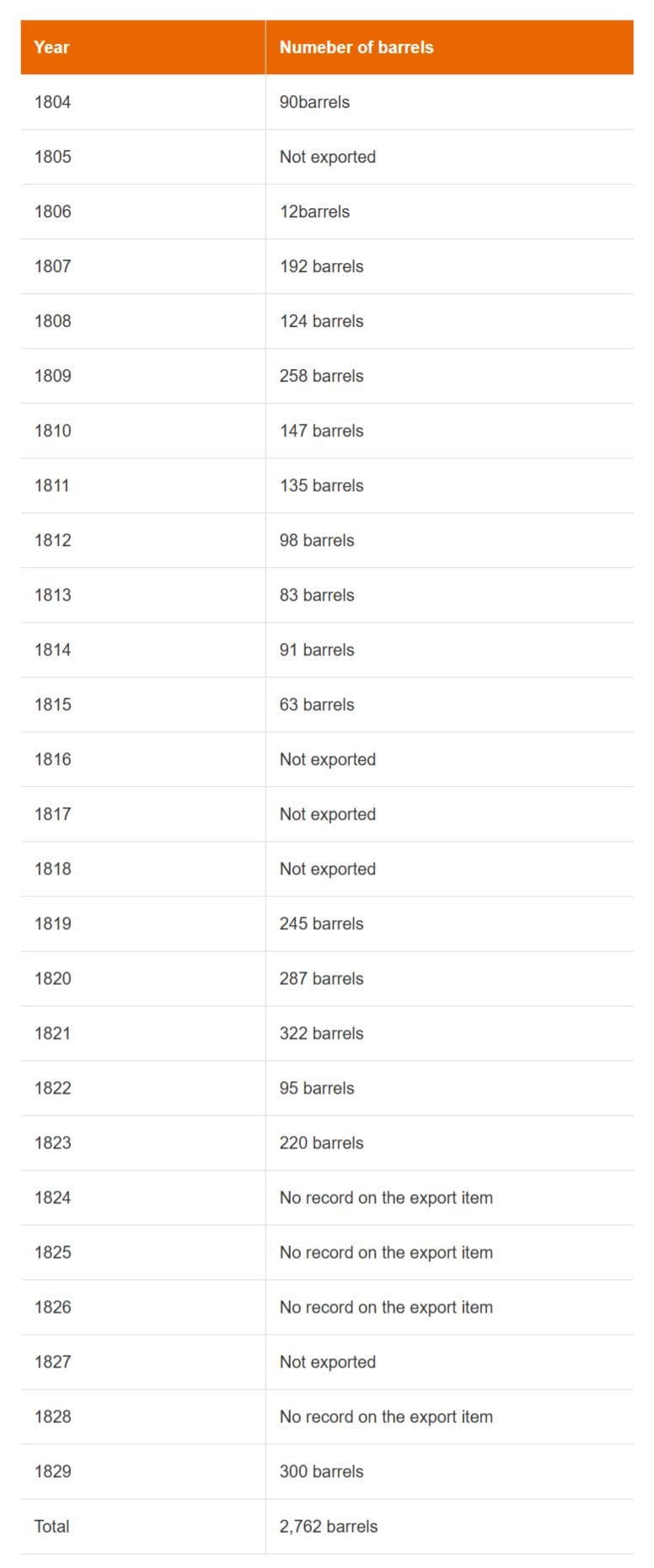
Table 5 shows the records for the 26 years from 1804 to 1829 found in the “Nagasaki Trading Firm Diary”. In both tables, only the number of barrels is shown because neither the size nor the capacity of the barrels exported by Chinese ships is known.
Excerpt from Soy Sauce Export in the Edo Period by Teijiro Yamawaki
Production Sites of Exported Soy Sauce
It is mentioned in the “Nagasaki Trading Firm Journal” of 1687 that 20 barrels of soy sauce produced in Kyoto (1 barrel contains approximately 29.104 litres) were shipped to Sri Lanka Trading HQ. It is believed to have been manufactured by a sake brewer in Kyoto. At that time, Sakai was famous in the Keihan region for its soy sauce production but Kyoto had grown to be another production site for soy sauce, as good as the ones produced in Sakai.
The amount of sake exported was always larger than the amount of soy sauce exports. The records of the exported sake produced in Kyoto appeared for the first time in 1670 in the “Nagasaki Trading Firm Journal”. In the “Batavia Castle Diary”, sake produced in Kyoto was recorded as a special gift to the emperor, called the “imperial rice wine”. In Batavia, soy sauce produced in Kyoto was also treated as a high-quality "imperial soy sauce", which may be described today as "soy sauce made only for the Emperor". There are records of exported soy sauce produced in Kyoto in the “Nagasaki Trading Firm Journal” until 1692.
In the “Meian Cho-hoki” (investigation records by a person named Meian) which describes practical trading operations in Nagasaki from 1764 to 1780, no records on soy sauce made outside of Sakai are found. The soy sauce in Sakai was made by 4 manufacturers, including Shobei Hosoya.
Soy sauce produced in Sakai was transported by ships from Sakai called the Sakai-Itokaisen(Sakai Raw Silk Carrier Boat) or the Sakai Bune. These ships had been authorized to carry imported raw silk from Nagasaki since the Keicho Period of the Edo Era. The empty ship going back from Sakai to Nagasaki was used for shipping soy sauce.
Based on this data, soy sauce exported to the Netherlands was mainly made in Sakai, while the Kyoto soy sauce was exported in a small amount for special occasions. In the Chinese and Western Freight Log, the trading of extremely low-priced soy sauce by Chinese ships is mentioned, leading us to believe that soy sauce made locally in Kyushu was also exported.
However, it is safe to say that none of the soy sauce exported during the Edo Era was produced in the Kanto Region.
Transportation of Comprador Soy Sauce Bottles
It must have been extremely difficult for the Dutch to maintain the quality of the soy sauce shipped all the way to the Netherlands by way of Batavia, right on the Equator and around the Cape of Good Hope. How did Dutch merchants prevent the products from being spoiled without any of the refrigeration or vacuum packaging technology we have today?
The following is an excerpt from the “Thumberg's Journal of Travel in Japan” by C.P.Thumberg, a Swedish doctor/botanist who worked for the Nagasaki Trading Firm as a medical doctor.
"Japanese people produce extremely high-quality soy sauce, much better than the Chinese equivalent. A large amount of soy sauce is shipped to Batavia, India and Europe. The Dutch discovered a reliable method for preventing soy sauce from being degraded or fermented at a high temperature. They boil soy sauce in an iron pot and pack it into bottles applying bitumen (coal tar) to the stopper."
(Excerpts from the “Thumberg's Journal of Travel in Japan” translated by Tamaki Yamada)
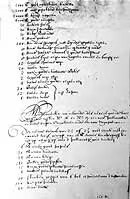
Though the amount of soy sauce exported from Nagasaki to the Netherlands via Batavia was recorded by the barrel, soy sauce was, in fact, repackaged into bottles at the Nagasaki Trading Firm before being shipped.
In 1790, 550 comprador bottles were used for the first time to export "sterilized soy sauce". This seems to refer to the soy sauce that was boiled and packed into bottles with coal tar-applied stopper.
(National Central Archive, Hague, the Netherlands)
Comprador Merchant Guild (1)
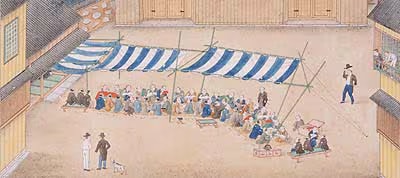
The Comprador Merchant Guild" refers to the group of merchants who were authorized to coordinate trading of commodity goods, exported products and freights between the Dutch staff at Nagasaki Trading Firm or the Dutch sailors and the Japanese merchants.
Comprador is Portuguese for "buyer". The Comprador Merchant Guild, an abbreviation for the "Merchant Guild for the Sales of Various Goods at Dejima", was established by 16 merchants in 1666 under the authorization of Michisada Kono, the Governor of Nagasaki. (The number increased to 17 at one stage.) They were the privileged group of merchants whose marketing rights were assured by the Governor of Nagasaki.
The Comprador Merchant Guild was believed to have sold goods to Dutch merchants, but what they actually did was to work for the Dutch merchants as their buyer in order to gain margin profits. The name, "Merchant Guild for the Sales of Various Goods at Dejima" refers exactly to this kind of activity.
In Nagasaki, besides the Comprador Merchants Guild, there was the Interpreter Guild, a group of interpreters who assisted the transaction of private trading freights. They gained commissions by interpreting and coordinating the private trading of waki nimotsu under the license granted by the Governor of Nagasaki in 1670. In the “Nagasaki Public Service Yearbook” written in 1701, 16 comprador guild merchants were counted as part of the 90 guild interpreters. Hence the comprador guild merchants and guild interpreters were treated as belonging to the same social status.
「Bidding on Merchandise」 by Kawahara Keiji
Comprador Merchant Guild (2)
The following is the history of the Comprador Merchant Guild. It was established under the authorization of Michisada Kono, Governor of Nagasaki in 1666. We now are going to take a closer look at the history of the Guild. (Excerpt from “Episodes associated with Comprador Bottles”, Masao Ichikawa)
When the Hirado Dutch Trading Firm was relocated to Dejima, Nagasaki, in 1642, Heizaemon Koyanagi and Bunzaemon Kujiraya, two merchants engaged in the marketing of Dutch merchant goods in Hirado, accompanied the Dutch merchants and were given permission to continue business operation in Nagasaki. Later, when the business became more prosperous in 1653, they recruited Rihei Hirayama and three other merchants from Hirado. Hence the merchant guild by this time was organized by six merchants. In 1666, Hikozaemon Murata and another nine merchants joined and the 16-member guild was established. Since then the number of the guild merchants has remained the same, excluding a certain period when it consisted of 17 merchants.
The number of guild shares was fixed at 16. There were no restrictions concerning stock exchange, and they were passed over to member,s descendents, friends or relatives. In 1858 when a trading treaty with the Netherlands, England, France and Russia became effective, the guild ceased to enjoy the commercial privilege and the purpose of the guild was lost. The merchant guild branched out into new businesses including the manufacturing/distribution of bread in June, 1868. However, because of the slump in business, the Comprador Merchant Guild dissolved in 1874, selling the shares and the sales office, the assets divided between the guild merchants.
Besides the regular business operation, the Comprador Guild Merchants were ordered by the Edo Shogunate to accompany the Dutch to Edo in 1844, 1850 and 1855 and to supervise them on the purchase of prohibited goods or to assist them as transaction agents.
“Duth Ship in Nagasaki Harbor” by Kawahara Keiji(Nagasaki Municipal Museum)
- 1Soy Sauce Export in the Edo Period, History of Noda City, Vol.3, Teijiro Yamawaki, Noda City History Editorial Committee
- Nagasaki Trading Firm of Dutch Merchants, Teijiro Yamawaki, Chuokoron
- 2Trading with Chinese Merchants in Nagasaki, Teijiro Yamawaki, Yoshikawa-kobunkan
- 3Modern History of Japan-China Trade, Teijiro Yamawaki, Yoshikawa-kobunkan
- 4History of Dutch East India Company, Kozo Shinano, Dobunkan
- 5"Industrial Society", Nagasaki Dictionary, Ichiro Irie et al. from Nagasaki History Study Group, Nagasaki Bunken-sha
- 6Modern History of Trading in Nagasaki, Shitsu Nakamura, Yoshikawa-kobunkan
- 7World Watch by Soy Sauce Trading, Norio tanaka, Ron Publishing Company
- 8Modern History of Trading with Holland and Seclusion, Tetsusuke Hatta, Yoshikawa-kobunkan
- 9History of Interaction between Holland and Japan in the 17th Century, Nafod Oskar (translated by Makitaro Tominaga), Yotoku-sha
- 10Nagasaki Trading Firm Diaries, translated by Naojiro Murakami, Iwanami-shokan
- 11Batavia Castle Diaries, translated by Naojiro Murakami, Heibon-sha
- 12Thumberg's Journal of Travel in Japan, C.P.Thumberg (translated by Tamaki Yamada), Okukawa-shobo
- 13History of Nagasaki City, Nagasaki Municipal Government, Seibundo Publishing Company
- 14History of Nagasaki Prefecture, Nagasaki Prefectural Government, Yoshikawa-kobunkan
- 15Governor of Nagasaki, Mikio Toyama, Chuokoron
- 16Sakai-Metropolitan Culture of the Coastal City, Sakae Kadokawa, PHP
- 17Nagasaki Public Service Diary, Hirofumi Yamamoto, Chikuma-shobo
Profiles of Dr. Teijiro Yamawaki
1914 Born
1950 Graduated from Faculty of Japanese History, Department of Literature, Tokyo University
1954 Doctorate in History, Tokyo University
Currently lecturer at Tokyo Metropolitan Daisan High School of Business Studies;
Department of Literature and Graduate School of Hosei University
Authored work include:
“Modern History of Japan-China Trade” (1960, Yoshikawa-kobunkan)
“History of Nagasaki in Kyoho Period” (1965, Asahi Shimbun Publishing Co.)
“Nukeni (smuggling)” (1965, Nikkei Shinsho)
“Trading with Chinese Merchants in Nagasaki” (1964, Yoshikawa-kobunkan)
“Nagasaki Trading Firm of Dutch Merchants” (1980, Chuokoron)
“Export of Imari Porcelain by Mediation of Chinese and Dutch Merchants” (1988, Arita Town History, Commerce Edition 1)
“Pharmaceutical Culture in Modern Japan” (1996, Heibonsha), etc.
This exhibition has been prepared by Kikkoman Institute For International Food Culture based on a summary of Dr. Yamawaki’s thesis, “Soy Sauce Export in the Edo Period,”published in “Nodashi-shi Kenkyu, Vol.3” (March, 1992, Noda City History Editorial Committee).