
Packages and Containers of Shoyu as Viewed from Food Culture
Scope of Exhibition
Have you ever stopped to look at and think about the packages you use every day? Not much attention is usually given to them. It would be normal for you to take notice of their contents but give little heed to the packages themselves. And yet, without packages, various foods would never reach you; and without good packaging performance, the quality of the food they contain could not be preserved. Without packages, our present-day diet would not exist. Foods and packages are as closely linked as that.
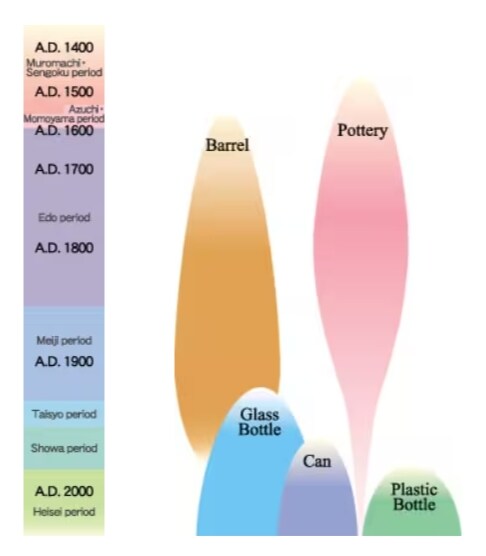
The package is a natural product of the wisdom garnered during mankind's long history, and packaging technology has grown with the progress of science: earthenware has continued to develop since mankind's earliest period; barrels and pails were used from medieval times until after the Second World War; canning techniques were developed for wartime food supplies; plastics technology has made it possible to reduce the weight of packages; the technique of packaging food in retort pouches came in answer to the needs of astronauts; and so on and so forth. Packaging has developed and advanced with the times to meet the requirements of each new age. And today, our affluent diet would be unthinkable if these "packaging revolutions" had not taken place.
In our own time, packaging must satisfy many requirements: improvements in the functions of food hygiene and food preservation, contributions to distribution, and from the point of view of protection of the environment, the production of packages which apply low loads to the ecosystem and are easy to recycle.
At the Institute, we keep our eyes on all these points and intend to take a fresh look at our food culture from the viewpoint of "packages". In the present exhibition, the meaning of packages and containers will be first examined, a brief overview of the history of Shoyu (Brewed Soy Sauce) containers will be presented, and the barrels typical of shoyu containers from the Edo period onward will be discussed in detail.
What is Packaging? (1) The Definition of Packaging
Packaging is a technique to provide proper materials and containers together with the condition that such materials and containers provide for protecting the value and the state of products when they are transported, stored, transacted, or used. (JIS Z0108)
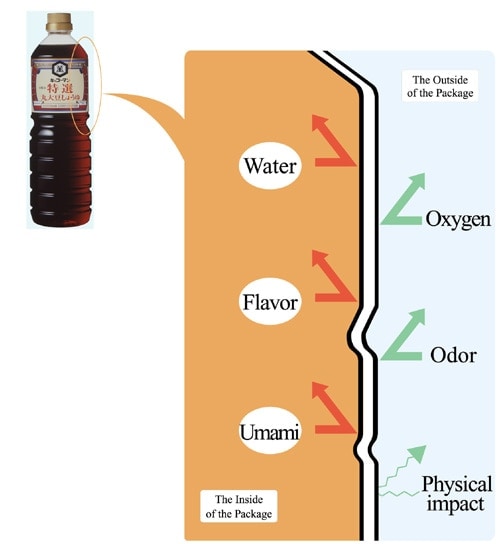
A package comprises not only the container, which is "something to hold the product in", but also the labels, caps, and the cardboard used.
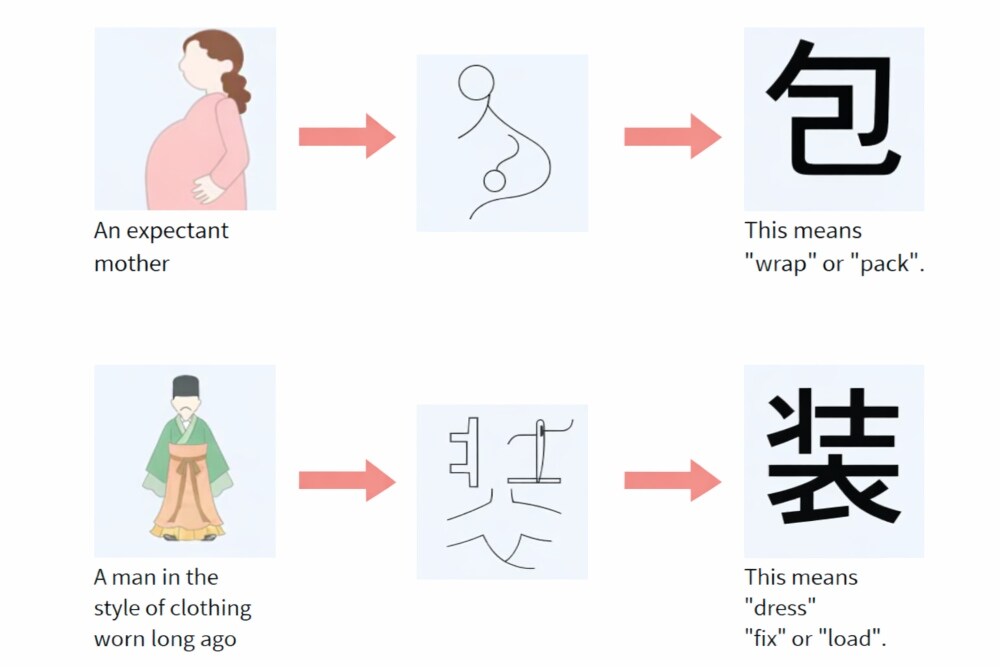
The origins of the Kanji characters 包 and 装.
What is Packaging? (2) Purposes of Food Packages
Physical considerations
Temperature,Humidity,Pressure,Electricity,Moisture,Light,Impact,Dust
Biological considerations
Microorganisms,Insects,Plants,Rodents
Chemical considerations
Oxygen,Corrosion,Chemicals
Human considerations
Tampering(maiking child-proof,etc.)
For manufactures and distributors
In transporting,stacking, and placing
For users
In placing,unpacking,using,classifying,and disposing
For recycling contractors
In classifying, and disposing
Brand
Which company's product?
Product name
What are the contents? Where were they originally produced?
Usage
How is the product used?
Best-before date
By when should it be used?
Contents
How much does the package contain?
Features
How is the product different from similar products?
What is Packaging? (3) Functions of Shoyu Containers
Brief History of Shoyu Containers
The Varieties of Shoyu Packages
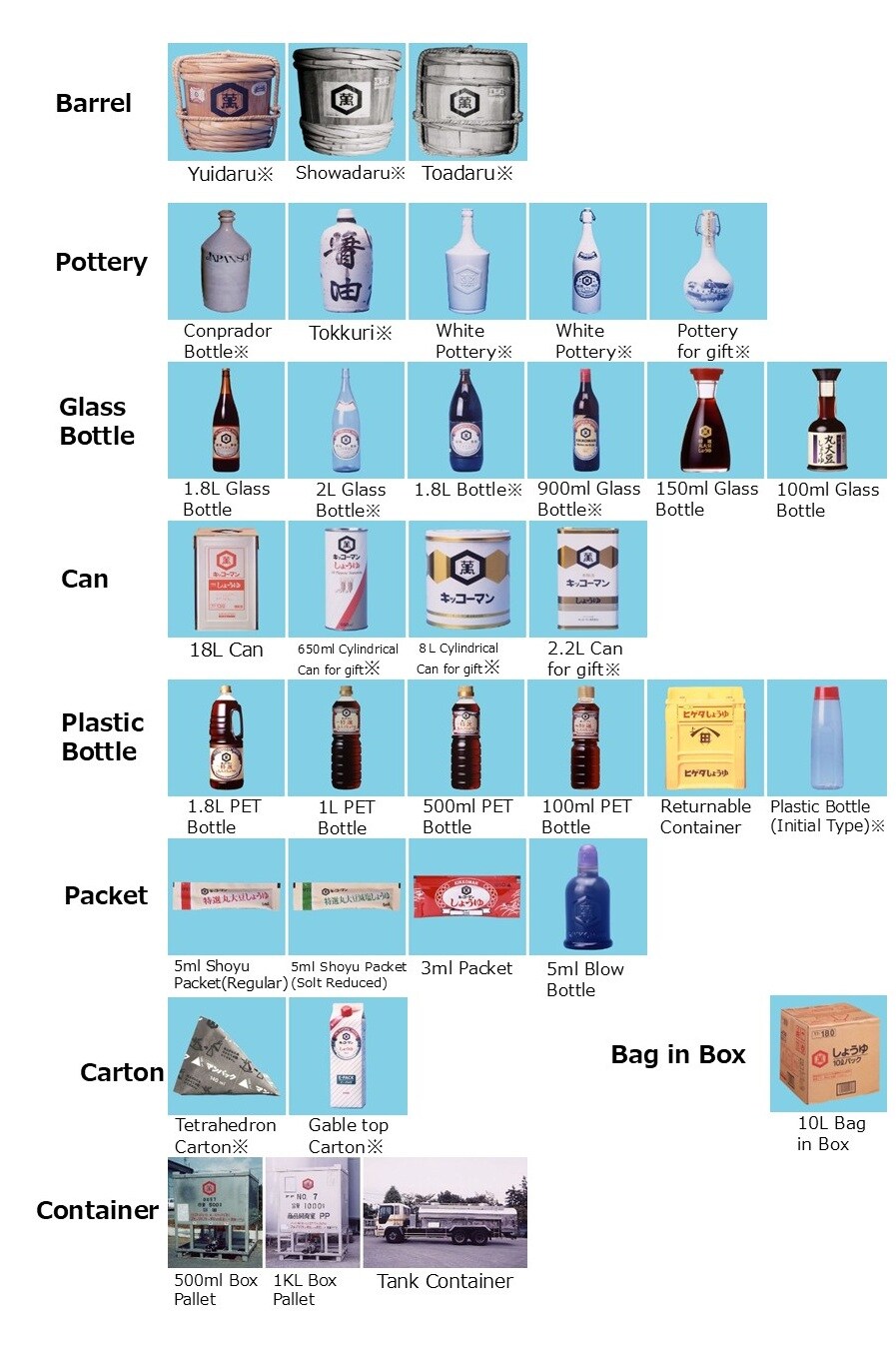
The Varieties of Shoyu Packages
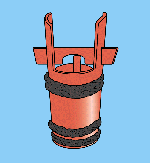
Sake barrel or decorative barrel for celebratory use.

Sake barrel with wooden panels assembled to form a box,a spout located at the top,and the whole body painted with black lacquer.Used for ceremonies.Went out of use in the latter part of the Edo period.
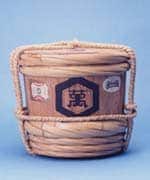
Most popular and typical barrel used to contain sake,shoyu, etc.
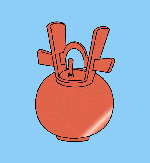
A kind of Tsunodaru. A barrel for celebratory use.

Short Yuidaru.
”Barrel” The Representative of Shoyu Containers(2) Development of the Barrel
Origin
It is not clearly known when the container called the "barrel" came into existence. The form we immediately conjure up in our mind is the kind called "Yuidaru (also called a Shibaridaru)". This is assumed to have originated from the Yuioke (pail) brought from China to Japan primarily through Japan-Sung (China) trade around the 13th century. This can be surmised from picture scrolls of those days in which the Yuidaru began to appear.
Popularization of the Yuidaru
Thereafter, these barrels became popular around Kyoto in the latter part of the Age of Civil Wars (the 16th century) and spread throughout Japan in the Edo period. The Yuidaru, which is superior to other barrels in its outstanding transportability and ease of fabrication, became very popular and the kind most commonly used.
Yuidaru as a Shoyu Container
Many varieties of barrel became available for barrel. Among them the kind exclusively used as a shoyu container was the Yuidaru made of Japanese cedar. This Yuidaru was primarily used for the transportation of sake, but eventually it came to be used for shoyu transportation. In the first part of the Edo period, when shoyu began to be produced on a commercial basis, conventional heavy and fragile earthenware pots and jars were inconvenient for distributing shoyu to the various parts of Japan. Thus, the Yuidaru, which was lightweight and less susceptible to breakage, was chosen as the container convenient for transportation. The shoyu barrel with a volume of 1-To (see note) containing 8-Sho(see note) of shoyu was designated as a standard among shoyu wholesalers in the Edo period, but in and after the Meiji era, one Yuidaru was filled with 9-Sho of shoyu.
(note):1-To=18L;1-Sho=1.8L
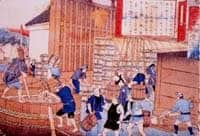
by Hiroshige Ando,3rd.
(Owned by Kikkoman Corp.)
Yuidaru as Shoyu Containers for Exports
In the Edo period, Japan had trade relations with the Netherlands, and the only port that was open for trade with the Netherlands (and so foreign countries) was Nagasaki. Japanese shoyu was exported to the Netherlands through Nagasaki, and the Yuidaru was also used for export containers, as were together with Comprador bottles. The photo below shows a trade document from the Netherlands East India Company and in the center portion of the document, we see "12 Ballen Soya" (12 barrels of shoyu), is written.

(Owned by Central State Archive Repository, Hague, the Netherlands)
Shoyu Barrels are Recyclable Containers
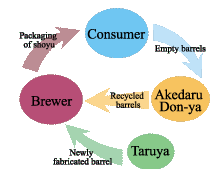
Newly fabricated barrels were of course used in those days, but used barrels were considered proper for the "best- quality shoyu". These were cleaned with water and hot water for reuse. In Edo, a merchants union called the "Akidaru Don-ya" (Empty Barrel Wholesalers Union) existed, and a system to collect empty barrels and sell them to brewers had been established. In addition, the recycling of sake barrels of "Kudari Zake" (sake shipped from the Kansai region to Edo) was practiced, and known as "Tsubushi Daru". 4-To (about 72L) sake barrels were disassembled to remake into 9-Sho (about 16L) shoyu barrels. Furthermore, there was the "Kashi Daru", a system to lease barrels, and selling shoyu by measure was also practiced for the people who bought only small volumes of shoyu. On such occasions, earthenware containers were used.
Development of Barrels during and after the Modern Period
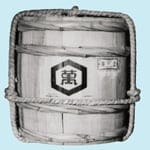
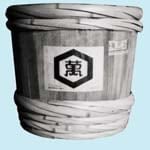
In and after the Meiji era, a large number of Yuidaru were used as shoyu barrels. In addition to the reuse of sake barrels which had been practiced before, barrels fabricated using high-quality Akita cedar were popularly used from around the end of the Meiji era. With the development of rail traffic and transportation represented by the opening of the Ōu Main Line in 1910 (43rd year of the Meiji era), suppliers of barrel material changed. In the Taisho era, shoyu saw the golden age of barrel packaging. Thereafter, demand for shoyu increased, and a still greater number of barrels were required. At Kikkoman, barrel-fabricating plants were established and mass-production began. However, as demand for shoyu increased, demand for containers also increased, and as a result, the use of cans and bottles also grew. Though the demand for barrels continued to increase, eventually, barrels were destined to lose their share of the market for containers for shoyu.
In wartime, due to the shortage of materials, Showadaru made from pine wood, and Toadaru made from Sugihiki-zai (sawn Japanese cedar timber), were among those developed to make up for the shortage of containers. After World War II , when the shortage of materials eased the use of cedar barrels was revived and continued, but because of changes in social needs and various technological innovations, the period of high economic growth saw the role of barrels severely diminished.
”Barrel” The Representative of Shoyu Containers(3) Barrel Marking
The barrel used for shoyu and sake was generally made of cedar (Cryptomeria japonica). This is because the material is easily obtained, cedar being a tall evergreen tree suited to the Japanese climate and distributed throughout Japan, and is comparatively soft and easy to work with. Furthermore, natural chemical substances such as terpene, etc (See note), in cedar create an environment that makes it difficult for microorganisms to proliferate in barrels made from this wood.
(Note)
Terpene,etc.: a group of organic compounds containing two or more isoprene units isolated from essential oils and natural resins.
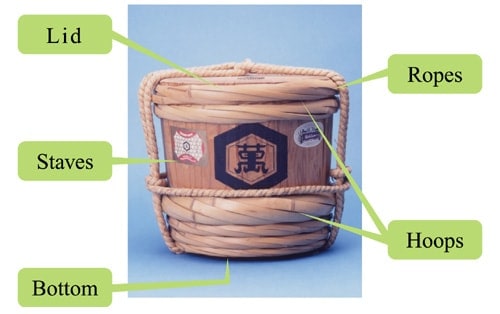
The barrel consists of a number of staves, a bottom and a lid, the headings, composed of one solid piece or several pieces of wood, respectively, and hoops made of metal, bamboo, or cords. Tightening the hoops prevents the contents from leaking as well as the bottom or the lid from coming off.
”Barrel” The Representative of Shoyu Containers(4) Making a Barrel
The fabrication of a shoyu Yuidaru follows several processes.
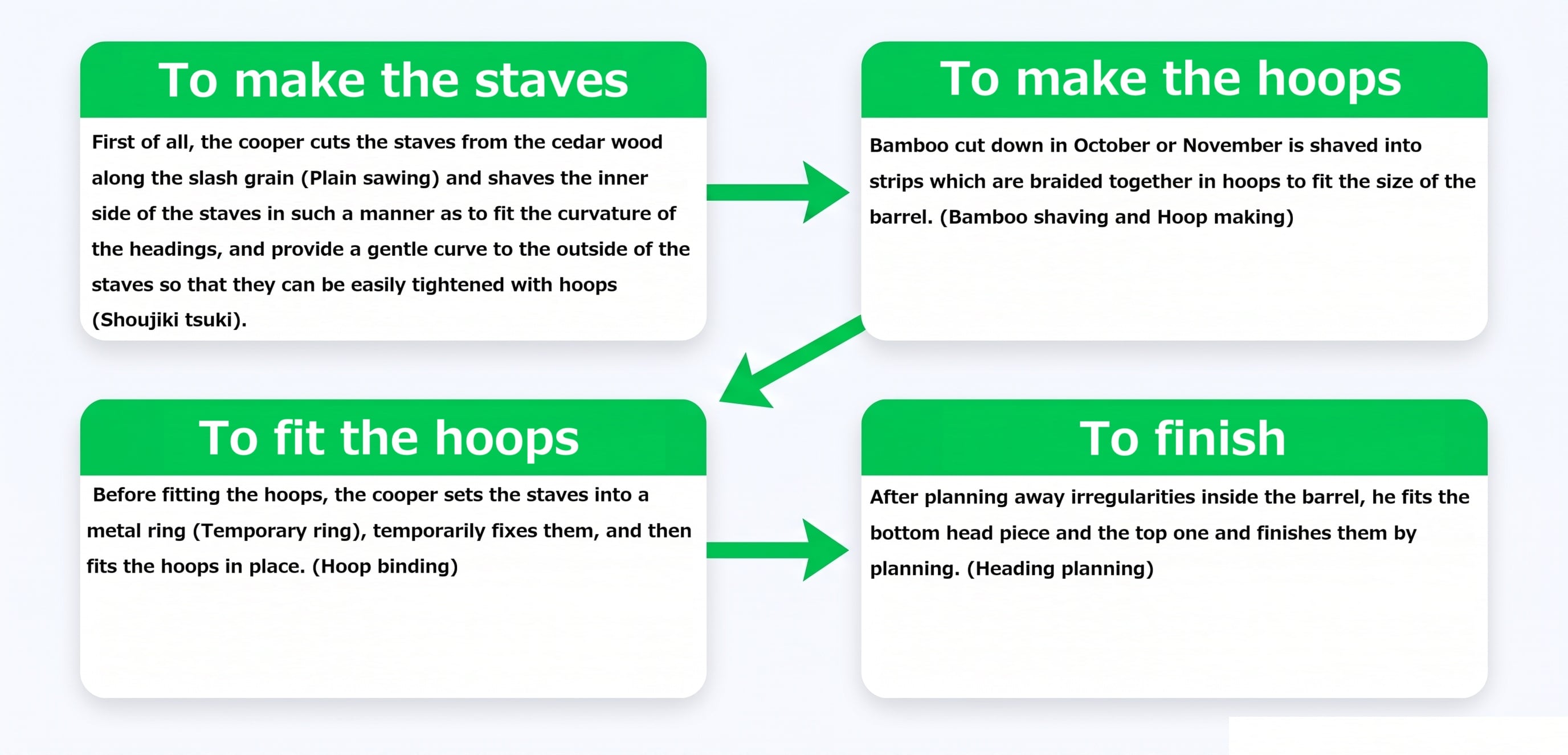
Because shoyu has high permeability, even an undetectable small crack in the packing will cause shoyu to leak. In the case of shoyu barrels, to prevent leakage, methods were developed to use only 100-to 300-year-old Akita cedar with tightly spaced annual rings, showing limited summer growth. Timber dried for about 3 months is used.
Enormous labor and time is required for fabricating barrels, but in the golden age of barrel production, by division of labor, the craftsperson of Noda are said to have produced a daily average of sixteen barrels per craftsperson.
Summary
We believe that through this exhibition after visiting this you will see more clearly than ever that packaging is indispensable to our way of life.
Here, the significance of packages and containers in our food culture is demonstrated with special attention given to shoyu containers of former times, in particular the "Taru"(barrel), which was widely used after the industrialization of shoyu production. We have shown that the Yuidaru was a container that made a great contribution to the transportation and distribution of shoyu for some 300 years in and after the medieval period. Cedar possesses various properties, but the reason why cedar barrels have been in such popular use is possibly the action of "Phytoncide", a chemical substance in cedar that enables it to inhibit the proliferation of microorganisms.
You will have seen that the Yuidaru was an outstanding container that took root in a society that recycled.
We are sure you will agree that there are many things that we in these modern times could learn from those societies that practiced recycling.
The theme of the next exhibition will be pottery, which were used for shoyu packaging during and after the Meiji era.
- 1Noda Shoyu Co.,Ltd.
"20 years of Noda Shoyu Co.,Ltd.- a History" (Noda shoyu Co.,Ltd.1940) - 2Noda Shoyu Co.,Ltd.
"35 years of Noda Shoyu Co.,Ltd - a History" (Noda shoyu Co.,Ltd.1955) - 3Kikkoman Shoyu Co.,Ltd.
"History of Kikkoman Shoyu" (Kikkoman Shoyu Co.,Ltd. 1968) - 4Reiko Murayama
"Barrels in Daily Life" ("Mingu Ronsyu", Keiyuusha,1969) - 5Tsuneichi Miyamoto
"Folk Implements and Their Materials-An Essay on Folk Implements,Part III." ("Mingu Ronsyu" Vol.3, Keiyuusha,1971) - 6Masaaki Hirano
"Containers for Shoyu"(Nihon Ryori Tankyu Zensho Vol,11 "Shoyu Tenpura Monogatari" Tokyo Shobosha,1979) - 7Hiroshi Ogawa
"Barrel Craftsmen in Noda" (Ron Shobou,1979) - 8Michiaki Kouno
"YUIDARU as viewed in illustrative Materials"(Kanagawa University Nihon Jyomin Bunka Institute "Mingu Monthly Vol.18 No.2,1985) - 9Hideo Kuroda
"Emergence of YUIOKE and YUIDARU"( "Weekly Asahi Encyclopedia: Japanese History 24" Asahi Shimbun, 1986) - 10Tatsurokuro Tochikura
"Science and Techniques of Shoyu Production"(The Brewing Society of Japan, 1988) - 11Sumio Miura
"Emergence and Popularization of YUIOKE"(Doshisha University Archaeology Series-Archaeology and Technology, 1988) - 12Japan Perfumery & Flavoring Association
"Encyclopedia of Scents"(Asakura Shoten 1989) - 13Yoshio Tamanoi
"Poems of Barrel Craftsmen"(Furusato Koubou, 1991) - 14Japan Packaging Institute
"What is Packaging?" (Japan Packaging Institute, 1994) - 15Seikatsushi Kenkyujo
"Comprehensive Historical Research on Pails and Barrels in Japan and Foreign Countries"(Seikatsushi Kenkyujo, 1994) - 16Kazuko Koizumi
"Pails and Barrels: All-Rounders in Every-Day Implements" ("Kitchen Tools of the Past and Present" Heibonsha, 1994) - 17Shinichi Ishigami
"Cultural History of Things and People No.82 - Pails and Barrels" (Hosei University Press, 1997) - 18Yukio Motegi et al.
What You Should Know About the Packaging of Food"(Saiwai Shobou, 1999) - 19Norio Tanaka
"The World from the Perspective of Shoyu: Shoyu and an Overview of the History of Foreign Relationships as Seen from Noda"(Ron Shobou, 1999) - 20Masatoshi Saiki, Denmi Kuwagaki
"Shoyu Packaging ("Handbook of packaging and Pharmaceuticals" Saiwai Shobou, 2000) - 21Hiroshi Ogawa
"Shoyu Breweries and Barrel Producers from the Meiji Era to the First Half of the Showa Era in the Noda Region"(Kazuko Koizumi et al. "Pails and Barrels:Wakiyaku no Nihonshi" published by Hosei University Press, 2000)
- Supervisor Hiroshi Ogawa
Born in Noda City.
Graduated from Kokugakuin University.
Scholar of Folklore and History.
Teacher of Japanese History at Chiba Prefectural Higashikatsushika High School,
Part-time Instructor at Showa Women's University. - Material Supplied by Yoshio Tamanoi
Born in Noda City.
A Taru Cooper in Noda.
Winner of the "Chiba Prefecture Designated
Traditional Craftworks" and the "Excellent Technician of Chiba
Prefecture" Awards