
Documents of the Horikiri Monjiro Family, Sagamiya
Documents of the Horikiri Monjiro Family, Sagamiya: Introducing the Historical Sources Donated by the Founding Family of Manjo Mirin
Introduction
The brewing of mirin, a sweet sake with low alcohol content, is a traditional industry in Nagareyama City, in the northwestern part of Chiba Prefecture. The mirin brewed here was called Nagareyama shiro mirin, literally meaning white mirin, because of its clear, pale hue. The brewing and sale of mirin in Nagareyama began in the early 19th century, if not earlier. Among several brands, Manjo mirin and Appare mirin are widely known. The documents to be introduced here are a part of more than 11,000 antique documents that have been passed down for generations in the Horikiri Monjiro family, which brewed and sold Manjo mirin under the trade name of Sagamiya. Seimiya Hidekata was a scholar of early Japanese classics and headman of Sawara Village (present-day Katori City in Chiba Prefecture). In Volume 15 of his book entitled Shimousa Kyujiko (the regional geography of Shimousa Province), completed in 1845, he wrote of Nagareyama mirin: “Nagareyama Village. (Unreadable) Town. Roughly 300 households. There are many merchants selling rice for sake brewing. Recently Seijun Kyu’un Shu holds a pre-eminent position in the three major cities.” If Seijun Kyu’un Shu refers to clear mirin, this is evidence that the shiro mirin of Nagareyama was widely known in the three major cities of Edo, Kyoto and Osaka at least as far back as the Tenpo era (1830–44).
The founder of Manjo mirin was Horikiri Monjiro of Sagamiya, while the founder of Appare mirin was Akimoto Sanzaemon. The historical documents passed down through the Akimoto Sanzaemon family (the Akimoto head family documents) are currently the property of the Nagareyama City Museum. Although the documents cannot be viewed by the public, they are used in several research reports, including those issued by the Nagareyama City Museum entitled “The Brewery Industry of Nagareyama I” and “The Brewery Industry of Nagareyama II,” which examine some of the Nagareyama mirin industry.
On the other hand, documents from the Horikiri Monjiro family of Sagamiya (Horikiri family documents) are the property of the Kikkoman Institute for International Food Culture (KIIFC), and sequential organizing work as well as interpretation have been underway since 2014. They are being organized for use as valuable historical sources that can aid in our understanding of the mirin brewing industry in Nagareyama.
This article touches on the background of the collection of the Horikiri family documents and how they have been organized, and then introduces major historical sources and describes some of the findings. Research and examination, including interpretation, have been conducted only on a part of the documents. Yet, we hope that, by being published in this FOOD CULTURE, the Horikiri family documents will become more widely known and accessible for further use, thereby advancing the study of the mirin brewing industry
Collection of the Horikiri Family Documents
The Horikiri family documents introduced here have been preserved for generations by the Horikiri family in Nagareyama, Nagareyama City, Chiba Prefecture. The collected historical sources had long been kept in the storehouse of the Horikiri family on the grounds of the former Manjo Mirin Co., Ltd. (present-day Nagareyama Kikkoman Corporation). After the Horikiri family residence was relocated from the company grounds to its current site in 1955, the documents were placed in a rebuilt storehouse. The Horikiri family mirin business was incorporated as Manjo Mirin Co., Ltd. in 1917 and merged with Noda Shoyu Co., Ltd. in 1925. The documents are thought to have been compiled by Horikiri Monjiro VI when these major changes took place.
The Horikiri Monjiro family had been running Manjo mirin and other brewing businesses under the trade name of Sagamiya since the early modern age. Beyond operation of the brewing business, the family was engaged in village administration as well as a part of the Katsushika prefectural administration that was established in the beginning of the Meiji era (1868–1912), and was in charge of handling goyokin (the levy the shogunate government or regional lords temporarily imposed on farmers and merchants as loans in the event of financial difficulty). Thus, while many of the documents concern Sagamiya, others concern the village and Horikiri family affairs.
The Horikiri family documents currently in the possession of the KIIFC were collected on four occasions. The historical sources collected on the first occasion were directly donated by the eighth-generation head of the family, Mr. Horikiri Noriaki, in January 2011. As groups of letters were included, it was decided to count, for convenience, each group of letters and documents as one lot as with each larger source (such as a book) being a lot, until the grouped contents are sorted. Roughly 1,065 lots were collected, including two wooden signboards.
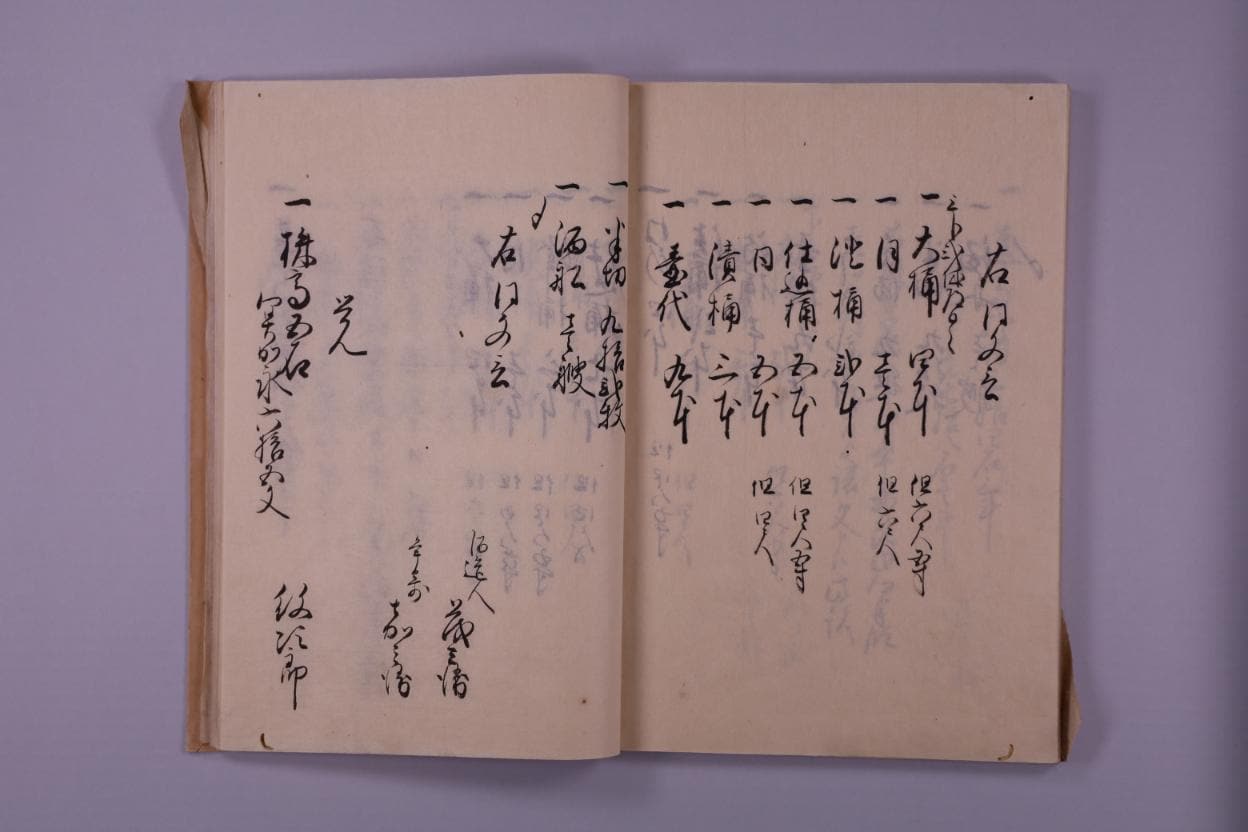
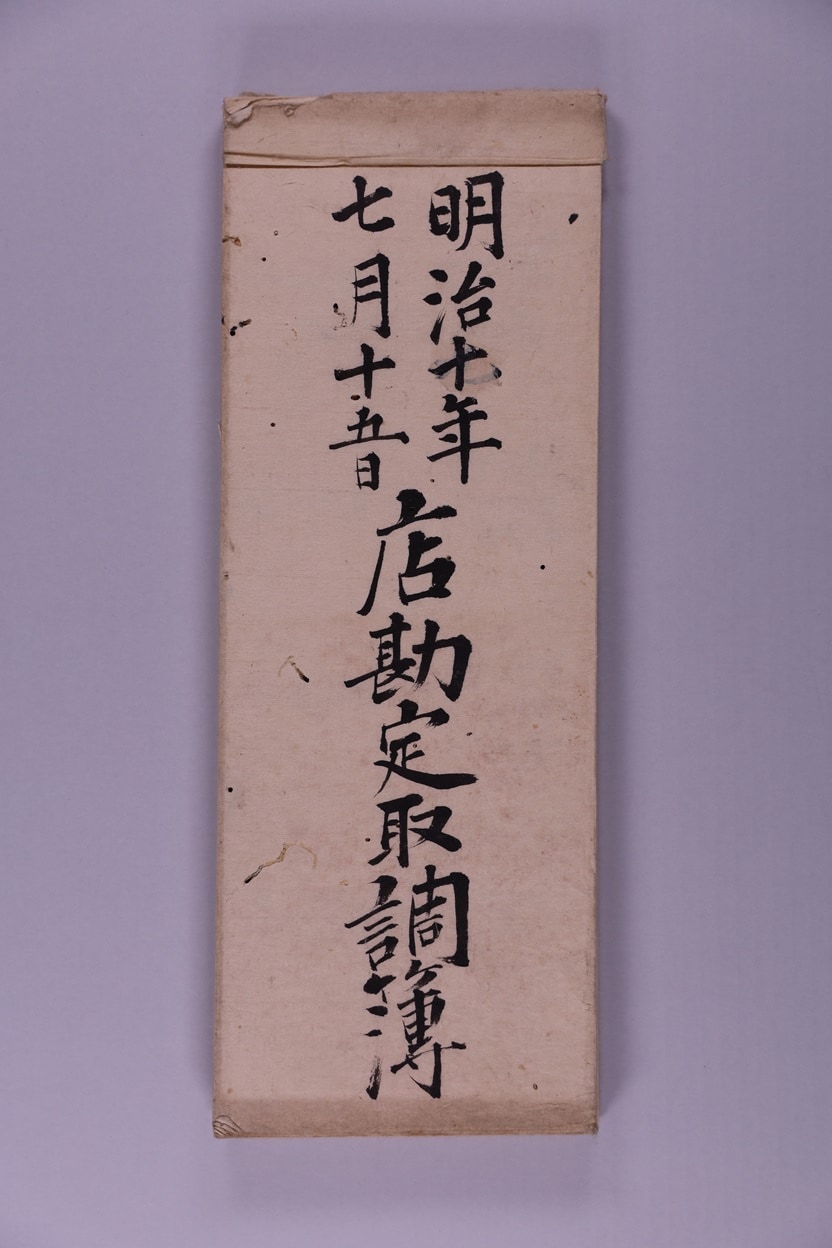
The historical sources collected on the second occasion are a part of those Horikiri family documents that had previously found their way into private hands. We bought 62 lots from an antiquarian bookseller in April 2011. They are valuable documents, mainly consisting of tanakanjo-cho (accounting books) and shoyu zukuri tanakanjocho (soy sauce production accounting books), with a few documents related to Katsushika Prefecture.
The historical sources collected on the third occasion had been placed with the Nagareyama City Museum by the Horikiri family some time before. The documents Mr. Horikiri Noriaki donated to the KIIFC in January 2011 led to the consideration that it would be preferable for the Horikiri family documents to all be stored in one place. Thus, the 483 lots housed in the Nagareyama City Museum were returned to Mr. Horikiri Noriaki and then donated to the KIIFC in September 2011. They had already been organized by the museum and several had been interpreted. The achievements have been utilized in the previously noted research and study reports of the museum, etc.
The historical sources collected on the fourth occasion comprise 69 letters, envelopes, etc. that the Nagareyama City Museum found in November 2016, when antique documents in their possession were reorganized. After consulting the museum as to where they should be stored, the KIIFC received them in November of that year for the same reason as they had received the documents collected on the 3rd occasion.
Through the four additions to the collection, roughly 1,679 lots of Horikiri family documents had been brought together by the KIIFC, creating a valuable collection that tells of the sake and mirin brewing industries in the Kanto region.
Organizing the Horikiri Family Documents
We sequentially organized the Horikiri family documents collected on the four occasions, starting by treating them to prevent degradation, including fumigation and encapsulation in acid-free paper boxes, followed by detailed organization for the collection of basic information and preparation of catalogs. The process of collecting and organizing is summarized in Table 1 Collection and organization process for the Horikiri family documents.
The condition of the historical sources collected on the first and second occasions was recorded, and they were fumigated before encapsulation in acid-free paper boxes and preliminary cataloging for entry in the KIIFC collection. The historical sources can be broadly classified according to their characteristic forms into bound and sewn accounting books, letters on rolled paper, ruled paper sheets, and other formats. Basic information such as rough numbers and dates was collected for each lot in bound and sewn accounting books, each bundle of letters, and each number of ruled paper sheets and others that could be stored in an acid-free paper bag.
For the historical sources collected on the third occasion, we maintained the collection system applied to the documents throughout the processes of cataloging, adding explanatory notes, and encapsulation by the Nagareyama City Museum, in view of their long period of storage with the museum. Meanwhile, of the numbers given to the Horikiri family documents by the museum, 197 to 212 are missing. How this happened and the whereabouts of the documents are not known. After the organization, the Preliminary Integrated Catalog of the Horikiri family documents collected on the three occasions (from the first to third) was prepared by November 15, 2011.
Starting in November 2014, when the basic organization of the lots had been completed, a more detailed organization of the historical sources collected on the four occasions was carried out. This detailed organization included a comprehensive check of the documents, cataloging, attaching bar codes, and creation of thumbnail pictures. For the 10th detailed organization project, conducted from March to June 2019, a detailed Integrated Catalog was completed for all except for the bundled materials.
In the 11th detailed organization project, conducted from June to October 2019, materials in groups were sorted and the total number of Horikiri family documents was estimated to be 11,489 items (give or take a bit, since detailed organizing work has not begun for some materials). Since the 12th detailed organizing work in 2020, detailed organization has been conducted for 5,202 of the more important among 6,568 sorted letters and documents. As a result of the 14th detailed organization project in fiscal year 2021, the total number of items was seen to be 11,498. The completion of the Horikiri family document catalog is scheduled for fiscal year 2023.
Overview of the Horikiri Family Documents
As noted earlier, the Horikiri family documents have been passed down for generations by the Horikiri Monjiro family, who were running a brewing business in Nagareyama Village, Katsushika District in Shimousa Province. Organizing and classifying these documents while simultaneously studying them will give us a vivid picture of a brewer family that played a central role in Nagareyama, which held a prominent position in the brewing industry in the Kanto region throughout the early modern and modern ages.
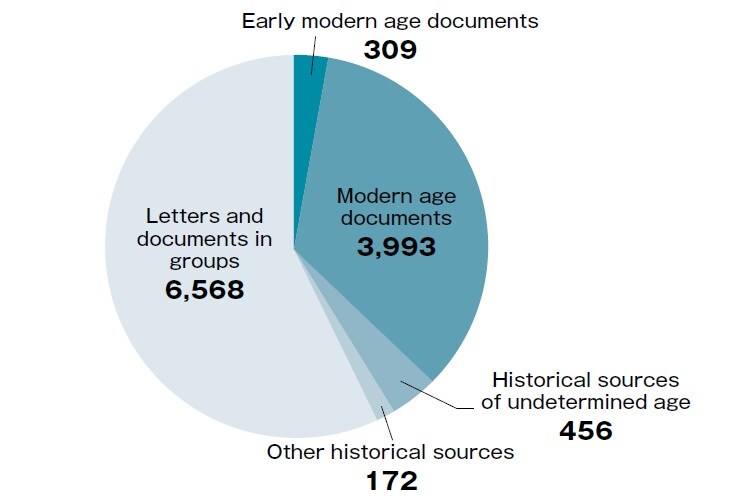
The Horikiri family documents can be broadly classified into the five large categories of early modern age documents, modern age documents, historical sources of undetermined age, other historical sources, and groups of letters and documents. Early modern age refers to the years up to 1871 when the han (feudal domain) system that lasted from the Kamakura period (ca. 1185–1333) to the Edo period (1603–1868) was abolished and the administrative divisions of prefectures were created under central jurisdiction. The modern age refers to the period after 1871. For the early modern age documents, modern age documents and historical sources of undetermined age among the large categories, detailed classifications were determined by dividing large categories into medium categories, and then dividing medium categories into small categories. “Other historical sources” refers to non-antique documents, including wrapping paper, envelopes, and signboards, while “groups of letters and documents” are historical sources stored in bundles by the Horikiri family, the bulk of which have not undergone detailed organization. As shown in Table 2 Large categories and the number of items among Horikiri family documents, classification resulted in 309 early modern age documents, 3,993 modern age documents, 456 historical sources of undetermined age, 172 other historical sources, and 6,568 letters and documents in groups, totaling 11,498. The ratios of each classification are shown in Fig. 1 Ratios of large categories of Horikiri family documents.
The early modern age documents were classified into 7 medium categories of commerce, home, governance, shrines and temples, community, pictures and charts, and others. Of these, 170 items (constituting roughly 60% of the early modern age documents) are related to the sake production business, mirin brewing business and soy sauce brewing business that fall under the commerce category. Major historical sources in this category include 75 sake production items, 46 kanjo-cho accounting books, and 26 tsuketate-cho accounting books. The home category documents are mainly diaries and miscellaneous notes, as well as historical sources concerning culture, religious beliefs, and ceremonial occasions. The governance category includes goyokin-related documents and government proclamations. The shrines and temples category has historical sources concerning temples, the community category has historical sources related to ko (confraternities) and village administration, and there are several pictures and charts for the pictures and charts category.
There are many modern age documents, accounting for slightly over 30 percent of the Horikiri family documents. They were classified into 10 medium categories of commerce, home, community, taxation, public administration, pictures and charts, books, published books, governance, and land tax. Slightly less than 70 percent of the modern age documents, 2,546 items, fall under the commerce category. As in the early modern age, they are related to the sake production business, mirin brewing business and soy sauce brewing business, with 226 items classified under sake, 299 under mirin, and 126 under soy sauce. In the modern age commerce category, many historical sources are related to records of income and expenses, stock shares, management, and facilities and equipment. The home category includes letters, records of income and expenses, various kakiage (reports submitted to superiors or authorities), and records of debts and credits. The community category contains historical sources related to associations, communications, banks, and railroads, and the taxation category includes sources related to income and tax payments. The public administration category includes proclamations and administrative orders, as well as village administration matters, while there are several maps and drawings in the pictures and charts category. The governance category contains goyokin-related historical sources. Groups of letters and documents are those that had been stored in groups by the Horikiri family. As mentioned earlier, detailed organization has not yet been completed, but they have been classified into five categories of invoices and receipts, others (related to commerce), letters, others (private), and waka (Japanese thirty-one syllabled poems) and religious beliefs. Except for waka and religious beliefs, the plans are to proceed with further detailed organizing of these historical sources to complete the catalog.
| Year | Month | Collection/Organization | Details |
|---|---|---|---|
| 2011年 | Jan | 1st collection | Received donation of 1,065 lots from Mr. Horikiri Noriaki |
| Jan-Mar | 1st organization | 1st collected historical sources were fumigated and encapsulated in acid-free paper boxes, and preliminary cataloging was done for entry in the KIIFC collection. | |
| Apr | 2nd collection | Purchased 62 lots from an antiquarian bookseller (Iwagami Shoten) | |
| Apr | 2nd organization | 2nd collected historical sources were fumigated and encapsulated in acid-free paper boxes. | |
| Sep | 3rd collection | Received donation of 483 lots (which had been deposited with the Nagareyama City Museum) from Mr. Horikiri Noriaki. | |
| Sep-Dec | 3rd organization | 3rd collected historical sources were fumigated and encapsulated in acid-free paper boxes, and the Preliminary Integrated Catalog of historical sources collected from 1st to 3rd occasions was prepared. | |
| FY 2014 | Nov-Feb | 1st detailed organization | 510 items were sorted. Then, a detailed catalog was prepared by adding information lacking in the preliminary integrated catalog. Barcodes were affixed on them and thumbnail photos of the items were taken for registration in the database. |
| FY 2015 | Jul-Oct | 2nd detailed organization | Work identical to the 1st detailed organizing work was conducted for 501 items, and their registration in database was initiated. |
| FY 2016 | May-Jul | 3rd detailed organization | 603 accounting books and other such sources were cataloged and thumbnail photos of the items were taken. |
| Jul-Oct | 4th detailed organization | Historical sources in bundles were sorted and cataloged, and thumbnail photos of the items were taken. | |
| Nov | 4th collection | Received 69 items from the Nagareyama City Museum. | |
| Jan-Mar | 5th detailed organization | 4th collected historical sources were cataloged, barcodes were affixed on them, and thumbnail photos of the items were taken. | |
| FY 2017 | Aug-Sep | 6th detailed organization | Work identical to the 1st detailed organizing work was conducted for 407 items. |
| Jan-Mar | 7th detailed organization | Work identical to the 1st detailed organizing work was conducted for 448 items, and the preliminary integrated catalog was integrated with the detailed catalog. | |
| FY 2018 | Aug-Oct | 8th detailed organization | Work identical to the 1st detailed organizing work was conducted for 1,623 items, and the preliminary integrated catalog was integrated with the detailed catalog. |
| Dec-Mar | 9th detailed organization | 407 items were cataloged, their thumbnail photos were taken, and the preliminary integrated catalog was integrated with the detailed catalog. | |
| FY 2019 | Mar-Jun | 10th detailed organization | Work identical to the 1st detailed organizing work was conducted for 962 items, and the detailed Integrated Catalog was completed. |
| Jun-Oct | 11th detailed organization | 65 groups of historical sources were sorted and categorized according to their contents, and category seals were affixed. The total number of Horikiri family document items totaled 11,489. | |
| FY 2020 | Oct-Jan | 12th detailed organization | For 723 of the 6,559 letters and documents that were sorted in the 11th detailed organization, a detailed catalog was prepared, barcodes were affixed on the items, and thumbnail photos of the items were taken. |
| Dec-Mar | 13th detailed organization | For 702 of the 6,559 sorted letters and documents, a detailed catalog was prepared, barcodes were affixed on the items, and thumbnail photos of the items were taken. | |
| FY 2021 | Jul-Oct | 14th detailed organization | For 769 of the 6,559 sorted letters and documents, a detailed catalog was prepared, barcodes were affixed on the items, and thumbnail photos of the items were taken. The number of items totaled 11,498. |
| Dec-Mar | 15th detailed organization | For 652 of the 6,559 sorted letters and documents, plans were made for preparation of a detailed catalog, affixing of barcodes, and thumbnail photos. | |
| FY 2022 | ー | 16th and 17th detailed organization | For 1400 of the 6,559 sorted letters and documents, plans were made for preparation of a detailed catalog, affixing of barcodes, and thumbnail photos. |
| FY 2023 | ー | 18th and 19th detailed organization | For 956 of the 6,559 sorted letters and documents, plans were made for preparation of a detailed catalog, affixing of barcodes, and taking of thumbnail photos. A batch registration of 1,366 items of waka, religious beliefs, etc. is planned, which will complete the entire organizing project. |
Table 2 Large categories and the number of items among Horikiri family documents
| Large categories | Number of items | Ratios | |
| Early modern age documents | 309 | 3% | |
| Modern age documents | 3,993 | 35% | |
| Historical sources of undetermined age | 456 | 4% | |
| Other historical sources | 172 | 1% | |
| Letters & documents in groups | Cataloged | 5,202 | 45% |
| Not cataloged | 1,366 | 12% | |
| Total | 11,498 | 100% | |
Early Modern Age Documents
As mentioned earlier, the early modern age documents were divided into seven medium classification categories of commerce, home, governance, shrines and temples, community, pictures and charts, and others. The number of items in each medium category is shown in Table 3 Medium categories of early modern age documents and the number of items.
This section focuses on the following historical sources: accounting books called tsuketate-cho, accounting books called kanjo-cho, ledgers called tanakanjo motocho, sake production records, Shoyu Zukuri Tanakanjo-cho (soy sauce production accounting books), and Tesei Sake Mirin Hon’naoshi Shirushi Kagami (hand-drawn samples of sake, mirin, and hon’naoshi seal marks) in the commerce category, which accounts for the majority of items among the medium categories; Katsushika Prefecture goyokinrelated accounting books in the governance category; Matsuo-sha Saiken Iriyo no Hikae (copy of Matsuo Shrine reconstruction fund raising) in the community category; and a picture of Manjo mirin barrels with a kite and townscape from the pictures and charts category.
| Commerce | Home | Governance | Shrines & temples | Community | Pictures & charts | Others | Total |
|---|---|---|---|---|---|---|---|
| 170 | 97 | 21 | 3 | 9 | 3 | 6 | 309 |
Tsuketake-cho, Kanjo-cho and Tanakanjo-cho
Names of the Horikiri family accounting books vary slightly during different periods, including names such as tsuketate-cho and kanjo-cho. The oldest accounting book is Tsuketate no Oboe (note of tsuketake accounts) of 1813, and the accounting books of almost every year still exist, from Tsuketate of 1831 to Tanakanjo Shitagaki-cho (draft tanakanjo accounts) of 1913. Along with them, ledgers called Tanakanjo Motocho were kept from 1816 to 1848, and those called Arimono Tsuketate-cho were kept from 1849 to 1893.
Items entered include quantities and prices of raw materials purchased, quantities of products in stock, such as sake, mirin, and shochu (a distilled spirit), and their value, income and expenses, estimated funds receivable from wholesalers in Edo, the payments to suppliers and service providers, and finally a settlement of accounts determined by balancing the numbers. Unit price was entered using a kind of code instead of numbers.
These accounting books are particularly important historical sources that help us understand the development of the finances of the Horikiri family business and changes in their methods of settling accounts.
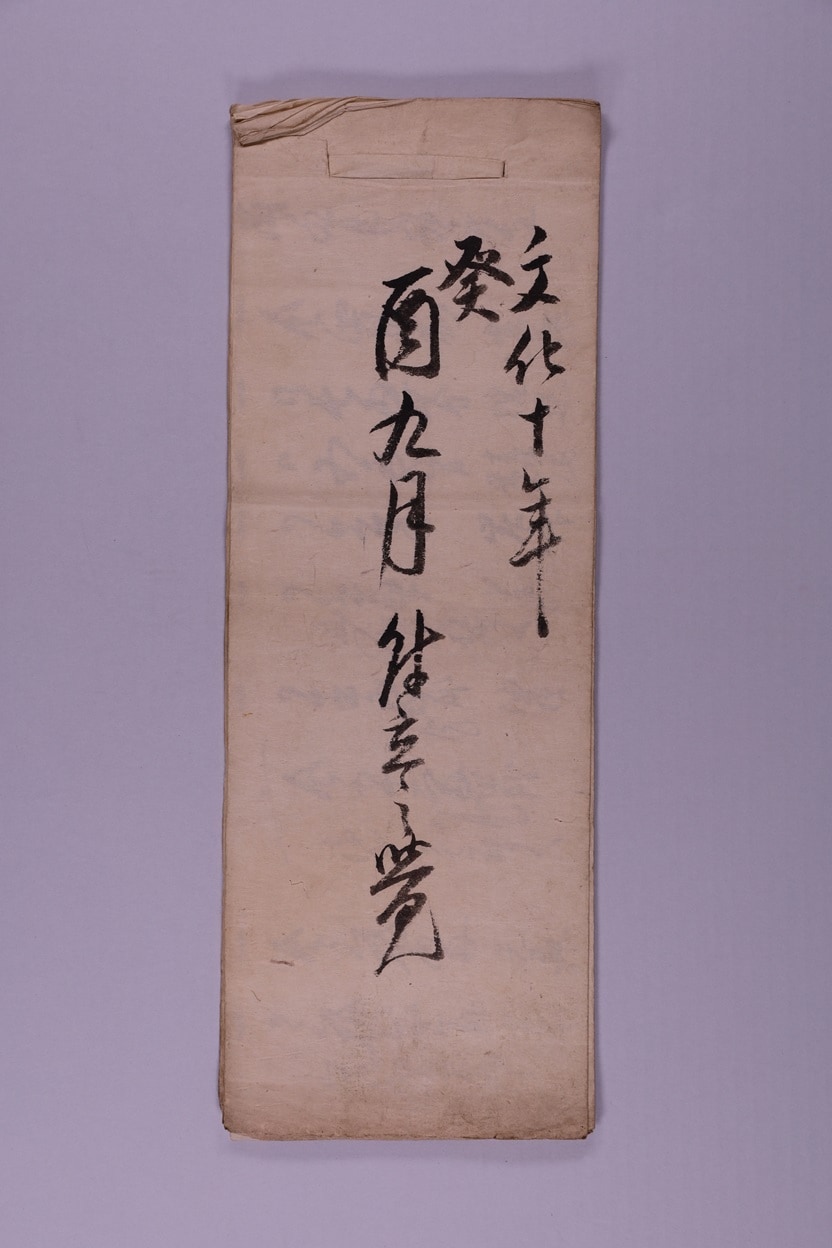
Tsuketate no Oboe (Note of Tsuketake Accounts), 1813
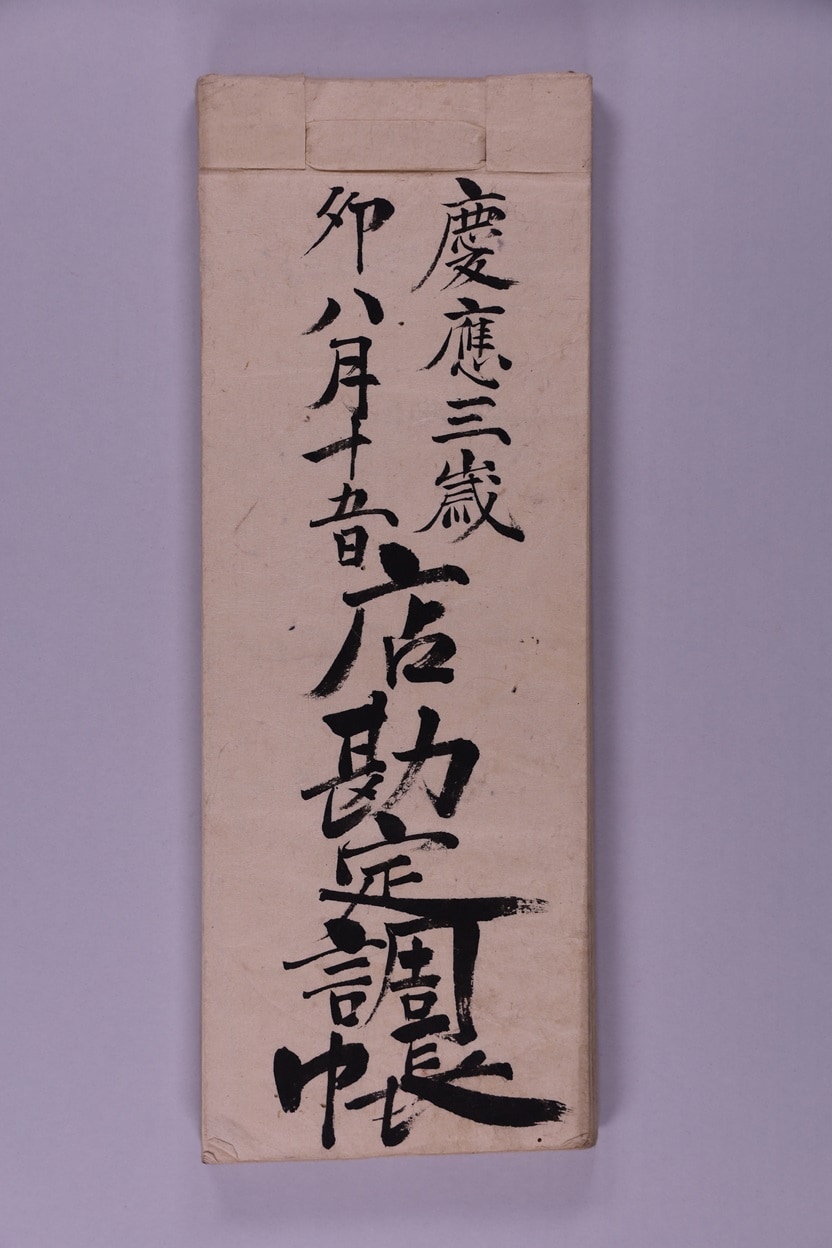
Tanakanjo Chocho (Examined Tanakanjo Accounts), 1867
Sake Production Records
The Horikiri family has five items marked as sake production records, such as Shuzo Kiroku Ichi (Sake Production Record 1) and Shuzo Kiroku Ni (Sake Production Record 2), and another five items of similar content without such titles written.
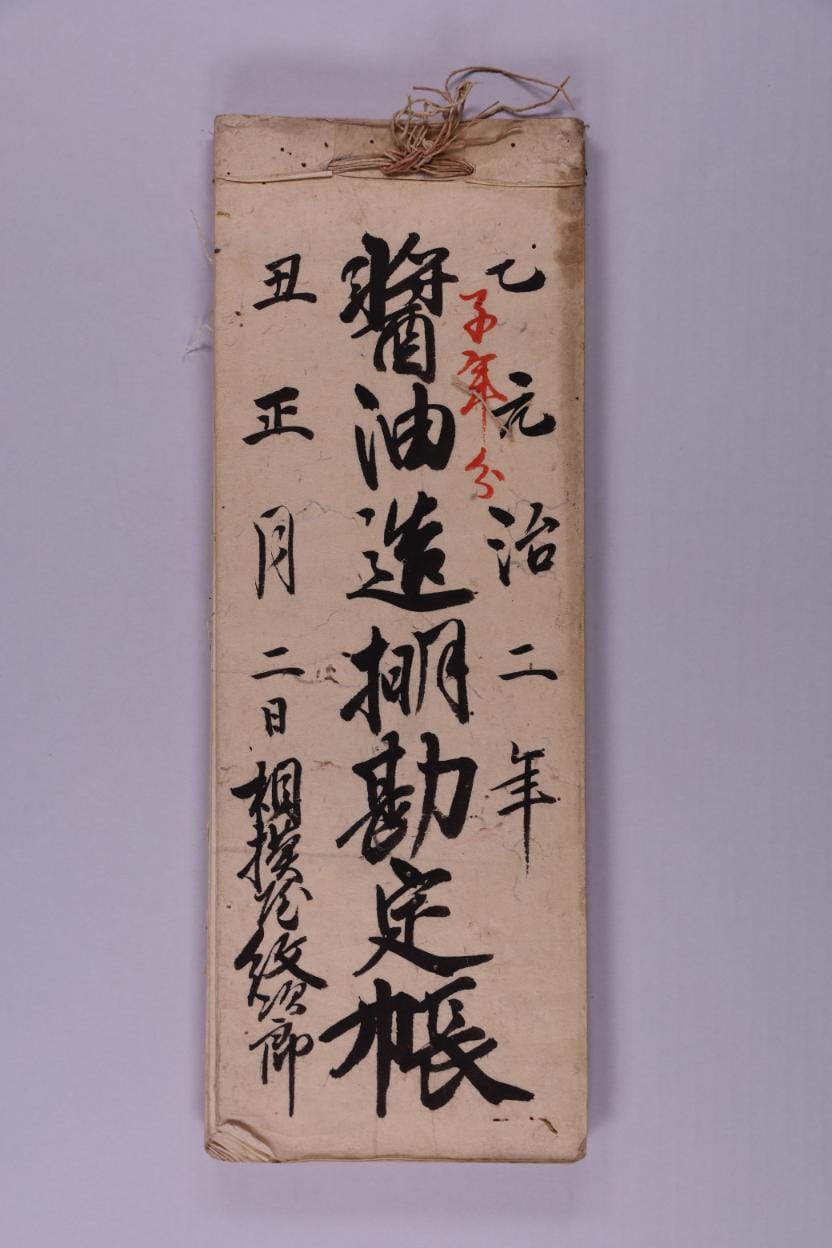
The sake production records include manual copies of government proclamations and submitted notifications, in which shuzokabu-daka or kabu-daka, myoga Ei (tax for business license paid in Eiraku coin), shuzomai-daka (ceiling volume of rice that can be used for sake production), and sake production tools and their quantities are recorded for each sake brewer. The oldest among them is Shuzo Kiroku Ichi, which kept records from 1786 to 1787, and the newest is Niban Shuzo Kiroku (Second Sake Production Record), which kept records from 1860 to 1868. Changes in sake brewers and transitions in sake production volume in Nagareyama can be understood through these documents, even though the remaining records are intermittent.
Horikiri Family Document No. 541 Oboe (Memorandum) of Sake Production Record 2 reveals that Horikiri Monjiro acquired a shuzokabu (official business license for sake production) of kabu-daka 5 koku (900 liters; roughly 180 liters per koku) in 1790. Horikiri Family Document No. 543 Shuzo Kiroku San (Sake Production Record 3) keeps records from 1790 to 1794. It contains the names of sake brewers who participated in the production of Kanto gomen joshu (a project to produce quality sake in the Kanto region under the supervision of the shogunate government to compete against the then-prevalent sake from the Kansai region) and the volumes of sake produced, Jimawari Zake Don’ya Namae no Oboe (a memorandum of the names of wholesalers handling jimawari zake [sake produced in the Kanto region]), and the numbers of barrels of quality sake from the Kansai region, such as Settsu province and Izumi province, that arrived in Edo.
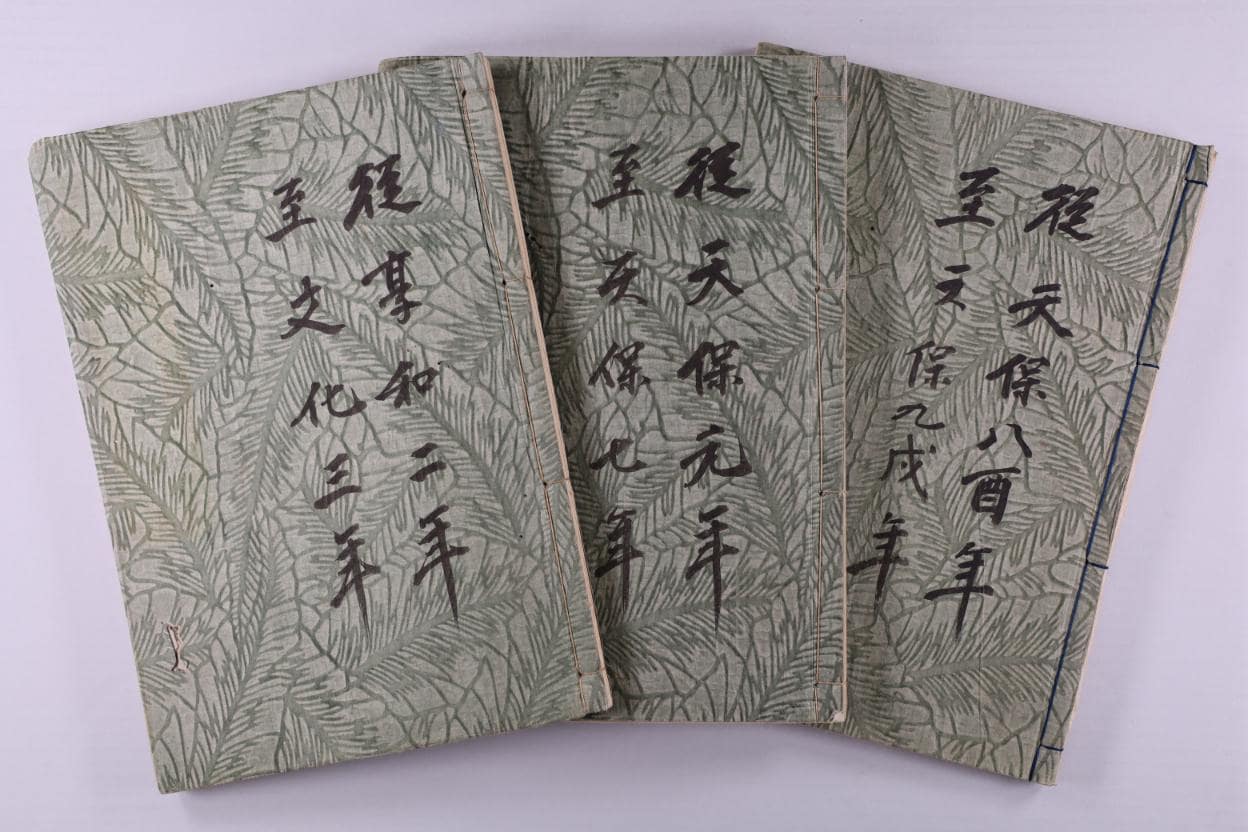
Shuzo Kiroku (Sake Production Records)
Shoyu Zukuri Tanakanjo-cho (Soy Sauce Production Accounting Books)
According to The Noda Shoyu Kabushiki Kaisha Nijunen-shi (The 20 Year History of Noda Shoyu Co., Ltd.), the Horikiri family entered the soy sauce brewing business in 1788 as an offshoot of their sake production business, and interrupted it in 1803 before resuming in 1838. The Horikiri family suspended sake production in 1876 as it was becoming unprofitable, after which soy sauce brewing became their main focus.
There are some 60 Shoyu Zukuri Tanakanjo-cho (soy sauce production accounting books), produced from 1844 (after the resumption of soy sauce production) to 1911. Horikiri Family Document No. 37-16, recorded in 1865, is one such book in which the date of preparation and the quantities are recorded for each of the numbered tanks, and the final quantity of moromi mash produced and other figures are totaled.
Tesei Sake Mirin Hon’naoshi Shirushi Kagami (Hand- Drawn Samples of Sake, Mirin, and Hon’naoshi Seal Marks)
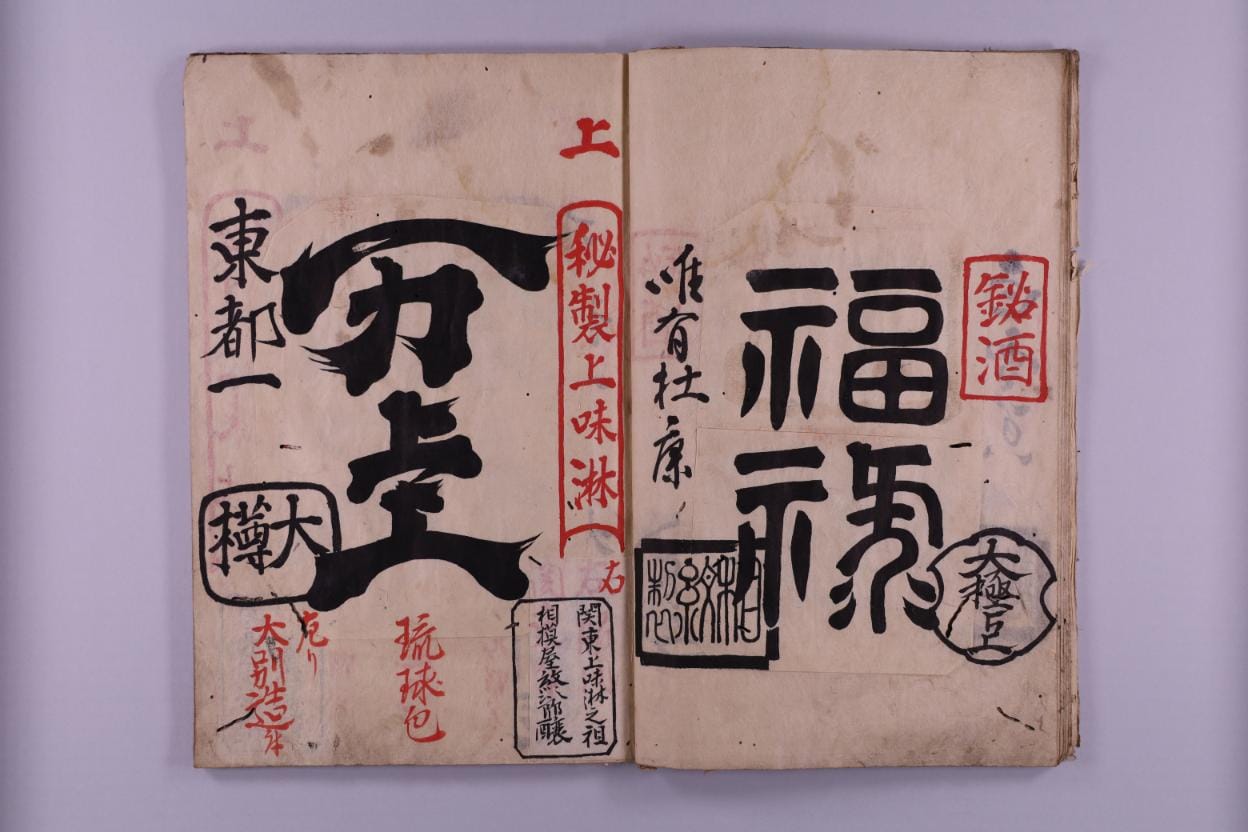
Horikiri Family Document No. 224 Tesei Sake Mirin Hon’naoshi Shirushi Kagami (hand-drawn samples of sake, mirin, and hon’naoshi seal marks) is a book bound in Japanese style containing hand-drawn product marks of sake, mirin and hon’naoshi.* “created by Mise Shinzo in January 1852” is written on the first page, and “1879” is found on the last page, which suggests this book was used from the late Edo period (1603–1868) to the early Meiji era (1868–1912).
Products, in order of appearance, in the book are: highest quality sakes, including Fukuroku, Tokai, Yodogawa, Keicho, and Tokimune; high quality sake called Aka; hisei jo-mirin (secret brewing method premium mirin), including Manjo, Matsubayashi, and Manjosen; ko-mirin (mirin put on sale in the indicated year), including Kanrosui; furuaji (conventional darker mirin), including Yamayama; and hon’naoshi, including Wago and Suzukaze. With this book, we can identify the varieties of products and their marks.
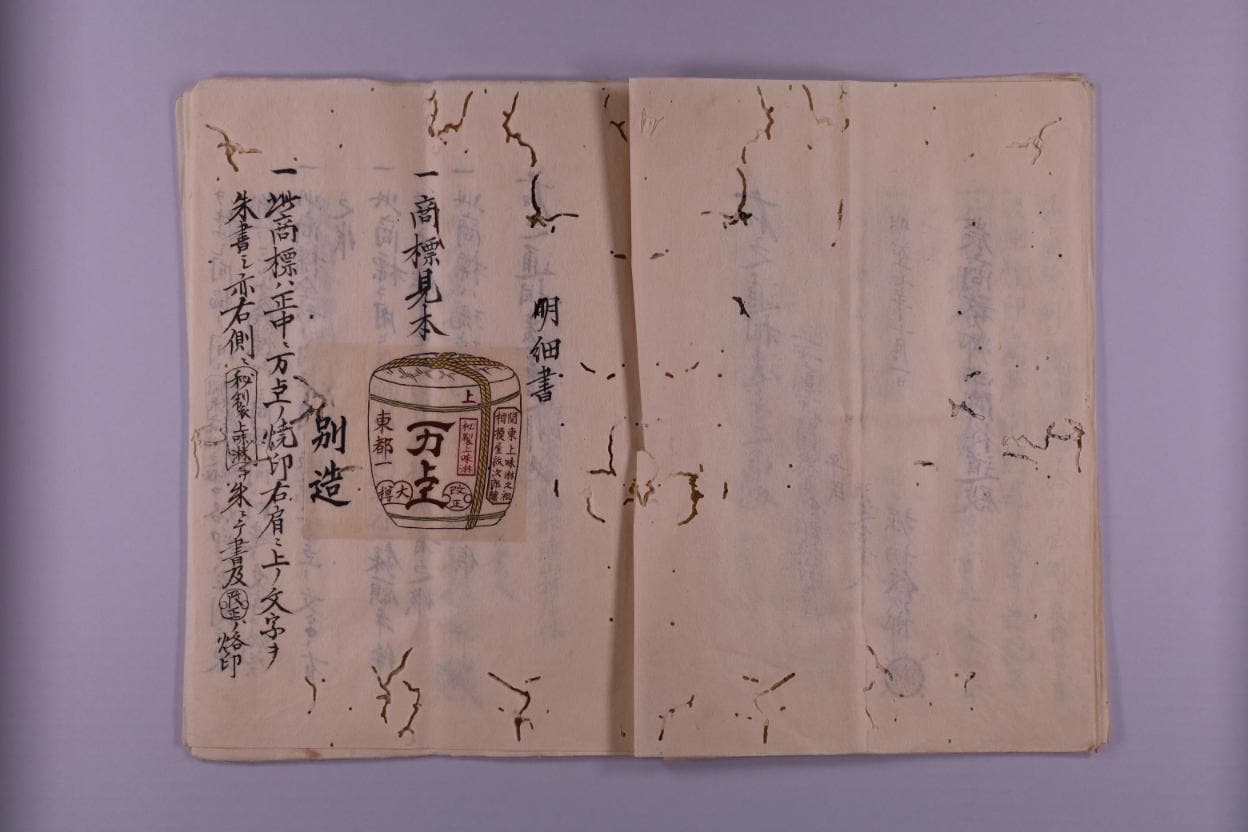
The mark used by Manjo, the flagship mirin brewed by the Horikiri family, had the name in large characters at the center, with Toto Ichi (the best in Edo) at the upper left, Kanto Jo-Mirin no So Sagamiya Monjiro Jo (brewed by the originator of premium Kanto mirin, Sagamiya Monjiro) at the lower right, and Jo (high quality) and Hisei Jo-Mirin (secret brewing method premium mirin) written in red at the upper right. This trademark was registered in 1885.
※Hon’naoshi is explained as “a mixture of roughly equal parts of mirin and shochu” in Morisada Manko, an encyclopedia compiled by Kitagawa Morisada in the late Edo period.
Katsushika Prefecture Goyokin-Related Accounting Books
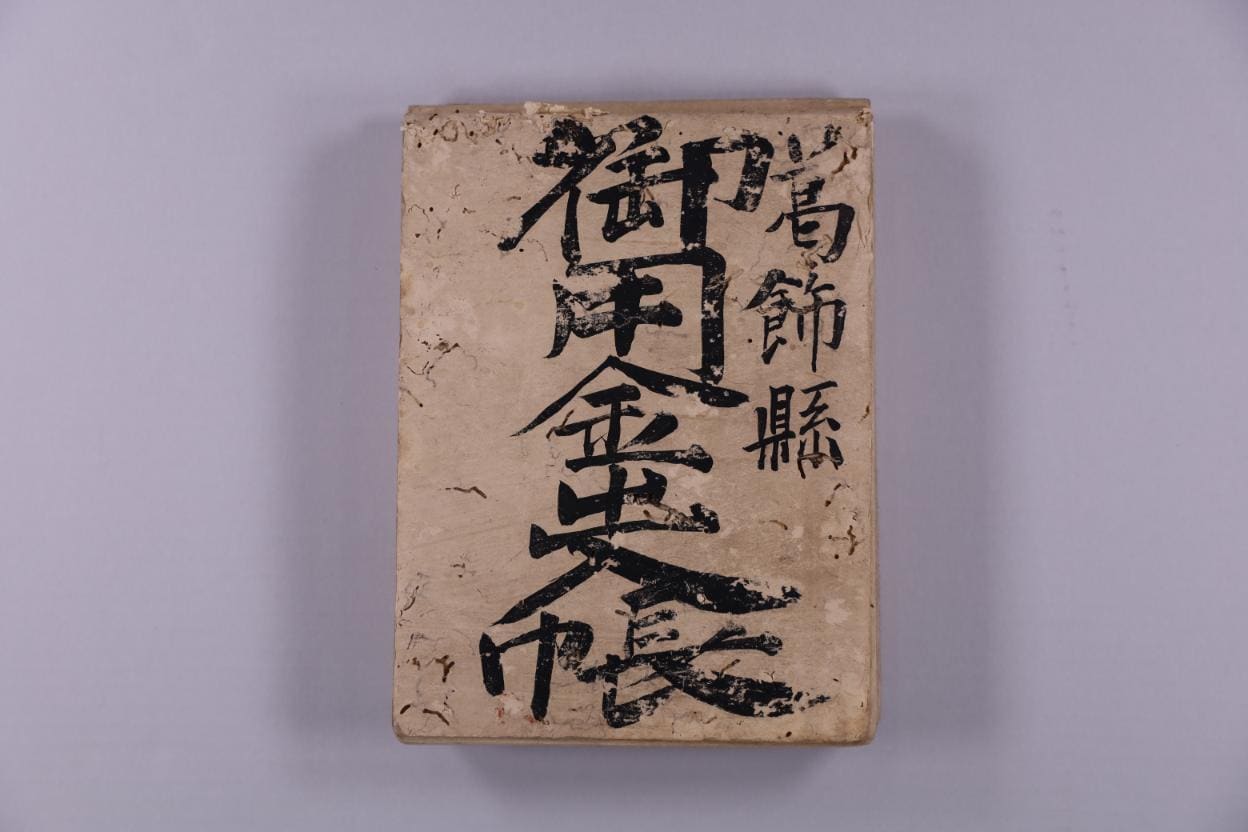
Katsushika Prefecture was established in 1869, with the prefectural government office placed in Ka Village (presentday Ka in Nagareyama City) adjacent to the north side of Nagareyama Village. Horikiri Monjiro III, a merchant representing Nagareyama, served as the officer in charge of Goyokin since the establishment of the Katsushika Prefecture. In the Horikiri family documents, there are 12 goyokinrelated accounting book items, such as Katsushika-ken Goyokin Deiri-cho (Katsushika Prefecture Goyokin Journal), Ichiban Katsushika-ken Goyokin Azukari Hikae (copy of Katsushika Prefecture goyokin on deposit), and Goyokin Showatashi-cho (goyokin transfer book). Some books were created under the name of “Kakeya, Horikiri Monjiro,” which shows that the officer in charge of goyokin was sometimes called Kakeya.
Generally, the responsibility of a goyokin officer was to collect taxes and money owed to the government by villages in the prefecture, and to make payments by draft according to instructions from the prefectural government. Yet, there are many unclear points in the contents of the work. Goyokin-related accounting books would contain records of nengu (annual rice-field tax), kuniyaku-kin (money for repair of rivers, etc.), and fushin-kin (money for public works) received from each village. These documents may elucidate how the actual nengu payments worked and details of the responsibilities of goyokin officers in the very beginning of the Meiji era, as well as the roles the Horikiri family played in the community.
Matsuosha Saiken Iriyo no Hikae (Copy of Matsuo Shrine Reconstruction Fund Raising)
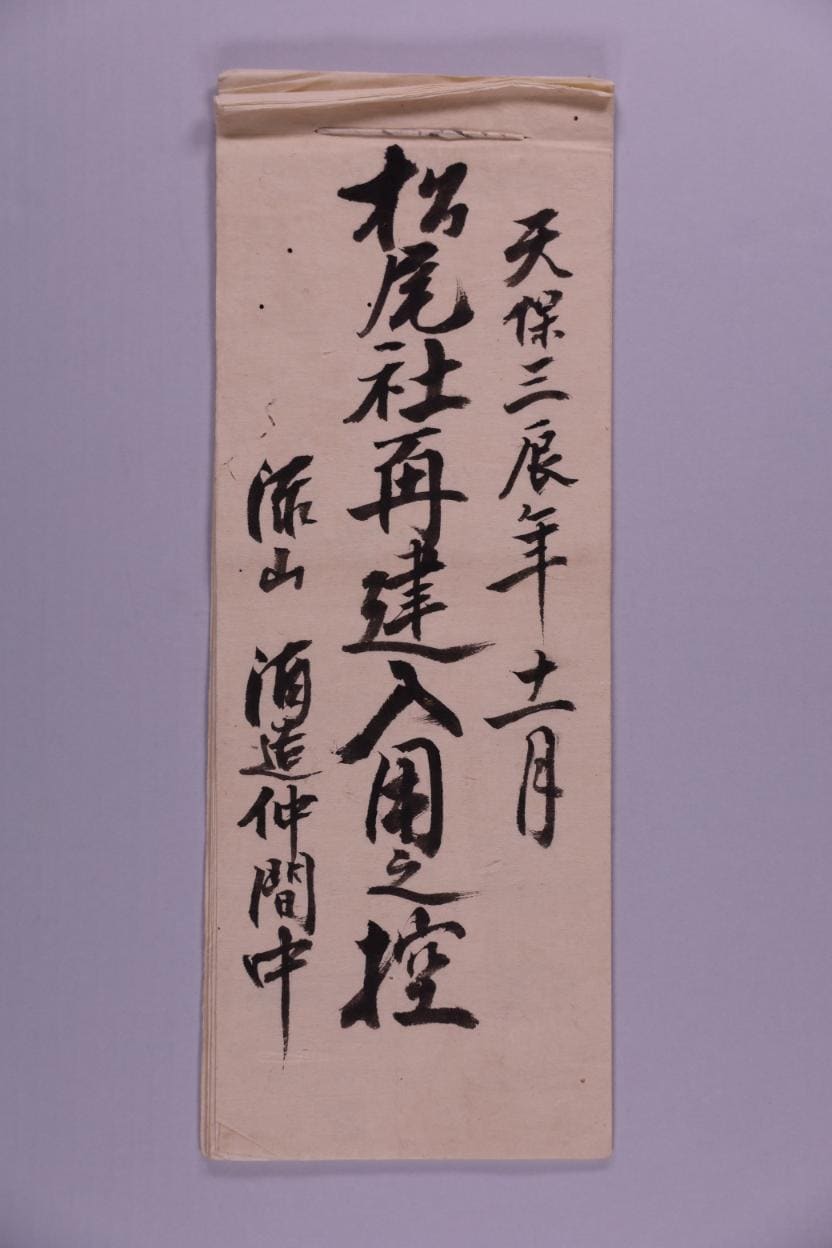
Horikiri Family Document No. 559 Matsuosha Saiken Iriyo no Hikae (copy of Matsuo Shrine reconstruction fundraising) is a record of a project in which the Nagareyama sake brewers collaborated to build a Matsuosha stone-built shrine dedicated to the god of sake production in 1832.
Matsuo Shrine is located on the grounds of Akagi Shrine in Nagareyama 6-chome and the current stone shrine was rebuilt in 1995. Immediately to the new shrine’s right is the original shrine of 1832. The record shows that seven sake brewers, Akimoto (Sanzaemon), Sagaju (Juzaemon), Sagamon (Monjiro), Yasukyu (Kyuzaemon), Konoike (Yoshitaro), Do’uragura (Eisuke) and Yasutoshi (Rihei) contributed 17 ryo 2 bu in total for construction of the stone-built shrine.
Picture of Manjo Mirin Barrels, Kite, and Townscape
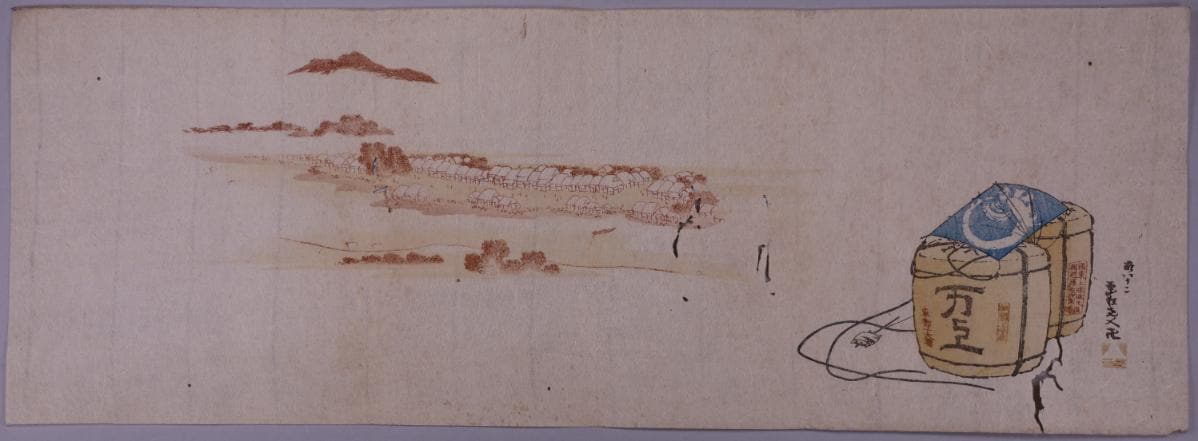
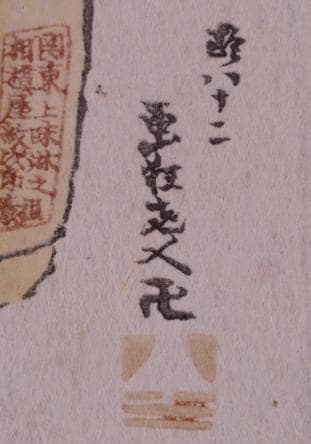
Horikiri Family Document No. 7-1-4-10 is a woodblock print with the artist’s signature reading “Gakyo Rojin Manji” (old man mad about art, Manji) On the horizontally wide (175 mm by 485 mm) print, the artist’s signature “Age 82, Gakyo Rojin Manji” and his square seal are at the lower right. On the right side of the print is a picture of two barrels, with a kite on top of them. The writing on the front barrel reads “Manjo” at the center, “Secret Brewing Method Premium Mirin” on the right, and “The Best in Edo” and “Odaru (large barrel)” written in red on the left. The back barrel has writing that reads “Brewed by the Originator of Kanto Premium Mirin, Sagamiya Monjiro.” A landscape drawn from the center to the left of the print shows a village that appears to be Nagareyama, the Edo River, a ferry boat plying Edo River toward the village, and Mount Akagi (which is related to the origin of the name “Nagareyama”) behind the village. Further back, a mountain range, presumably Mount Tsukuba, can be seen.
Gakyo Rojin is the professional name that the artist Katsushika Hokusai used in his later years from 1834 to 1849, and Manji is also a name he used during the same period. Regarding the square seal with the image of Mount Fuji, it is said that Hokusai used it the first time in the first edition of Fugaku Hyakkei (One Hundred Views of Mount Fuji) published in 1834. Based on these studies, this historical source is presumed to have been created in 1841, when Hokusai was 82. This work is scrupulous in its sketching, carving, and printing, and high-quality Japanese mulberry paper was used. Although the purpose of this print is unknown, the image of a kite suggests it might have been for some sort of New Year’s celebration. This is one historical source implying that, after the birth of the Manjo mark, mirin symbolized by the Manjo mark was promoted through various means during the Tenpo era (1830–44).
Modern Age Documents
As stated earlier, the modern age documents were classified into 10 medium categories: commerce, home, community, taxation, public administration, pictures and charts, books, published books, governance, and land tax. The numbers of items within each medium category are shown in Table 4 Medium categories of modern age documents and the numbers of items.
This section introduces shikiri-cho (wholesalers’ accounts books), shikomi-cho (preparation records), daifuku-cho (ledgers), shurui uriage-cho (alcoholic beverage sales books), nimotsu hantori-cho (merchandise delivery books), trademark-related documents, and diaries in the commerce category (which accounts for a large part of the items among the medium categories), as well as testimonials in the home category, “Petition regarding Nagareyama Light Railway Modification” and “Shisei-ko Rules” in the community category, and the Manjo mirin factory floor plan in the pictures and charts category.
| Commerce | Home | Community | Taxation | Public administration | Pictures & charts | Books | Published books | Governance | Land tax | Total |
|---|---|---|---|---|---|---|---|---|---|---|
| 2,546 | 1,065 | 121 | 135 | 49 | 73 | 1 | 1 | 1 | 1 | 3,993 |
Shikiri-cho (Wholesalers’ Accounts Books)
Shikiri-cho (wholesalers’ accounts books) contained in the Horikiri family documents include Mirin Shikiri-cho and Soy Sauce Shikiri-cho, which were produced in the early 30s of the Meiji era (1868–1912).
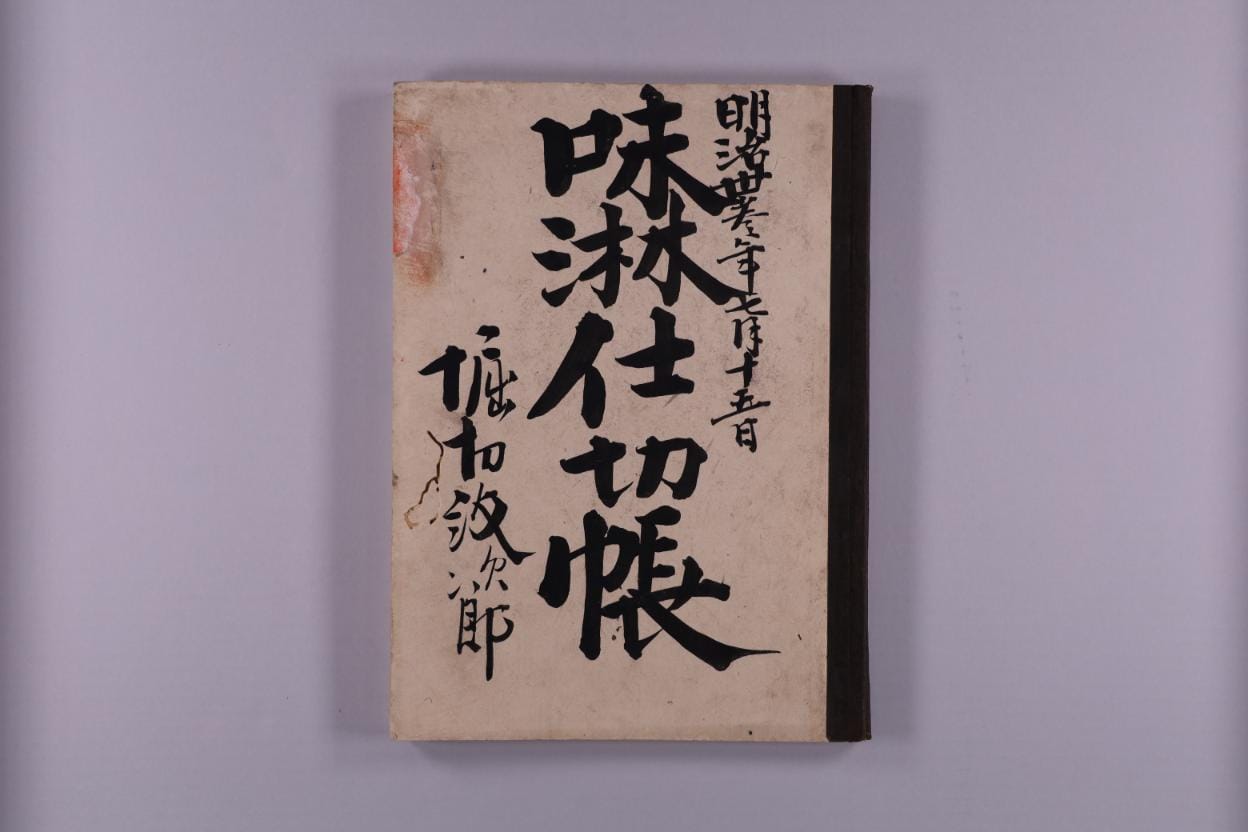
Horikiri Family Document No. 154 Mirin Shikiri-cho is dated July 15, 1900 on the cover. For the first half-term from January to June and for the second half-term from July to December, records were kept for each wholesaler who traded with the family.
Entries include the date, varieties of mirin delivered (such as Manjo), product names and quantities (such as “Shiroaji [shiro mirin], two and a half horse-loads [315 liters]” and “Furuaji [conventional dark mirin], 10 horse-loads [1,260 liters]),” vessel name that carried the merchandise (such as the Risuke Bune and Shobei Bune), and unit price and price of mirin. Then, the quantities and prices of delivered products were totaled for each half-year term, and the balance after deducting deposits already received, sales commissions, barge charges and other deposits are calculated. Finally, the date when that balance was received is written in red, with a red stamp affixed that reads shikiri-zumi (account settled).
Shikiri-cho is a valuable source of information on things such as the wholesalers with whom Sagamiya was trading, sales quantities of mirin and the amounts of money involved, and exclusive vessels used to transport Manjo products.
Shikomi-cho (Preparation Records)
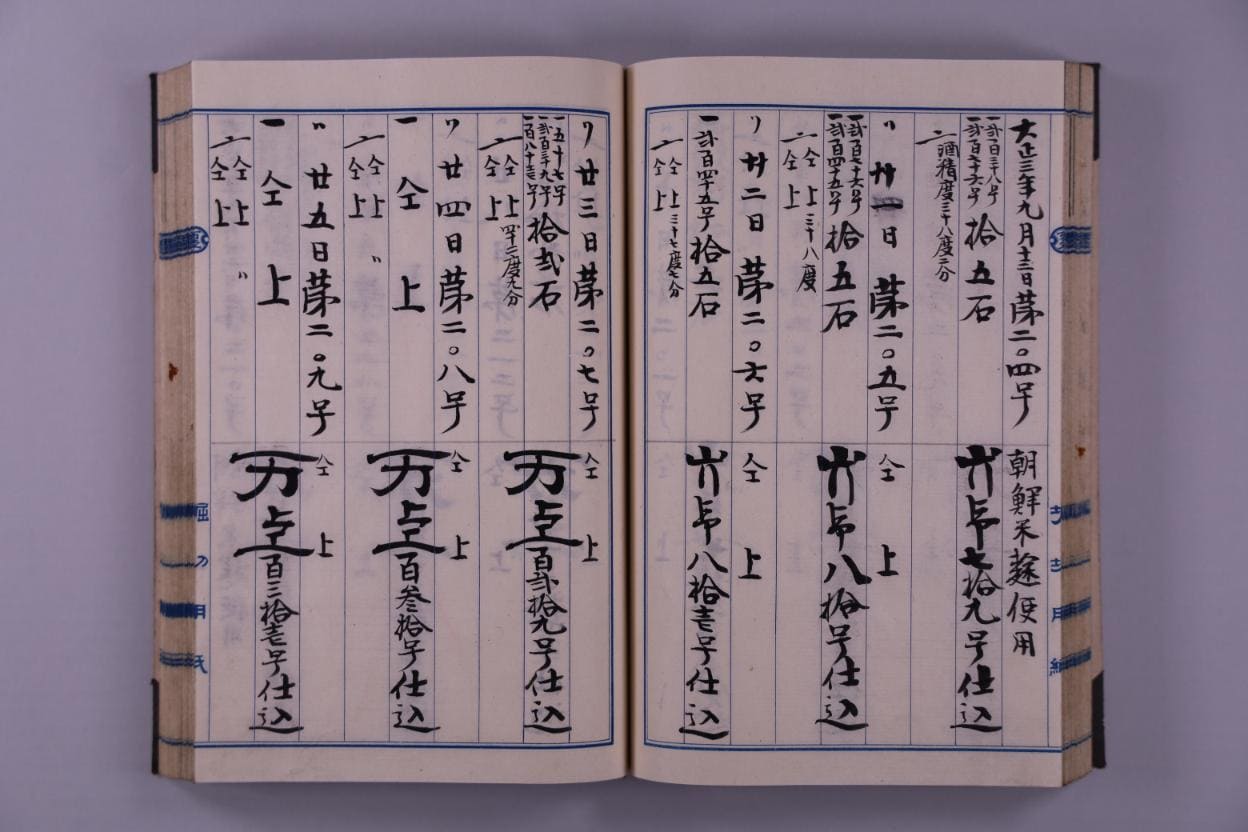
There are 15 shikomi-cho (preparation records) in the modern age. Among them, a bound book titled Mirin Shikomi and Shochu Joryu Nikki-cho (mirin preparation and shochu distillation journal) was made every year from 1911 to 1918. They were kept by Horikiri Monjiro until 1917 and by Manjo Mirin Co., Ltd. in 1918.
Horikiri Family Document No. 8-13 Mirin Shikomi and Shochu Joryu Nikki-cho is a record of preparation from 1913 to 1914. Entries include date of preparation, barrel numbers used for the preparation process, quantities of ingredients, alcohol content, where the rice for making koji (malted rice) was grown, and varieties of mirin products, such as Yamayama and Manjo. These documents tell us the varieties and quantities of mirin brewed each year.
Daifukucho (Ledgers)
Although daifukucho (ledgers) are considered major accounting books, only several from 1890 to 1898 remain among the Horikiri family documents. Most were likely discarded after expiration of the required record-keeping period after the entries were transferred to other accounting books.
Horikiri Family Document No. 16-8 is a daifukucho made in 1898, with writing in large characters reading daifukucho on the front cover and Horikiri Monjiro on the back cover. For each wholesaler that traded with the family, such as Takatame, Ichiki, Nurihiko and Makihara, and for each date of sales made, the following items were entered: the varieties of mirin sold, such as Manjo-jirushi Shiroaji (Manjo mark shiro mirin), quantities in the number of horseloads, unit prices and payments written in red, as well as the names of the vessels used for carrying the merchandise.
At the end of June and December, the quantities of mirin sold and the amounts billed for sales were totaled, and the balance was calculated by deducting deposits, rent, sales commission, and barge charge. Finally, the stamp that reads “settlement completed” was affixed.
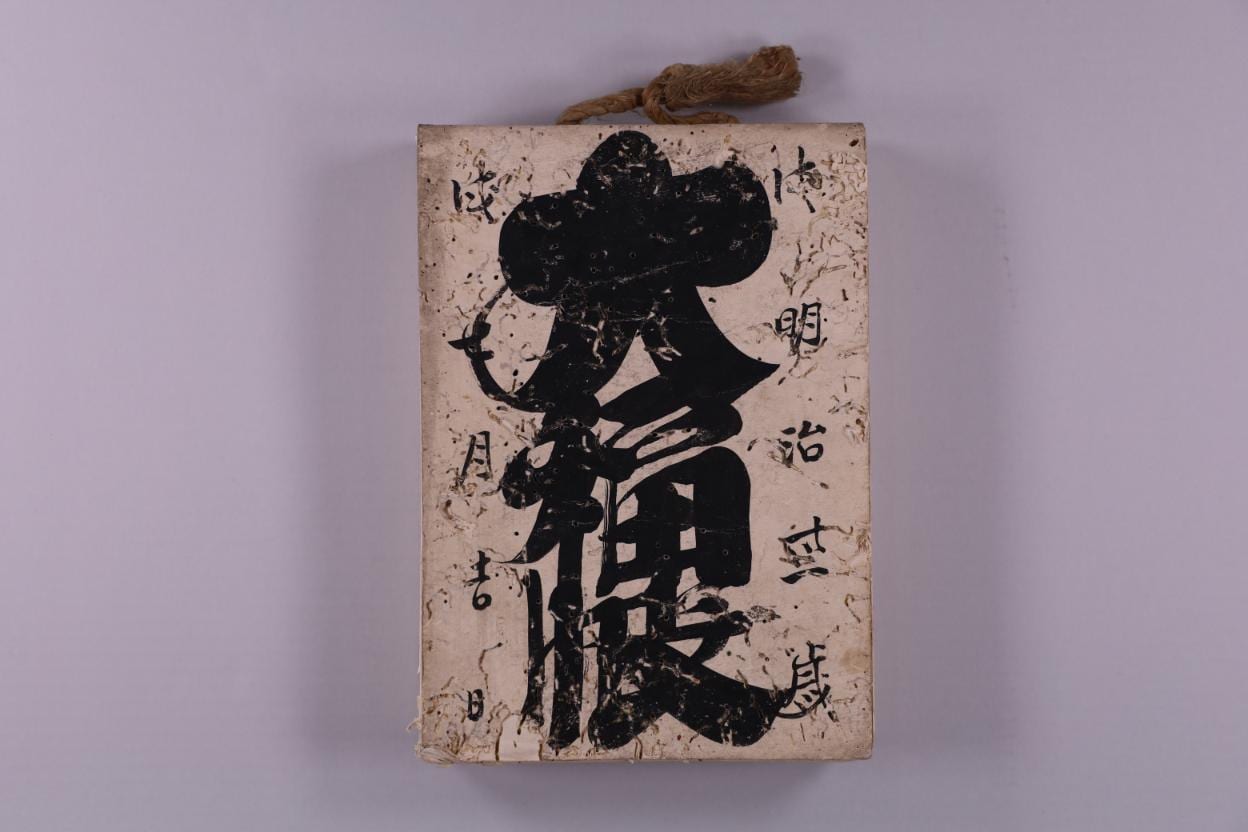
Shurui Uriage-cho (Alcoholic Beverage Sales Books)
There were 13 shurui uriage-cho (alcoholic beverage sales books) made from 1896 to 1908.
Horikiri Family Document No. 22-13 is a Shurui Uriagecho made in 1899, in which the sales of two types of mirin, Sanjuichi-nendo Ko-mirin (mirin put on sale in 1898) and Sanjuichi-nendo Shin-mirin (mirin brewed in 1898) were recorded for each retailer and each wholesaler. Sales destinations for retailers included Hokkaido, though the majority were in the Kanto area, including Tokyo, Chiba, Saitama, Tochigi, and Gunma, as well as Nagareyama. Date, quantity in koku, price, and name and address of the sales destination were entered for each date and each buyer, and the monthly total and grand total were calculated. The quantity unit used for sales to retailers was usually to (roughly 18 liters per to), while that used for all sales to wholesalers in Tokyo was koku (roughly 180 liters per koku).
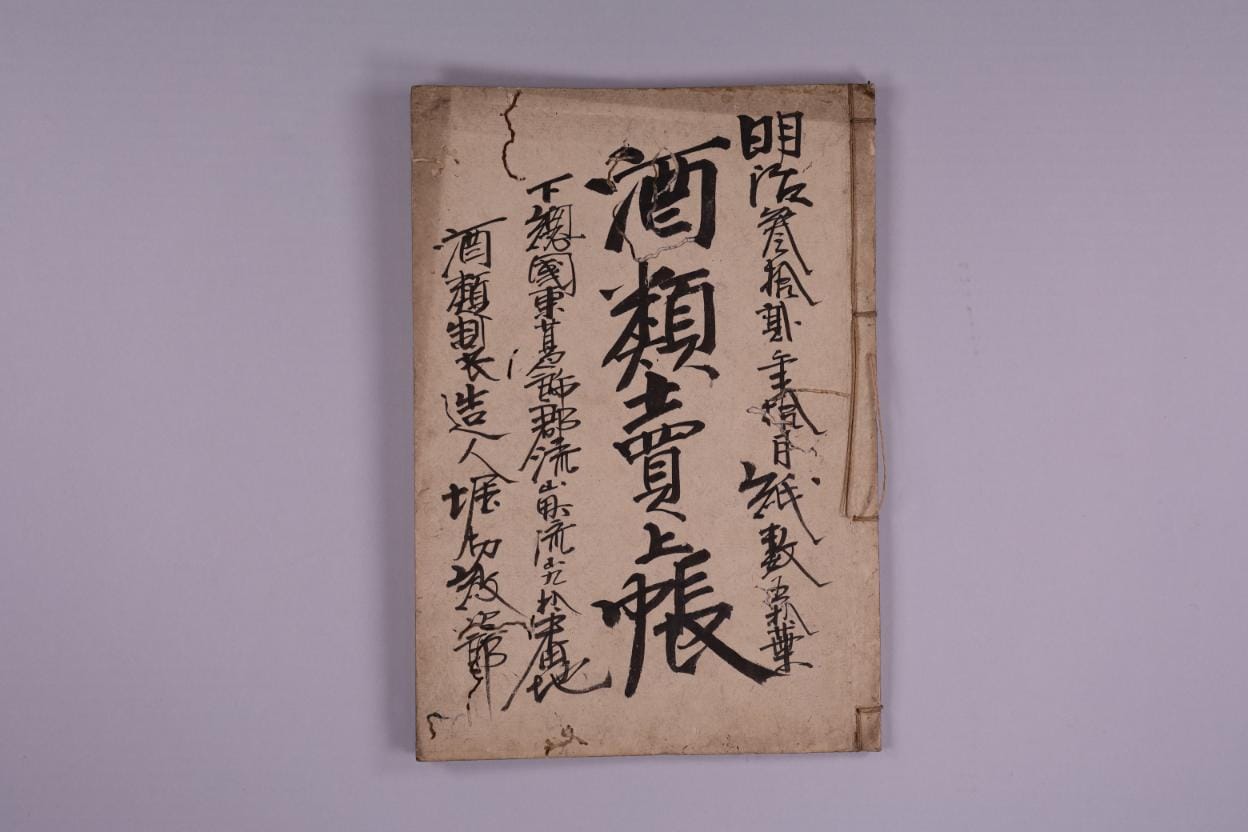
Nimotsu Hantori-cho (Merchandise Delivery Books)
There are 17 nimotsu hantori-cho (merchandise delivery books) dated from 1897 to 1909. Such a book was made for each boat that carried Manjo mirin, such as the Taihei Kobune, Shobei Bune, Tebune Risuke Bune, and Tebune Kamekichi Bune.
Horikiri Family Document No. 14-4 was a book made for the Shobei Bune in 1907. It is written on the first page, with a revenue stamp affixed, that this book can be used for entries from August 1907 to July 1908 and that there are 120 pages within. Horikiri Monjiro’s signature and seal are also affixed. In the book, the wholesaler who received the cargo entered the varieties and quantities of mirin and affixed his signature and seal with the date after writing “have duly received the above” or another such phrase.
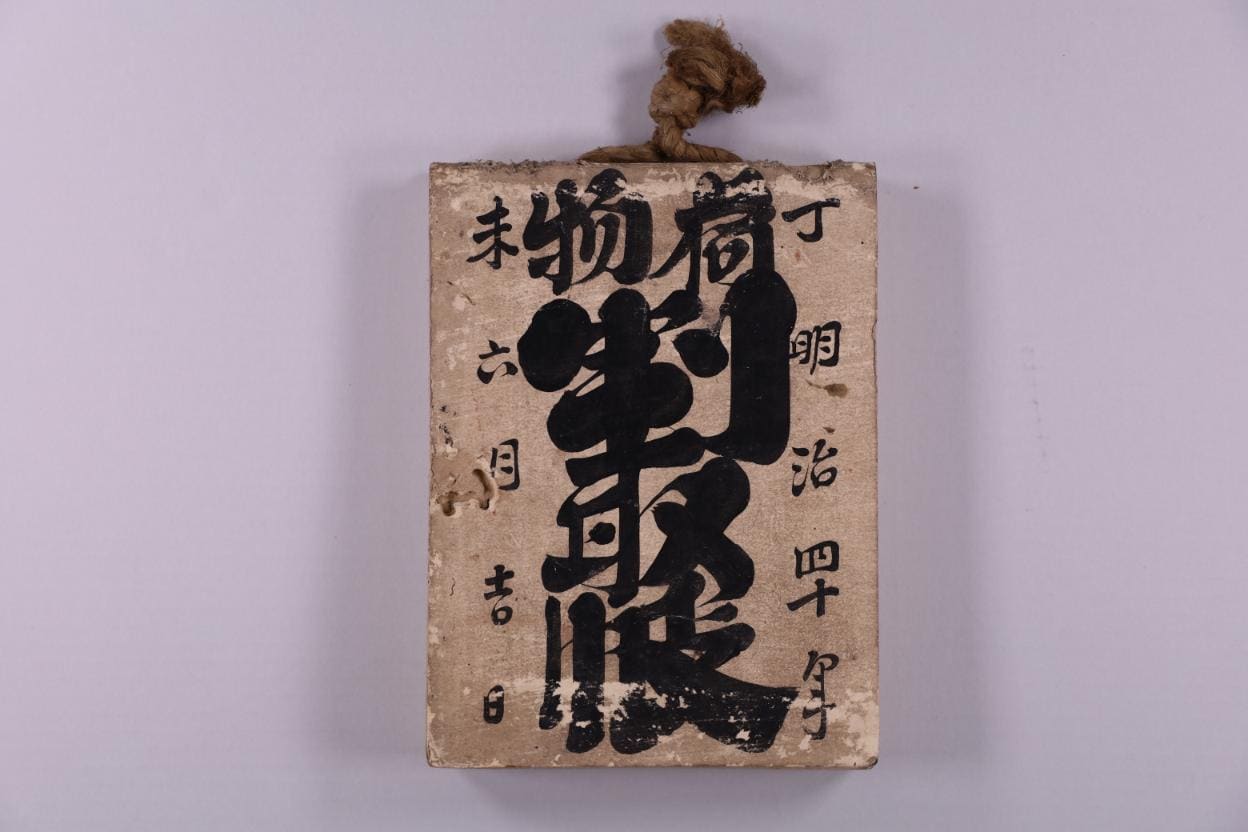
Trademark-Related Documents
Trademark-related documents include those concerning the trademark ordinance enacted in 1884 and Transcript of the Examiner’s Decision on Associated Trademark Registration dated 1920.
Horikiri Family Document No. 226 is a copy of the document prepared to apply for trademark registration when the ordinance was enacted in 1884. This document, containing sample trademarks to be used for soy sauce and mirin along with design descriptions, was submitted to Judo Saigo, the Minister of Agriculture and Commerce. Design and layout of the characters in the trademark to be used on the Manjo mirin barrels are explained in detail: the “Manjo” stamp is arranged with the character Jo (high quality) on the upper right, Hisei jo-mirin (secret brewing method premium mirin) written in red on the right, and Kaisei (improved) stamped on the right, with Kanto Jo-Mirin no So Sagamiya Monjiro Jo (brewed by the originator of Kanto premium mirin, Sagamiya Monjiro) stamped on their right side.
Diaries
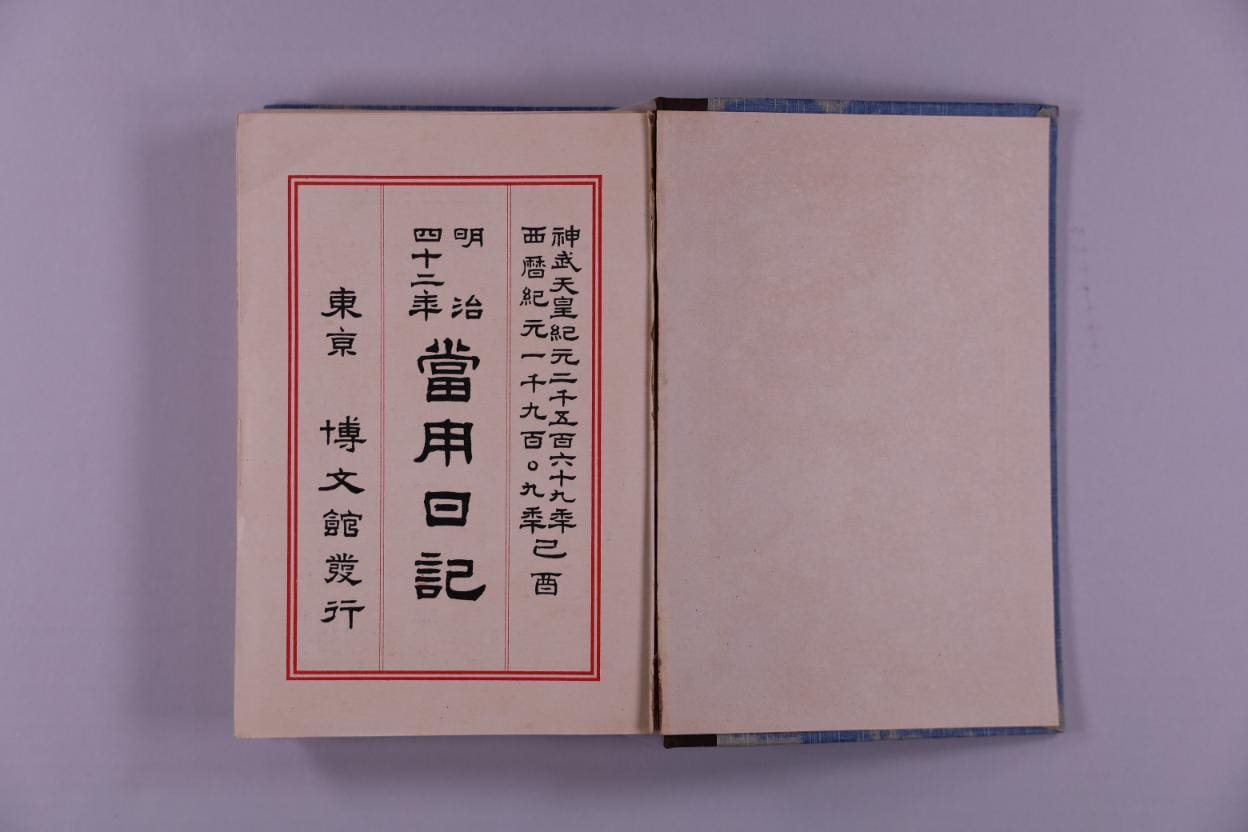
Diaries kept by Horikiri Monjiro VI are in Horikiri Family Document No. 442, 1908 Diary and Horikiri Family Document No. 441, 1909 Diary. These were written when the economic crises of the post Japanese-Russo War began, which was also when the Horikiri family total assets reached their peak. The diaries tell us that Monjiro, aged 37 and 38*, carried out aggressive management as a brewer. He conducted ardent studies on improving his mirin brewing methods in 1908 and filed patents for a rich mirin brewing method and pure glucose manufacturing method. It was also a time when Japan was heading toward modernization of its industry. His diaries reveal his efforts to improve brewing facilities, including the introduction of a steam engine and advanced filtering machine, the drilling of wells, the purchase of new huge kettles, and construction of a large chimney.
※This article uses the modern age counting system, in which age is in increments of birthdays, except when otherwise quoted in the text.
Testimonials of Contributions
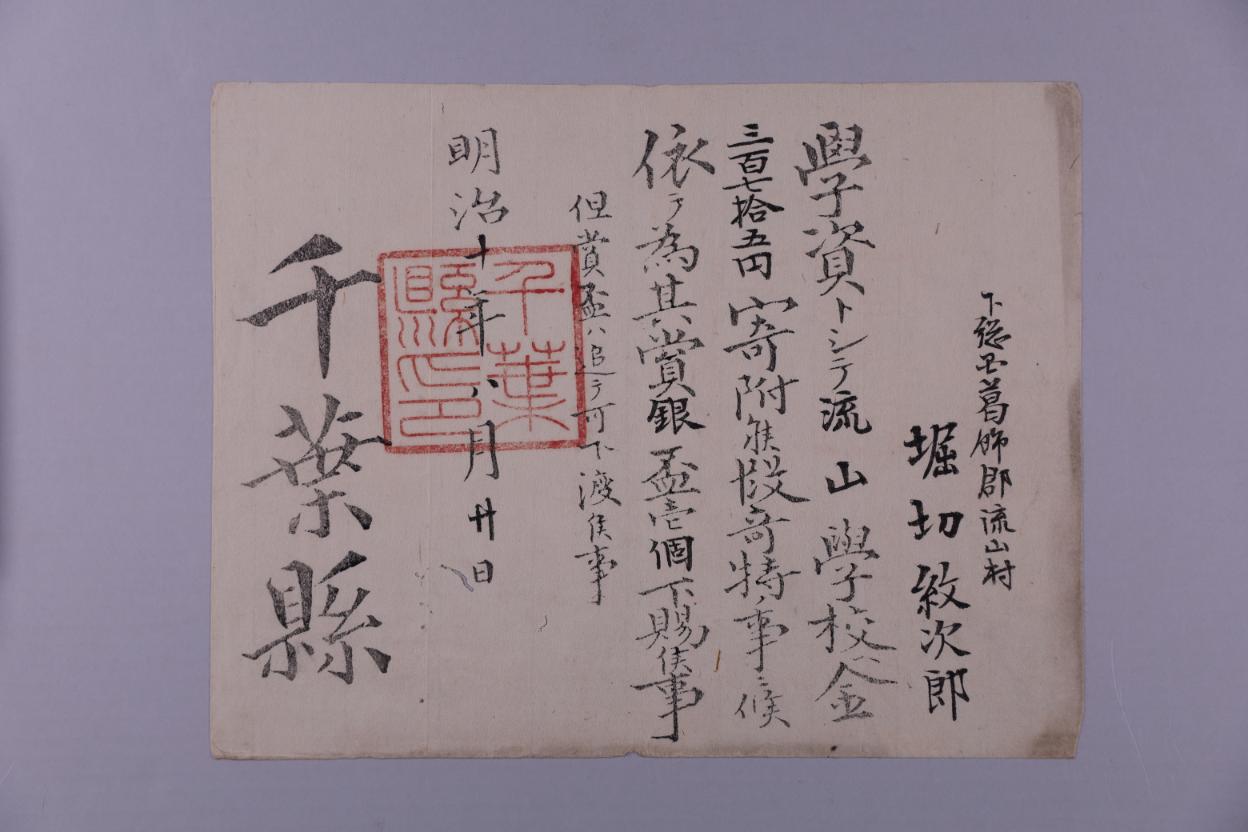
Contributions the Horikiri family made to the community can be seen through certificates of appreciation and certificates of commendation. Horikiri Family Document No. 13-9 is a testimonial received from Chiba Prefecture for a scholarship donation to Nagareyama School in 1877. Moreover, there are many testimonials for donations for such purposes as epidemic prevention to counter the cholera epidemic in 1879, the construction of a new isolation facility to cope with the cholera pandemic in 1886, the construction of Nagareyama precinct station under the Matsudo police station, the repair of roads between Sekiyado and Matsudo in March 1889, and for the civil engineering work of Mito Wakikaido in 1890. Besides providing relief in the event of fires, the Horikiri family made donations in a wide variety of areas to contribute to the community, including donations for the dissemination of education and construction of educational facilities, donations to medical institutions, and donations for the construction of police stations and the construction and maintenance of roads.
Petition Regarding Nagareyama Light Railway Modification
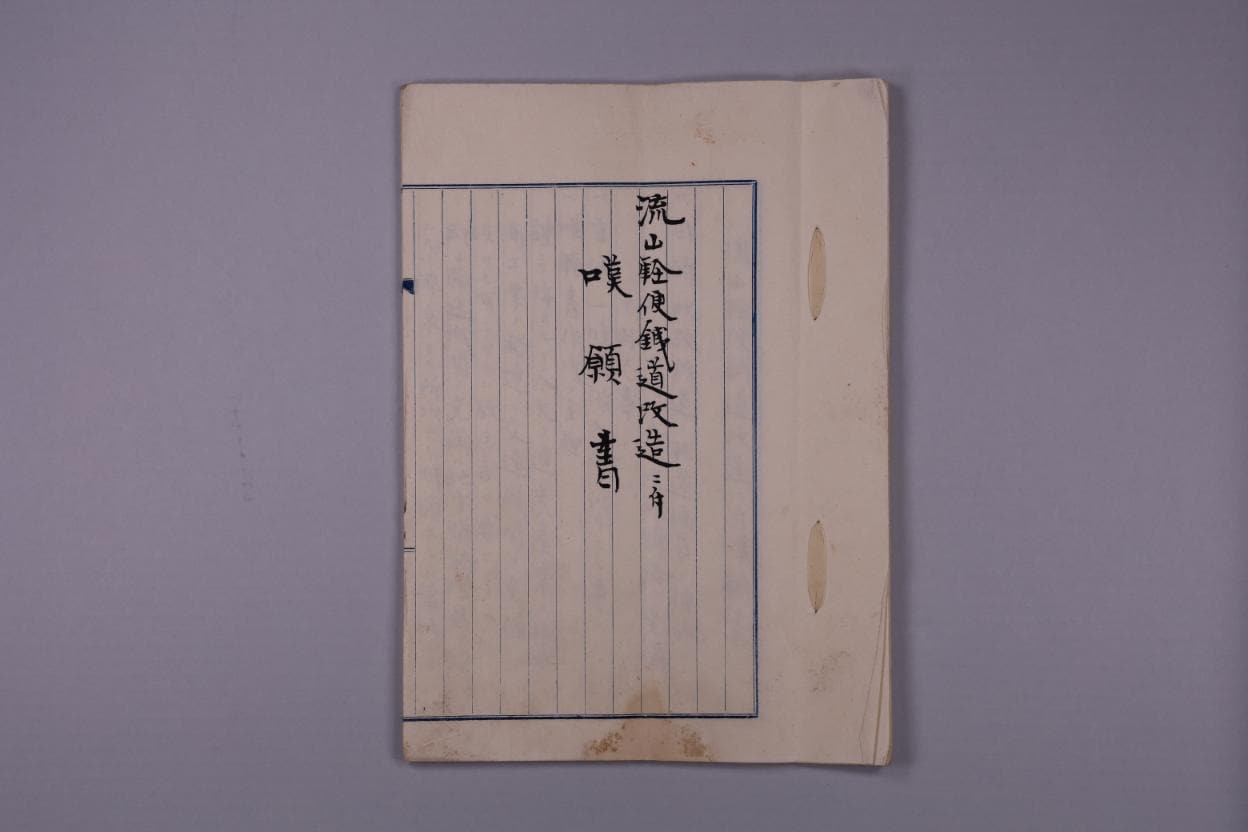
The current Nagareyama Line, operated by Ryutetsu and connecting Mabashi station in Matsudo City and Nagareyama station in Nagareyama City, began operation as Nagareyama Light Railway in 1916. In his response to the application for construction of a railway, the governor of Chiba Prefecture stated that installation of the railway would enable the quick transportation of mirin, the specialty product of Nagareyama Town.
Horikiri Family Document No. 19-283 Petition, regarding Nagareyama Light Railway Modification, is a petition of 1920 to expand the railway gauge. It was signed by 129 Nagareyama townspeople, including the mayor, and addressed to Horikiri Monjiro, the executive advisor of Nagareyama Light Railway Kabushiki Kaisha.
Narrowly gauged at 2 feet 6 inches when opened, the Nagareyama Line could not directly operate on the Joban Line track. The document pleaded for special assistance because, with the expansion of the railway gauge, the Nagareyama Line could be linked to the Joban Line, which would enable through transportation of cargo and help the town further develop. In 1924, direct operation with the Joban Line commenced.
Shisei-ko Rules
Sengen Shrine, located in Nagareyama 1-chome, Nagareyama City, is said to have been built in 1644.
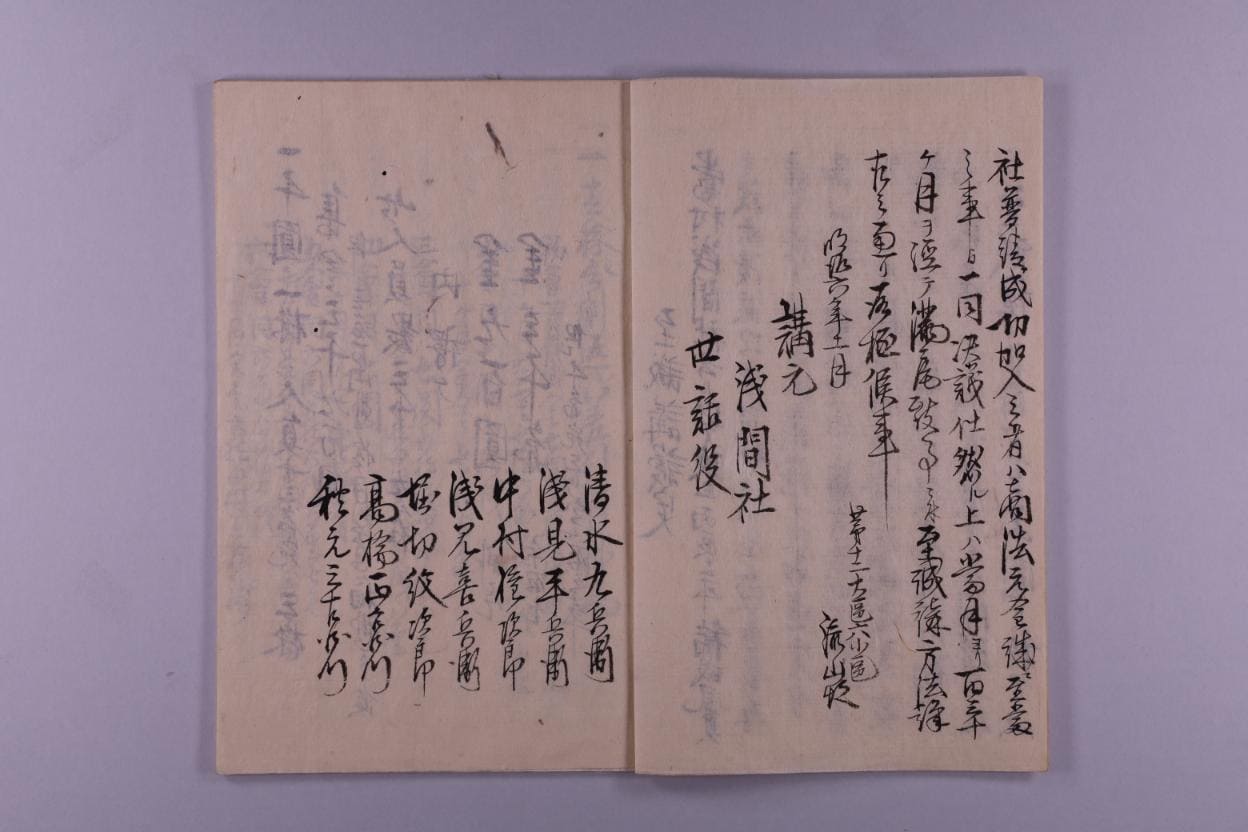
Horikiri Family Document No. 19-385 Shisei-ko Rules in 1873 provides the arrangement on how to raise a reconstruction fund for Sengen Shrine.
The shrine hall was destroyed by strong winds in 1856, and the deity the shrine is dedicated to was enshrined in a provisional shrine hall. Six coordinators, including Horikiri Monjiro and Akimoto Sanzaemon, organized a confraternity called Shisei-ko to raise 3,000 yen by accumulating money for 130 months, starting with the month the confraternity organized to rebuild Sengen Shrine.
Manjo Mirin Factory Floor Plan
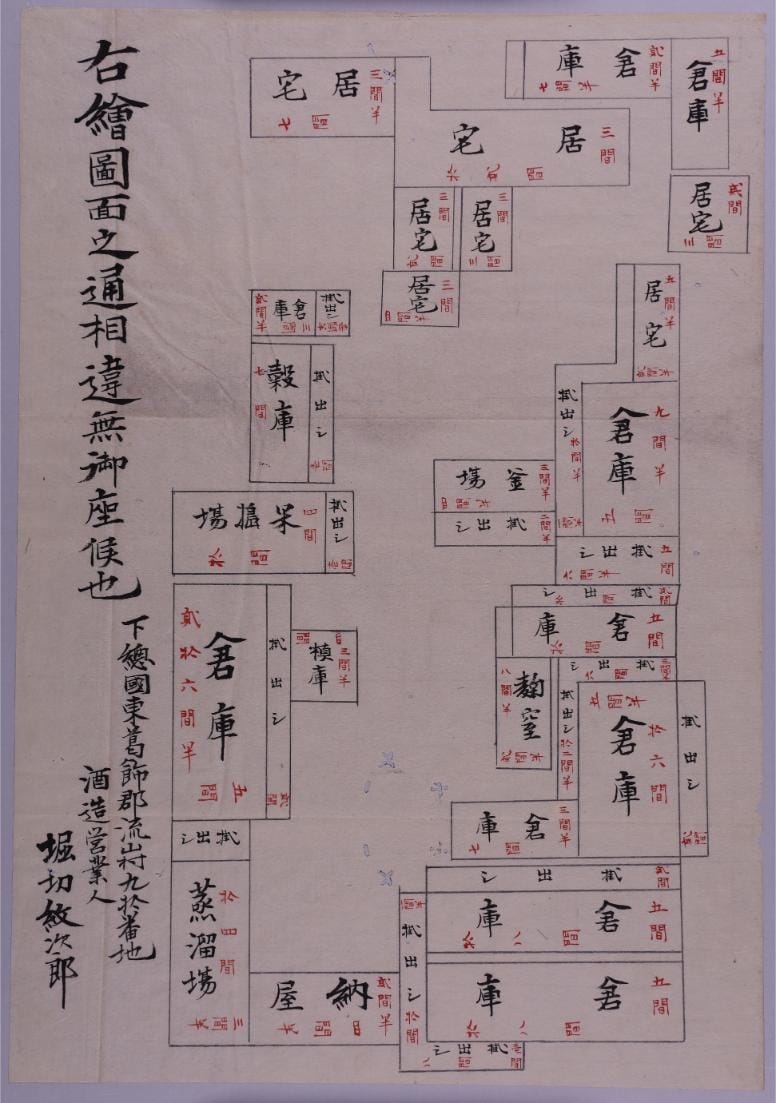
The Manjo mirin factory floor plan was drawn in 1888 and was an attachment to Horikiri Family Document No. 32- 81-4 Shuzo Mikomi Shumoku Narabini Kokusu Otodoke (Notification of Expected Varieties of Sake Production and Quantities in Koku) that Horikiri Monjiro submitted to Funakoshi Mamoru, Governor of Chiba Prefecture.
The only information sources for buildings in the Manjo mirin factory known to date were the etchings (Fig. 2 to Fig. 4) contained in Chiba-ken Hakuran-zu (Chiba Prefecture Picture of Extensive Interest) of 1896. The layout, uses, and scales of the buildings were unknown.
Stated in the notification were estimated quantities (in koku) of mirin and brand sake production, brewing methods, sake brewery buildings, quantities of various tanks, and varieties of tools and their quantities. As shown in the plan, the buildings on the sake brewery premises included those related to sake production as well as those not directly related. The former included eight storehouses, one steaming building, one koji culturing building, one barn, one distillation building, one firewood shed, one rice polishing building, and one grain storage, while the latter included six residential buildings and two storehouses. For each of the buildings, the scale and floorspace in tsubo (roughly 3.3 sq. meters per tsubo) are indicated.
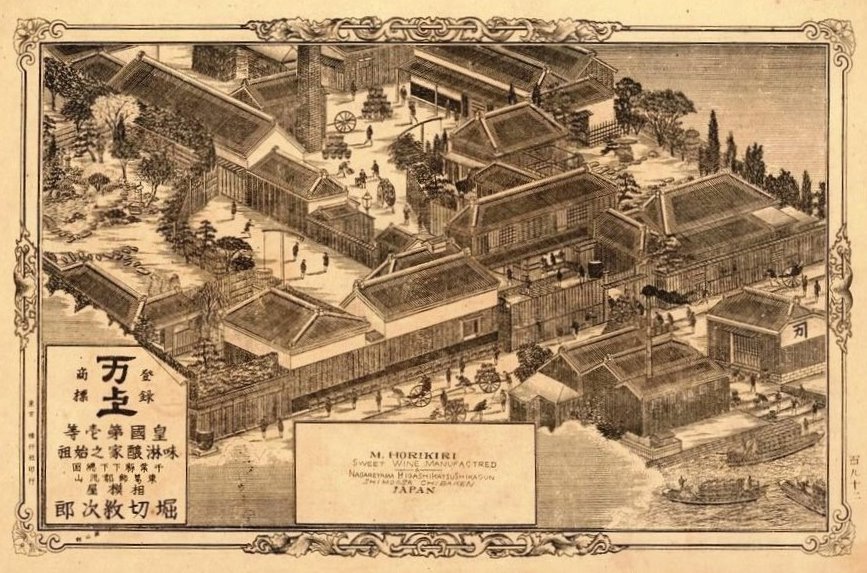
Manjo. The Best in the Empire. Founder of Mirin Brewery. Nagareyama, Katsushika District, Shimousa Province in Chiba Prefecture. Sagamiya. Horikiri Monjiro (West Half)
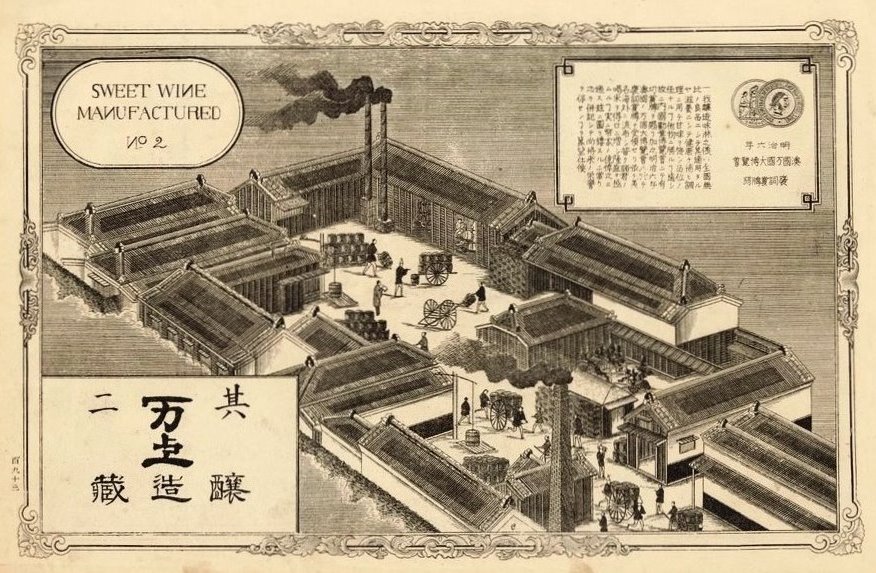
No. 2 Manjo Brewery (East Half)
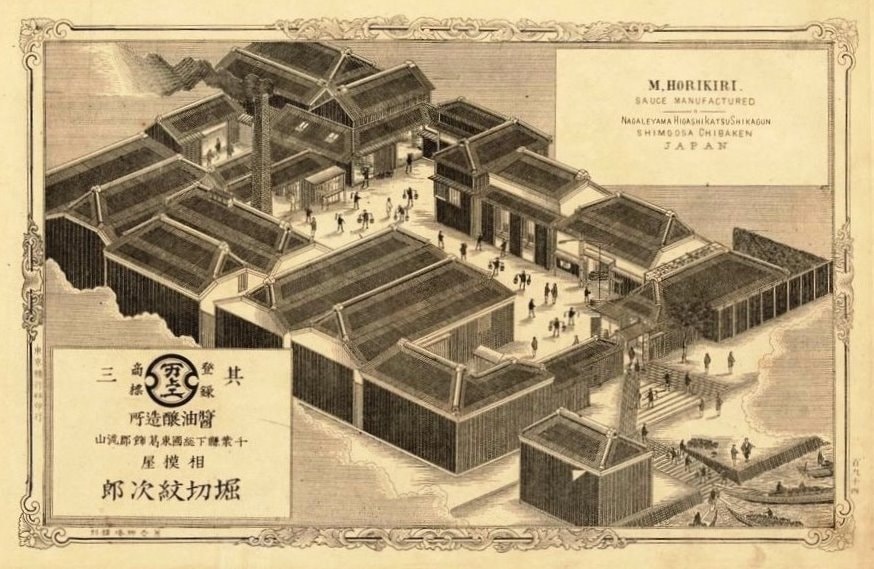
No. 3 Fundo Manjo Soy Sauce Brewery. Nagareyama, Katsushika District, Shimousa Province in Chiba Prefecture. Sagamiya. Horikiri Monjiro Property of the KIIFC
About the Horikiri Monjiro Family
Lands the Horikiri Monjiro Family Came From
It is obvious that the Horikiri family in Nagareyama, known as the Manjo mirin brewers, had moved in 1766 from present-day Banshomen, Misato City in Saitama Prefecture. The inscription on the first Horikiri Monjiro’s gravestone in the graveyard of Komyoin Temple of Shingon Buddhism Buzan Sect in Nagareyama 6-chome, Nagareyama City reads “Monjiro, the founder of Nagareyama Sagamiya and the third son of Horikiri Asaemon of Banshomen Village, Nigohanryo, Musashi Province, died on February 25, 1837 at age 77. Yae, wife of the founder Horikiri Monjiro and a daughter of Mogi Saheiji of Noda Town, Katsushika District, Shimousa Province, died on January 19, 1843 at age 77.”
According to The 20 Year History of Noda Shoyu Co., Ltd. and other sources, an ancestor of the Horikiris is said to be Chibanosuke Tsunetane, who was a member of the Chiba Clan that descended from Kanmu Heishi (descendants of 8th century Emperor Kanmu) and who was a warlord that played an active role from the late Heian period (794– ca. 1185) to the early Kamakura period (ca. 1185–1333). Tsunetane’s third son, Takeishi Tanemori (1146–1215), lived in Horikiri Village (present-day Katsushika Ward, Tokyo) after fall of his castle, where he assumed the name of Horikiri Shogen. For roughly 400 years thereafter, the family is said to have lived as lordless samurai. Katsuemon, who is an 11th generation descendant of Shogen, is said to have moved to Kamihikogawado Village, Nigohanryo (present-day Misato City, Saitama Prefecture) sometime during the Kan’ei era (1624–44). His son, Den’emon is said to have further moved to Shimohikogawado Village.
Uemon was a son of Den’emon, and Uemon’s second son was Seizaemon. Seizaemon lived in Banshomen Village, Nigohanryo sometime during the Kyoho era (1716–36), and assumed the name of the first Horikiri Asaemon. Asaemon I began the brewing of sake and miso, and assumed Sagamiya as the trade name because his remote ancestors lived in Kamakura in Sagami Province. The third son of Asaemon II moved to Nagareyama in 1766. He founded the Horikiri Monjiro family and started the sake production business.
For the trade name, he decided to use the same Sagamiya name as the head family. In the Horikiri Monjiro family, the name Monjiro was passed down until the 7th generation, and the 8th-generation family head is Mr. Horikiri Noriaki. According to Saikatsu no Sake Bunka (Sake Culture in the Saikatsu Area), among the Horikiri Asaemon family, which was the head family of the Horikiri Monjiro family, Seizaemon, who was the first Asaemon, brewed Kanto gomen joshu 2,500 koku (450,000 liters) in 1790 and 1,700 koku (306,000 liters) in 1793. Monjiro also participated in the production of Kanto gomen joshu in 1794, but the volume was just 320 koku 5 to (57,690 liters). This shows the scale of the Horikiri Asaemon family business. Haiku (traditional poems) were popular among wealthy merchants and farmers of the time. Along with Akimoto Sanzaemon, who liked to compose haiku and assumed the pen name Soju, both Asaemon III and Asaemon IV are known as haiku poets (with pen names of Kochiku and Rijo, respectively) of the Katsushika school. Horikiri Asaemon V died in 1868 and Asaemon VI took over as head of the family. In the Horikiri family documents, there is a letter dated 1874 in which Asaemon VI asked Horikiri Monjiro and other relatives for advice as to how his family’s business should be run. It seems that the Horikiri Asaemon family continued in the sake production business through the period of Asaemon VI.
According to The 20 Year History of Noda Shoyu Co., Ltd. and some other sources, Manjo mirin was developed by Horikiri Monjiro II when he was 27 years old, under the aegis of the Takanashi family, and was put on the market in 1814. The Takanashi family is a long-established family in Kamihanawa Village (present-day Noda City, Chiba Prefecture), and one of the eight families who merged to establish Noda Shoyu Co., Ltd. Although it is written that Horikiri Monjiro had the cooperation of the Takanashi family in developing mirin, no details are given as to how and what kind of cooperation was provided. It is known that the Horikiri Asaemon family and the Takanashi family had a relationship since 1821 if not earlier, so the relationship of the families would have most probably begun not with the Horikiri Monjiro family but with the Horikiri Asaemon family first. As the wife of Horikiri Monjiro I, Yae was the second daughter of Mogi Saheiji III and a granddaughter of Takanashi Hyozaemon XXII, a cooperative relationship between the Horikiri Monjiro family and the Takanashi family can be inferred
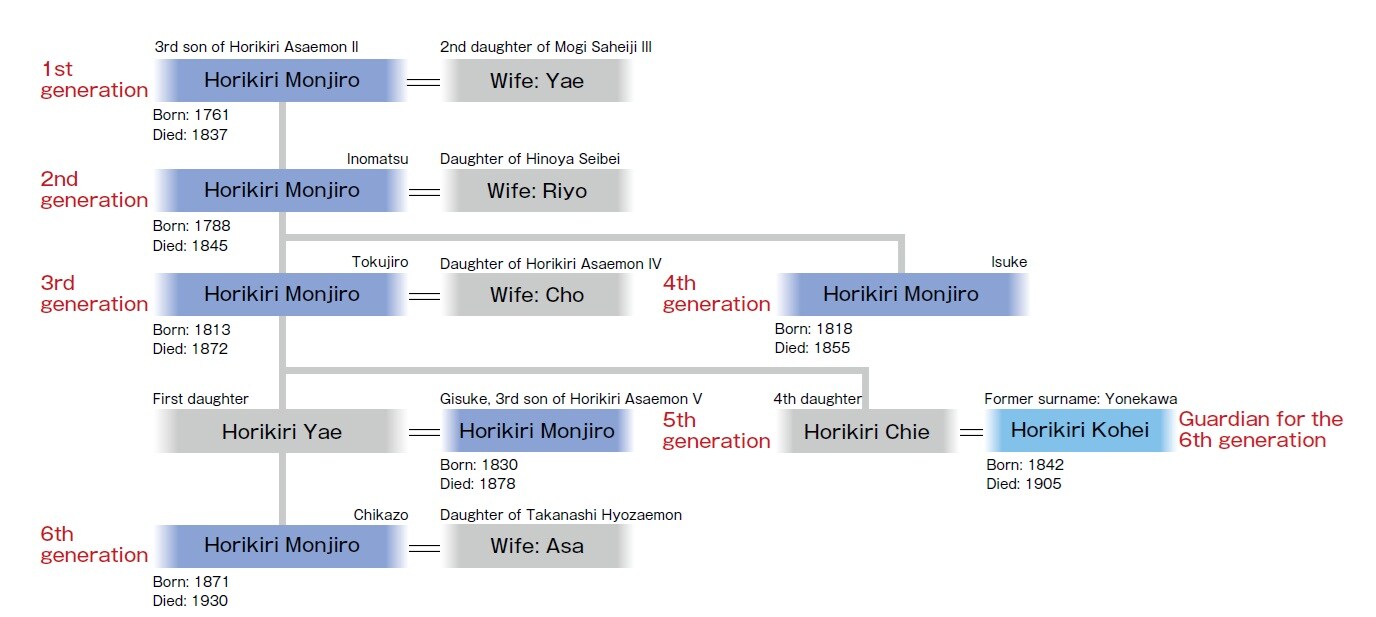
Achievements of Successive Monjiros, and Family Precepts and Constitutions
As noted earlier, the inscription on the gravestone of the first Monjiro reveals that the Horikiri Monjiro family in Nagareyama was founded by the third son of Horikiri Asaemon of Banshomen Village. The achievements of six Monjiro generations and of individuals who were deeply involved in the family business, and the family precepts and constitutions they left, are introduced here in sequence as far as can be known from the historical sources and materials available.
Shinji-Shoshin-Shinji
The graves of the Horikiri family are in the graveyard of Komyoin Temple of Shingon Buddhism in Nagareyama 6-chome, Nagareyama City. The grave among them considered to be the oldest (dated 1808) is that of Shinji-Shoshin-Shinji, which is a posthumous Buddhist name. Although his name in life, birth year and relationship with the Horikiri Monjiro family are unknown, Horikiri Family Document No. 32-33 indicates that the family held a 100th year memorial service for him in 1907.
As mentioned earlier, the Horikiri Monjiro family is said to have been founded when the first Monjiro moved to Nagareyama in 1766, which means he was 5 at that time. It could be assumed, albeit there is no supporting historical source, that ShinjiShoshin-Shinji moved from Banshomen Village with Monjiro I and was deeply involved in founding the family business.
The First Horikiri Monjiro (1761–1837)
Founder of the Horikiri Monjiro family, he was the third son of Horikiri Asaemon II of Banshomen Village and was born in 1761. The gravestone inscription indicates that he died in 1837 and his posthumous Buddhist name is Agaku-JoseiShinji. His wife, Yae, was the second daughter of Mogi Saheiji of Noda Town. She was born in 1767, and died in 1843, and her posthumous Buddhist name is Juho-Myo’un-Shin’nyo.
The inscription on the right side of the gravestone reveals that the first Monjiro was the third son of Horikiri Asaemon of Banshomen Village, and the founder of Nagareyama Sagamiya. The 20 Year History of Noda Shoyu Co., Ltd. states that he moved to Nagareyama in May of 1766 and founded a sake brewery, which he named Sagamiya-gura (literally, Sagamiya storehouse). It also states that he began brewing soy sauce as a sideline in 1788, but discontinued it in 1803. Although the book says Monjiro I was the third son of Horikiri Asaemon III, it seems more likely that he was actually the third son of Asaemon II, especially as Asaemon III’s year of birth was 1753 and Monjiro I’s was 1761. It is known from Horikiri Family Document No. 541 Shuzo Kiroku Ni (Sake Production Record 2) that Monjiro acquired a shuzokabu license in 1790, when the head of the family was Monjiro I. In 1794 and 1795, he participated in the production of Kanto gomen joshu. Given Monjiro II commenced mirin sales in 1814, that would have been when Monjiro I was 53.
The 20 Year History of Noda Shoyu Co., Ltd. contains the family precepts, which were said to have been written by Monjiro I, and are quoted below.
|
覚
|
| 一、御公儀様御法度之儀堅く相守申候事 |
| 一、親類朋友に親み睦敷可致候事 |
| 一、貧賤又は奉公人等に至る迄慈愛すべし |
| 一、火の用心大切に可致事 |
| 一、百姓は菜種きらすな公事するなと申すたとへ忘る可からず |
| 右の外は常々申教へ候通り相心得可申候事 |
| 未七十五歳 初代 堀切紋次郎 |
These were the first family precepts of the Horikiri Monjiro family set by Monjiro I in 1836, in his last years. First, he tells them to respect the Shogunate government and authorities; second, he says to live in harmony with relatives and friends; third, he directs them to be considerate toward servants, etc.; and fourth, he tells them to take precautions to prevent fires.
As to the fifth precept, which says to be diligent in farming and not to institute a lawsuit, it is unclear whether he set it because he considered farming to be the family’s main business and sake production as subsidiary or because he likened sake production to farming. As he did not give any specific guidelines on business, the precepts would have meant to be guidelines observed in home life and life in general. However, before closing, he mentioned that the family should follow what he had usually told them, so there might be unwritten guidelines regarding the business. The provision noting a spirit of benevolence toward servants is a fundamental principle of the Horikiri Monjiro family that was passed down through the family for generations thereafter.
Horikiri Monjiro II (1788–1845)
their trade names, both Hinoya and Yanoya might be merchants originally from Omi Province (present-day Shiga Prefecture).
The 20 Year History of Noda Shoyu Co., Ltd. tells us that Monjiro II conducted trial brewing of shiro mirin when he was 27, with the backing of the Takanashi family, and started selling it in 1814. The book explains that the decline of the sake production business was the reason they developed mirin, though historical sources supporting this explanation are lacking. Sales of mirin that Monjiro II started are considered to have gotten on track during the Tenpo era (1830–44), and mirin brewing was becoming the main business of the family instead of sake production. During the Tenpo era, however, there was a great famine. Monjiro II bought additional shuzokabu licenses, by which he might have thought he could preclude the risk of the famine lowering the shuzomai-daka rice limit. His shuzomai-daka increased to 1,350 koku (243,000 liters) during the Tenpo era. The “Manjo” mark was also created when Monjiro II was the head of the family.
Horikiri Monjiro III (1813–1872)
Son of Monjiro II, he was born in 1813 and died in 1872. His name was Tokujiro and his posthumous Buddhist name is Taikan-Choei-Shinji. His wife was Cho, a daughter of Horikiri Asaemon IV. She was born in 1819 and died in 1868. Her posthumous Buddhist name is Taishin-Myoka-Shin’nyo.
Monjiro III played an active role as the central figure in running the family business from the time he turned 32, when his father, Monjiro II, developed a serious illness in July 1845. He took over the accounting ledger called Tanakanjo Motocho that Monjiro II started and he painstakingly kept Arimono Tsuketate-cho as the subsequent ledger from 1849. He greatly increased the trading volume of alcoholic beverages with wholesalers in Edo, except for the very late years of his life in the early Meiji era (1868–1912). He also bought additional shuzokabu licenses aggressively, and shuzomai-daka rice limit increased to 2,750 koku (495,000 liters) during the Ansei era (1854–60) and to 3,650 koku (657,000 liters) in 1860.
Monjiro III seems to have passed the family business on to Monjiro IV in the early Ansei era, but took it over again when Monjiro IV died in 1855. Before his death in 1872, Monjiro III took Ryosuke into the family as his first daughter Yae’s husband. However, because Ryosuke died in 1862, he brought Gisuke, who was born to the Horikiri Asaemon family, into the family as his daughter Yae’s next husband, who later became Monjiro V.
In May of 1865, there was an incident called the Second Choshu Expedition. As a reward for offering money for the departure of the 14th Shogun Tokugawa Iemochi for the expedition, Monjiro III was allowed to officially use a surname and wear a sword and Gisuke received 10 silver coins. In February of 1869, the Katsushika prefectural government office was placed on the site of the residence of the Hondas of the former Tanaka domain in Ka Village, adjacent to Nagareyama Village. Monjiro III became the financial officer responsible for managing the receipt and disbursement of prefectural government funds, and he supported the prefectural administration in financial aspects. Horikiri Family Document No. 112, quoted below, contains the family precepts written by Monjiro III. The year it was written is unknown, but it is presumed from the contents that it would be around 1864, roughly when Gisuke (who later became Monjiro V) was married into the family following the death of Monjiro IV.
|
御公儀様御法度之儀者何事ニ不寄堅く相守可申事 |
|
| 一. |
万事之儀表立て儀母たり共婦人江相談致間敷候事女は知恵浅く心かたましきゆへなれバなり |
| 一. |
醤油造蔵之儀は手前持之心得ニ致し可申候乍去余り手広にて行届兼候節は兄弟之内慥成者も出来候ハヾ支配申付分合取り抔ニも為致候儀は其時宜ニより何れ共取斗ひ可申事 |
| 一. |
味淋醤油共品物落不申候様時々刻々気ヲ付可申候升目ハ勿論之事ニ候然ル上ニ高利ヲむさぼらず薄利ヲ専一ト心掛け可申候酒造之節は手練次第ニ而銘酒も出来候品故是ハ其時宜ニより掛引可致候右之心得ニ而商内油断不致候へは永続可致事○諸商内共身分ニ不応おもむく大手の事ハ堅く致間敷候手広之商売ニ相成候故日々刻々心ヲ用ひ候共不行届勝手成事と相心得可申候おもむく商内は時々致し候間は大利とも得候へ共大損も又ゝ有之候事故夫がために手広之商売不行届ニ相成候而は却而大損之基ひニ相成申候 |
Respect for the Shogunate government and authorities is written at the top, as with the Monjiro I precepts, followed by three articles prescribing specific rules regarding business.
First among the three is an instruction on managing the brewery that tells managers not to consult women about business. In 1839, when Monjiro II was 51 and Monjiro III was 26, the Horikiri family resumed the soy sauce brewing business that had been interrupted. The second article urges limiting soy sauce brewing, in principle, to a level that the family can handle on their own, without outside help. This can be understood in light of sake production being the family’s main business, with soy sauce brewing positioned as a sideline. At the same time, Monjiro III suggested that work be shared among brothers as the business develops. The third article, regarding both mirin and soy sauce, instructs remembering not to allow short measurements or a decline in quality, and to maintain thin margins. Proficient skills can create a quality brand sake, and the business could last only as long as complacency was avoided.
As an overall instruction on business, Monjiro III urged conducting business commensurate with one’s station, as business on an extensive scale could cause heavy losses. He would have written these family precepts to preclude the risks involved in development and expansion of the business, and thereby to ensure the succession of the family’s sake and soy sauce brewing businesses. A tanka (thirty-one syllabled poem) said to be a death poem is introduced in Horikiri-ke no Kakun (family precepts of the Horikiri family) authored by Iwasaki Sodo, which is kept as Horikiri Family Document No. 48 Sansei Monjiro Kakun (family precepts by Monjiro III). The poem is quoted below, as it is not contained in The 20 Year History of Noda Shoyu Co., Ltd. or other company history books
家の業よく勤よやこの外に いゝおく露のことの葉もなし
According to Horikiri-ke no Kakun, the poem means that one’s lifetime ideal has been achieved by having succeeded in the improvement of mirin, and was offered by a later-generation head of the Horikiri family. The book took it up as a poem composed by Monjiro II, though.
Horikiri Monjiro IV (1818–1855)
Monjiro IV was said to be a younger brother of Monjiro III. He was born in 1818 and died in 1855. His name was Isuke, and posthumous Buddhist name is Ho’oku-Chigo-Shinji. His wife, Taki, was a daughter of Anbiru Gonzaemon of Matsudo. She was born in 1822 and died in 1890. Her posthumous Buddhist name is Bussho-Myoshin-Shin’nyo.
It is not known when or how Monjiro IV came to take over the family business from Monjiro III, and Monjiro IV passed away at 37, well before Monjiro III. The accounting ledgers called Arimono Tsuketate-cho that Monjiro III kept were interrupted after 1853 and later resumed by Monjiro V from 1872, the year Monjiro III died. From this and other findings, we can presume that Monjiro IV took charge of the family business from 1854 to 1855. In 1854, Monjiro III was age 41.
The 20 Year History of Noda Shoyu Co., Ltd. states that both the third and fourth heads of the family worked industriously on the business, spreading the good reputation of Nagareyama mirin and dramatically increasing sales.
Horikiri Monjiro V (1830–1878)
The third son of Horikiri Asaemon V, he married into Monjiro III’s family. His name was Gisuke. He was born in 1830 and died in 1878, and his posthumous Buddhist name is Jikei-Ryokaku-Shinji. His wife, Yae, was the first daughter of Monjiro III. She was born in 1835 and died in 1915, and her posthumous Buddhist name is KenmyoMyojin-Shin’nyo.
Horikiri Family Document No. 18-5 Arimono Tsuketatecho ledger contains a draft of the document submitted to the Inba prefectural office in 1872 to ask for acceptance of the notification that Monjiro III was retiring due to illness, and to state that Gisuke would be renamed Monjiro and succeed as head of the family. The document is quoted below, as it is the only historical source submitted to a government office for the succession of a family head.
弐郷半番匠免 |
| 堀切浅右衛門三男 |
| 堀切儀助 |
| 三拾五才 |
| 流山村 |
| 堀切紋次郎方江 |
| 元治元年子三月聟養子成 |
| 壬申歳五月九日家督願 |
| 左ニ記置候也 |
| 乍恐以書附奉申上候也 |
| 御県下流山村堀切儀助奉申上候 |
| 私儀堀切紋二郎長男ニ御座候 |
| 当区内戸長勤役中ニ候処 |
| 今般父紋二郎義病身ニ |
| 相成候ニ付考平与改名隠居 |
| 致私儀者堀切紋二郎与 |
| 改名家督仕度此段奉申上候 |
| 何卒以御仁恤右之段御聞済 |
| 被下置度奉願上候以上 |
| 御県下流山村 |
| 農堀切紋二郎倅 |
| 壬申 戸長 |
| 五月九日 堀切儀助 |
| 右 |
| 堀切紋二郎 |
| 印旛県 |
| 御役所 |
The above document shows that Gisuke married into Monjiro III’s family at the age of 34 in 1864 and 8 years later, in 1872, assumed the name of Monjiro V and took over the family business. Due to the upheavals in the final years of the Edo period that lasted until the beginning of the Meiji era, the Horikiri family’s total assets dropped in 1868, but Monjiro V steadily increased them thereafter until 1875. The bookkeeping of Arimono Tsuketate-cho ledger that was once interrupted after 1853 was resumed by Monjiro V in 1872, the year of Monjiro III’s death. Horikiri Family Document No. 14-7 Tanakanjo Torishirabe-bo (book of accounts examination) dated 1877 states that sake production was suspended in 1876 because it was unprofitable. He then overcame this unstable period by such means as increasing the soy sauce brewing part of the business, and further developed the family business.
Monjiro V received a merit medal for mirin exhibited at the Vienna World’s Fair held in Austria in 1873, and a flower crest medal from the National Industrial Exhibition held in Ueno, Tokyo in 1877.
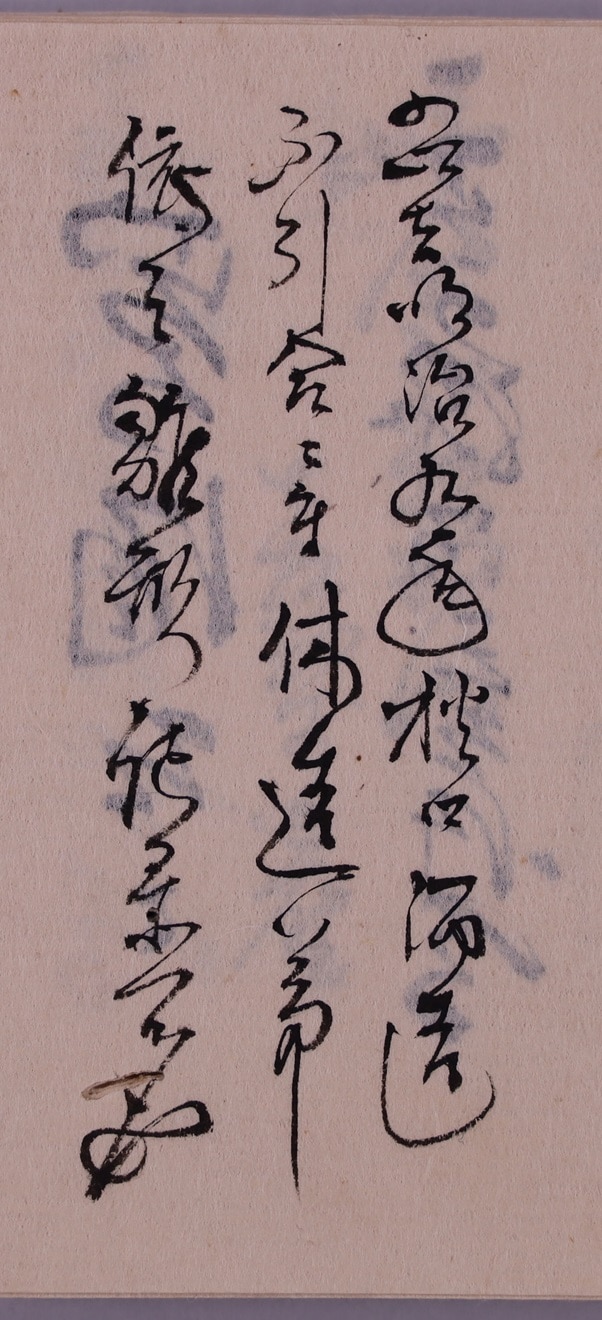
Horikiri Kohei (1842–1905)
Horikiri Kohei was born in 1842 and died in 1905, and his posthumous Buddhist name is Jisshin-TatsudoShinji. The inscription on his gravestone indicates that his original surname was Yonekawa, and that he was a nephew of Suga Magoshichi, who was the representative of the farmers in Nagareyama Village. His wife, Chie, was the fourth daughter of Monjiro III. She was born in 1841 and died in 1915. Her posthumous Buddhist name is Shinjin-Myo’un-Shin’nyo.
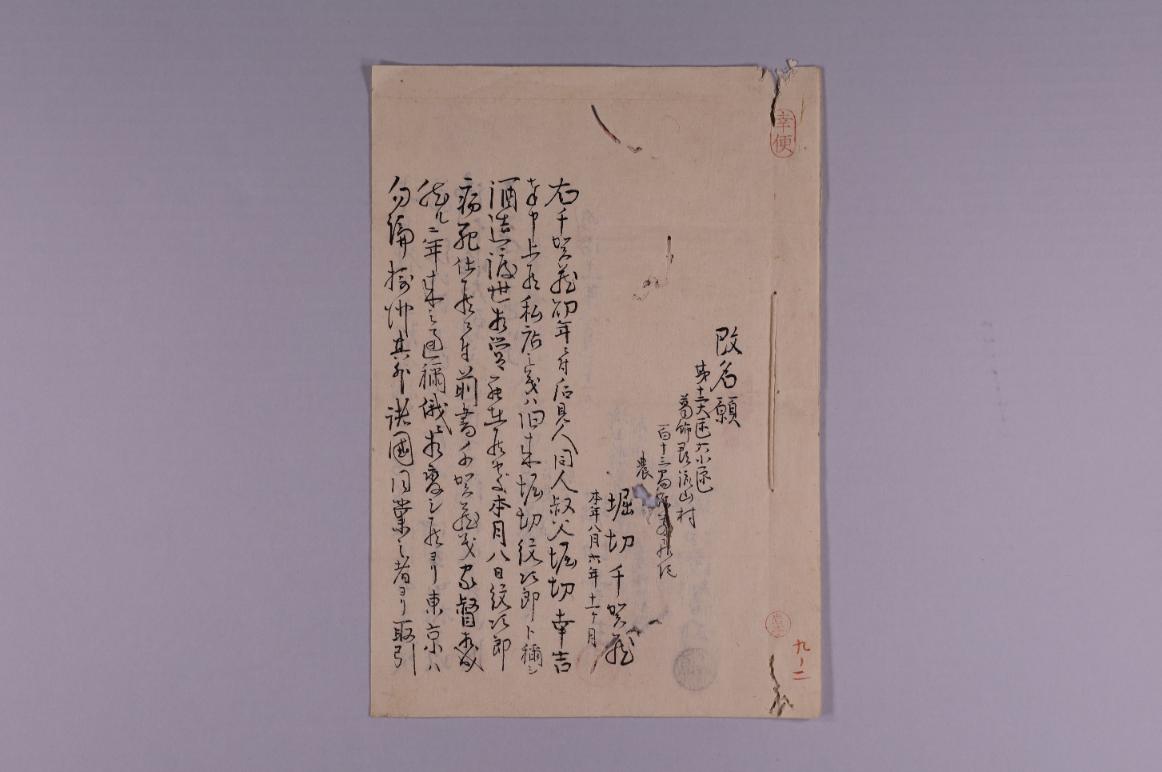
When Monjiro V died at 48 in 1878, his son, Chikazo, who later assumed the title of Monjiro VI, was 6 years and 11 months old. Horikiri Kohei acted as guardian until Chikazo grew old enough to assume charge. As an uncle and guardian, Kohei, jointly with Horikiri Asaemon, submitted a Kaimei Negai (request regarding name change) to change Chikazo’s name to avoid inconvenience in business. This was submitted to Governor Shibahara Yawara of Chiba Prefecture on the day of Monjiro V’s death. The document is quoted below. In response, the document was returned from the prefectural office with a comment stating the change of the name to Monjiro had been noted. This is Horikiri Family Document No. 34- 158. Thereafter, Chikazo assumed the title of Monjiro VI. Horikiri Kokichi in the quoted document and Horikiri Kohei were the same person, though Kohei was his real name. At the time of compilation of the family register in 1872, his name was registered as Kokichi by mistake, and many documents were made thereafter under the name of Kokichi. His name was officially corrected to Kohei after submitting a request for correction of the name to the head of the village in 1886.
| 改名願 第十二大区六小区 葛飾郡流山村 百十三番屋敷居住 農 堀切千賀蔵 本年八月六年十一ヶ月 右千賀蔵幼年ニ付後見人同人叔父堀切幸吉 奉申上候私店之義ハ旧来堀切紋次郎ト称シ 酒造渡世相営罷在候処本月八日紋次郎 病死仕候ニ付前書千賀蔵義家督相成 然ルニ年来之通称俄ニ相変シ候ヨリ東京ハ 勿論摂州其外諸国同業之者ヨリ取引 上ニ付往々不都合相生シ殆難渋仕候ニ付千賀 蔵ヲ紋次郎ト改名仕度候ニ付何卒出格之以 御仁恤右願之通御聞済被成下度此段 奉願上候以上 右千賀蔵幼年ニ付 後見人 叔父 明治十一年八月三十一日 堀切幸吉㊞ 埼玉県第三区 武蔵国葛飾郡番匠免村 親類 叔父 堀切浅右衛門㊞ 用掛 寺田伊助㊞ 右区戸長三上貞次郎代理 副戸長 飯島祐三郎㊞ 千葉県令柴原 和殿 |
|---|
Kohei is thought to have acted as guardian until Monjiro VI reached adulthood. Total assets decreased during the years from 1879 to 1882 but recovered their previous level in 1883 and 1884. Although there was a slight decline thereafter, Kohei overcame several economic crises. Manjo mirin received a merit medal at the second National Industrial Exhibition held in 1881. As it was when Monjiro VI was 10, it would be Kohei who participated in the exhibition.
Horikiri Monjiro VI (1871–1930)
Monjiro VI was a son of Monjiro V. He was born in 1871 and died in 1930, and his name was Chikazo. His posthumous Buddhist name is Tokujitsu-Seikan-Shinji. His wife, Asa, was a daughter of Takanashi Hyozaemon. She was born in 1873 and died in 1958. Her posthumous Buddhist name is Jitsujun-Myosei-Shin’nyo.
Monjiro VI lost his father, Monjiro V, when he was seven, and assumed the name of Monjiro VI under the guardianship of his uncle, Horikiri Kohei. During the Meiji era (1868–1912), the Horikiri family’s total assets declined after peaking in 1875, then turned upward again after 1900 before dramatically increasing in 1905. Monjiro VI wrote diaries in 1908 and 1909. According to these sources, he ardently studied mirin brewing methods as well as how to improve brewing facilities. As noted earlier, he filed patents for the rich mirin brewing method and pure glucose manufacturing method.
Beginning with the third National Industrial Exhibition in 1890, he showcased mirin in exhibitions including the fourth and fifth National Industrial Exhibition, the Alaska–Yukon–Pacific Exposition in 1909, the JapanBritish Exhibition in 1910, the Tokyo Taisho Exposition in 1914, and the Panama–Pacific International Exposition in 1915, and received various awards. His participation in these exhibitions and the improvements he made in brewing facilities and brewing methods are evidence of the proactive management Monjiro VI was known for.
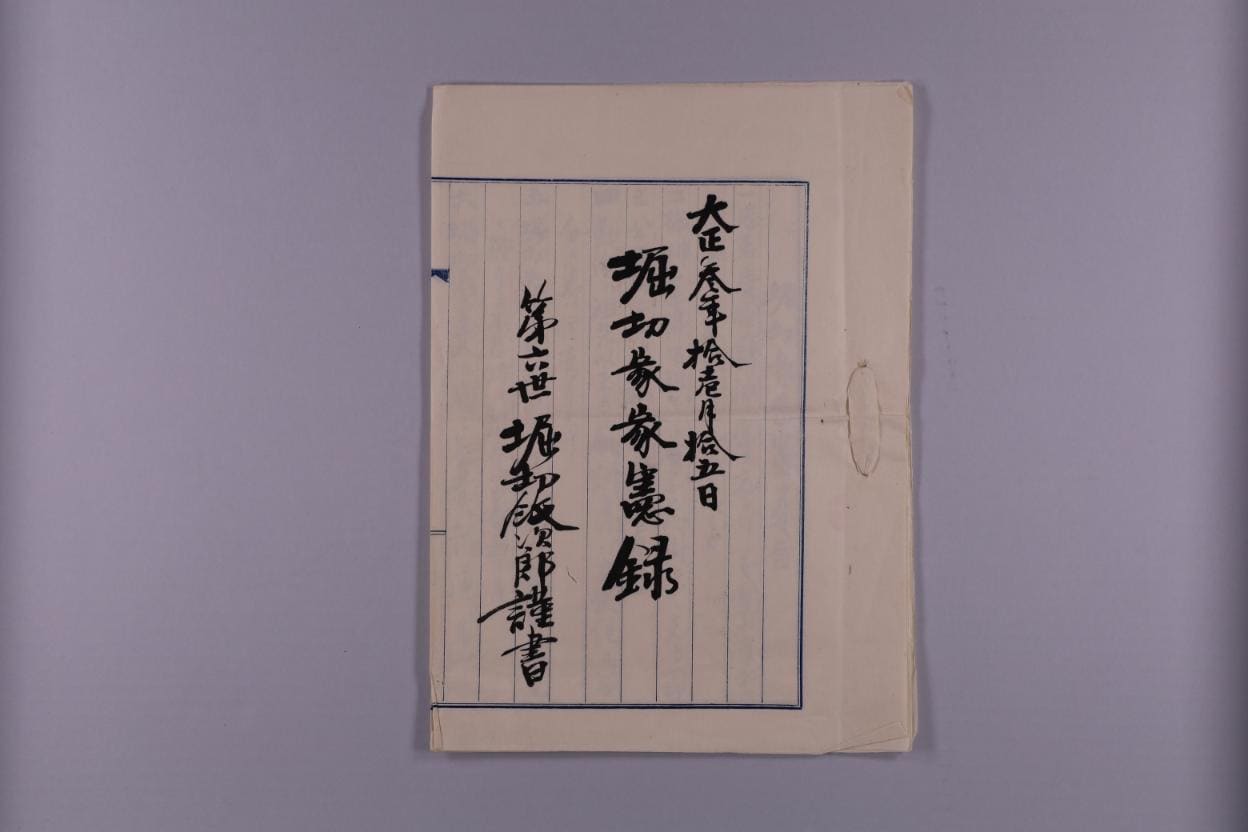
In December 1917, Manjo Mirin Co., Ltd. was established with Horikiri Monjiro VI as president. In April 1925, Manjo Mirin Co., Ltd. was dissolved to merge with Noda Shoyu Co., Ltd. The family precepts set by Monjiro VI make up Horikiri Family Document No. 444-1, shown below. They were written on November 15, 1914, and titled Horikiri-ke Kaken-roku (Horikiri family precepts).
| 堀切家家憲録の要旨 | |
|---|---|
| 一 | 忠君愛国の精神常ニ忘る可らず国家有事の際ハ奮て臣民の本分を尽せよ |
| 二 | 敬神崇仏及祖先を尊ぶの心掛常ニ忘る可らず |
| 三 | 公益の為ニハ私財を吝むなかれ |
| 四 | 勤倹ハ祖先以来の厳訓なれば衣食住とも分ニ応して為す事 |
| 五 | 堀切家ハ一夫一婦ノ制を確守し畜妾及ひ是ニ類する不品行の行為を厳禁す |
| 六 | 堀切家ノ主人ハ自ら家業ニ精通し第一ニ醸造ノ研究ハ申迄もなく原料の買入商品の売買及日常の帳簿等ニ至る迄可目を通して精励し決して雇人任せニ致ざる事主人として勤勉ハ店員も是ニ倣ふ主人早起なれバ店員何□□朝ゟ援を為さんや正働きて人ニ示さバ会せすして前事行ハる也 |
| 七 | 子孫多くハ祖先の勤労を知らず何事ニ任せて安佚驕奢を為大ニ慎を□可らず |
| 八 | 小事ニ齷齪タルモノ大事業を為す器ニ非ず大胆ニ沈着ニ冷静の態度を以て家業を精励せよ |
| 九 | 家庭ハ質素にして事業ハ進取的タル事 |
| 拾 | 家業ハ天授ノ福なれバ至誠を以て尽す可き事万上の二字ハ如何なる犠牲を払ふも守る可き事 |
| 拾壱 | 商品ハ品質本位とす好き物を勉強して売れバ天之意ニ叶ふて繁昌し家富み栄ゆ |
| 拾弐 | 商業上の資本金ハ主人と雖も勝手ニ使用を許さざる事 |
| 拾参 | 堀切家ハ衆議院、貴族院、県会議員タルたる(ママ)事確く禁し置事若し此禁を犯す者あれば即時隠居せしむ可き事猶政党員等と深く交際せざる事 |
| 拾四 | 雇人ハ目を掛け使ふ可き事忠実なる者と見ば一層優遇して本人前途の幸福を計る可き事 |
| 拾五 | 商業上ノ利益ある場合ニハ通常の積立金を為し残余ハ一家族ニ分配ハ勿論雇人下男等ニ到る迄勤労ニ応して賞与金の分配を為す事 |
| 右家憲の條々確守可致事 | |
| 大正参年十一月拾五日 第六世堀切紋次郎謹書㊞ |
Articles 1 to 5 are guiding principles to be observed by the family, and include mental attitude toward the nation as a citizen, the importance of worshipping Buddha and Shinto gods and revering ancestors, and the practice of frugality, economy, and moral standards. Articles 6 to 12 provide specific guidelines regarding the business. Article 10, in particular, instructs ensuring that the two characters of 万上 (Manjo) are maintained. Article 13 prohibits family from becoming members of the House of Representatives, the House of Peers, or the prefectural assembly, and from being too closely associate with politicians. Despite this, Monjiro VI became a Nagareyama Town councilperson as of 1920. It is likely that he thought a town councilperson, whose main responsibility is contributions to the community, was an exception to this rule. Articles 14 and 15 cover basic principles governing attitude toward employees, as with Monjiro I’s family precepts.
Unlike the precepts of Monjiro I and III, those of Monjiro VI provide detailed instructions regarding mirin brewing as the family business, and reflect his strong aspiration for the continuance of the family business while coping with changes in the business environment.
Commencement of Manjo Mirin Brewing Business
Location of Nagareyama
Nagareyama, where the Horikiri Monjiro family operated their mirin brewing business, had been developing as a river port since the early Edo period. This section looks at the relationship between the geographical position of Nagareyama and the mirin brewing industry.
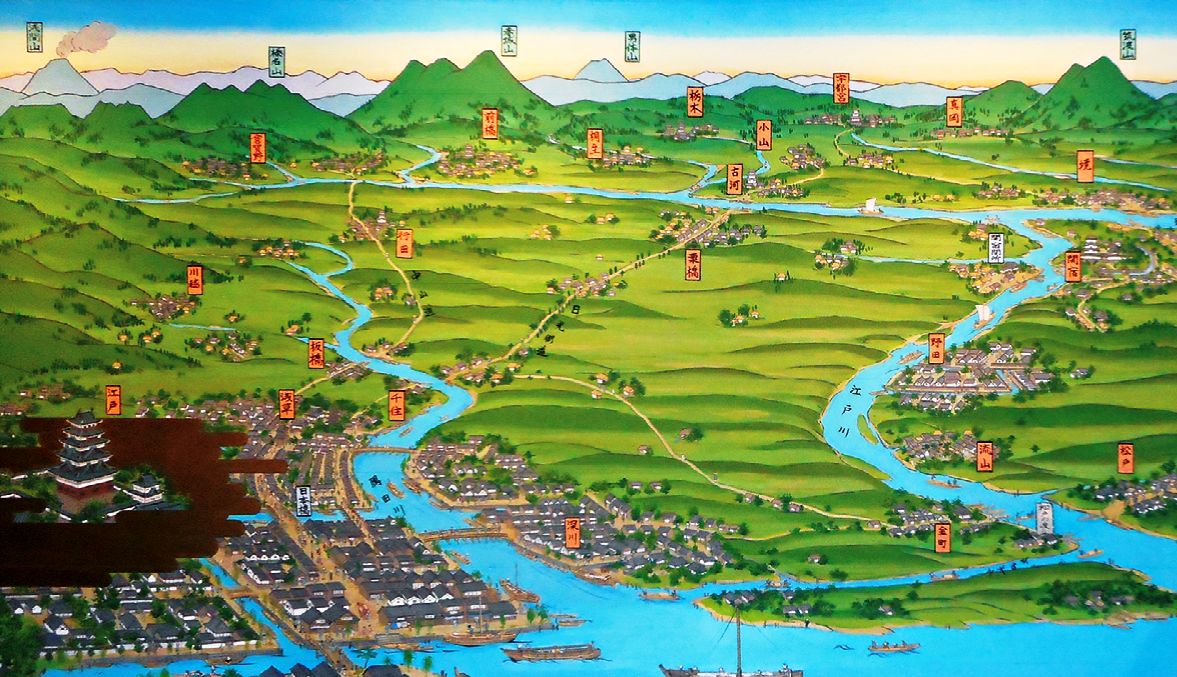
Nagareyama City is in the northwestern part of Chiba Prefecture, 25 kilometers from the center of Tokyo. It is bordered on the north by Noda City, on the east by Kashiwa City, and on the south by Matsudo City, while to the west it faces Yoshikawa City and Misato City of Saitama Prefecture across the Edo River. In April 1951, Nagareyama Town merged with Yagi Village and Shinkawa Village to establish Edogawa Town (renamed Nagareyama Town in the following year), which made the city almost as it is today. The former town of Nagareyama was incorporated through the merger of the six villages of Nagareyama, Ka, Miwanoyama, Nishihirai, Hiregasaki, and Ki under the municipal system and the town and village system put into force in April 1889. Presumably, Nagareyama Village was established by the beginning of the early modern age, as the name Nagareyama is found in Kogane no Ryo Yaba Uritsuke no Cho (Sales Record of Wild Horses in Kogane Ryo) dated 1614 and a record of rice yield in Nagareyama in 1626 in Nagareyama-cho Shi (magazine of Nagareyama Town) edited by Iwata Kisuke. Nagareyama had Nagareyama Port, and its neighboring village of Ka on the north had Kamura Port. Nagareyama Port functioned as a place to ship out rice collected as nengu in the territory then under direct control of the Shogunate government in the Genroku era (1688–1704), and Kamura Port was where rice collected as nengu for the Honda family of the Tanaka domain was shipped from. A wide variety of commodities were loaded and unloaded at both ports, including rice, wheat, soy sauce, salt, taro, konjac corm, as well as conifer lumber, paper, oil, wax, Japanese lacquer, hair oil, medicines, sake, and tobacco.
Nagareyama, which had developed as a port from the early Edo period, had geographical advantages that made it easy to obtain materials and brewing water needed for sake production and mirin brewing, and easy to ship products to Edo using the water-faring transportation. After departing Nagareyama, a boat would travel down the Edo River 20 km to Hongyotoku in Ichikawa. Then, from shortly before Myokenjima, it would enter the Shinkawa and Onagi canals and pass under the Mannen Bridge and through the Sumida River to enter the Nihonbashi River, after which it would arrive at Nihonbashi Koami-cho. The total route was about 33 km. A boat that departed Nagareyama around 4 in the morning would arrive at Edo by dusk.
Manjo Mirin and Appare Mirin had exclusive ports. It is recorded in the Horikiri family documents that during the Edo period, Manjo was carried by takasebune (flatbottomed river boats) such as the Shosuke Bune, Juzo Bune, Tahei Bune, Heikichi Bune, Kaheiji Bune, Otojiro Bune, and Kinzo Bune. In the Meiji era, mirin was carried by takasebune such as the Risuke Bune, Kamekichi Bune, Shobei Bune, and Tahei Kobune, as well as by steamboats such as the Tsu’un Maru. One factor that contributed to the development of sake production and mirin brewing in Nagareyama was that Nagareyama had a port. Choshi, Sawara, and Noda had ports on the Tone and Edo Rivers, and the brewing industry developed there early on.
Sake Production Industry in Nagareyama
The best-known brewing industry in Nagareyama is that of mirin. Blessed with the convenience of boat transportation on the Edo River that directly connects with the huge market of Edo, the sake industry has long been as active in Nagareyama as in Sawara. Both the Horikiri and Akimoto families started as sake brewers before becoming known for mirin. To study the background that led these families to make mirin brewing their primary business, this section takes a look at the sake production industry in Nagareyama.
As mentioned earlier, the Horikiri family documents have several old records titled Shuzo Kiroku (sake production record). Shuzo Kiroku Ichi (Sake Production Record 1) was a record from 1786 to 1787, Shuzo Kiroku Ni (Sake Production Record 2) was from 1787 to 1790, Shuzo Kiroku San (Sake Production Record 3) was from 1790 to 1794, Shuzo Kiroku Yon (Sake Production Record 4) was from 1794 to 1801, and Niban Shuzo Kiroku (Second Sake Production Record) was from 1860 to 1868. In addition, several sake production records (although not titled so) made from 1802 to 1839 are found among the Horikiri family documents. These sources, albeit intermittent, help us to understand the changes in sake brewers and transition of shuzomai-daka rice limit for sake production.
Although there are some differences in recorded contents between the two oldest sake production records of Shuzo Kiroku Ichi and Shuzo Kiroku Ni, the following items were recorded for each brewer: shuzokabu-daka, shuzomaidaka, tax for business license paid in Eiraku coin, initial volume of sake production, volume of sake production to the current time, and tools and their quantity. According to these records, there were seven sake brewers in 1786, and nine brewers in 1788 in Nagareyama, and their sake production level was kabu-daka 65 koku (11,700 liters) and shuzomai-daka 3,994 koku (718,920 liters). However, during the great Tenmei famine, which was triggered by cold weather and the eruption of Mount Asama, the actual volume of sake production was roughly 1,000 koku (180,000 liters). During the same period in Sawara, there were 35 sake brewers, and their shuzomai-daka exceeded 13,000 koku (2,340,000 liters), which presents significant difference in scale from Nagareyama.
Shuzo Kiroku Ichi and Shuzo Kiroku Ni of the Horikiri family documents also note the previous holders of shuzokabu licenses and the years of acquisition. Reference to these records show that there were four sake brewers in Nagareyama in the Kyoho era (1716–36), when sake production is considered to have begun in Nagareyama. In 1772, there were seven sake brewers, and the total of their kabu-daka was 35 koku (6,300 liters).
Horikiri Monjiro and Akimoto Sanzaemon acquired shuzokabu licenses in 1790. Monjiro got a license for kabu-daka 5 koku (900 liters) and shuzomai-daka 511 koku 5 to (92,070 liters) from Jintaro in Nagareyama Village, and Sanzaemon got one for kabu-daka 5 koku and shuzomai-daka 480 koku 6 to (86,508 liters) from San’emon in Nagareyama Village. This was in the Kansei era (1789–1801) when Kansei Reforms led by Matsudaira Sadanobu were taking place. Two types of sake were being consumed in Edo at that time. One was kudari zake produced in the Kansai region, which included Itami, Ikeda and Nada, and the other was jimawari zake produced in the Kanto region. Kudari zake seems to have been preferred, as jimawari zake had a lesser reputation.
The Kanto gomen joshu production project that began in 1790 was a part of Kansei Reforms. Horikiri Family Document No. 543 “Shuzo Kiroku San” contains a text titled “Kanto ni Okeru Kamigata-shu Doyo no Joshu Tsukuri-kata” (How to produce Kanto sake that is as good as Kansai sake) in the section of “Sashiage Mosu Oukeshomon no Koto” (submission of the acceptance of appointment to brewers). This gomen joshu production policy of the Shogunate government was aimed at rectifying the economic imbalance between Edo and Kansai. In 1790, eleven sake brewers of economic influence from present-day Saitama Prefecture, Chiba Prefecture, Ibaraki Prefecture, Tokyo, and Kanagawa Prefecture participated in the project. Heihachi and Juzaemon from Nagareyama Village were among them. Seizaemon in Banshomen Village, who was the first Asaemon of the head Horikiri family, participated in this project with a trial production of 2,500 koku (450,000 liters), which was the largest volume among the 11 participants.
As preferential treatment, trial production using idle tanks was allowed for participants in the Kanto gomen joshu production project even in years when sake production was restricted by decree, as production of gomen joshu was considered to be exempt from the production limit. This decree was promulgated when the rice harvest fell short, and sake makers were ordered to limit their use of rice to a half or third of their original shuzomai-daka. In 1794, when restrictions limited the use of rice for sake production to a third of the shuzomai-daka (one-third sake production limit decree), Heihachi, a participant in the project since 1790, produced a much larger volume of gomen joshu in trial production by using idle tanks. Even while a third of his original shuzomai-daka was 200 koku (36,000 liters), he applied an additional 400 koku of rice (which was two thirds of his shuzomai-daka) and used the two thirds of the tanks, which were idle due to the restriction, to produce gomen joshu. Another preferential advantage received by the project participants was a rice borrowing system for sake production. In 1790, Heihachi used 2,000 koku (360,000 liters) of rice in the gomen joshu trial production, of which 750 koku was borrowed rice, and Juzaemon borrowed 300 koku out of 800 koku (144,000 liters) of rice used for the trial production. To borrow the rice, sake brewers had to pledge land as collateral and pay for it in cash the following year at the market value of when they borrowed it. This system allowed them to preferentially secure the rice needed for sake production.
The brewers in Nagareyama Village who participated in the Kanto gomen joshu production were Heihachi in 1791, Yoshitaro in 1792, Heihachi and Sanzaemon in 1793, Heihachi, Yoshitaro, Sanzaemon, Monjiro, and Iemon in 1794 and 1795, and Yoshitaro in 1799. Horikiri Family Document No. 554 Shuzo Kiroku Yon states that there were 37 gomen joshu brewers in 1796 and their shuzomai-daka was 33,600 koku (6,048,000 liters), which indicates the policy had been carried out steadily. The policy is said to have continued until 1833. However, the seal of Gomen Kanto Shinsei Joshu, which each participant borrowed from the Shogunate government to brand on the gomen joshu barrels, was returned to the Shogunate government by Juzaemon in 1791, Heihachi in 1796, and Sanzaemon and Monjiro in 1797. After 1800, there were no participants in the project seen from Nagareyama Village. Kanto gomen joshu production, a policy aimed at developing the sake production industry in the Kanto area, was determined to have been a failure as the trial production volume and participating brewers dramatically decreased after 1802 and 1803.
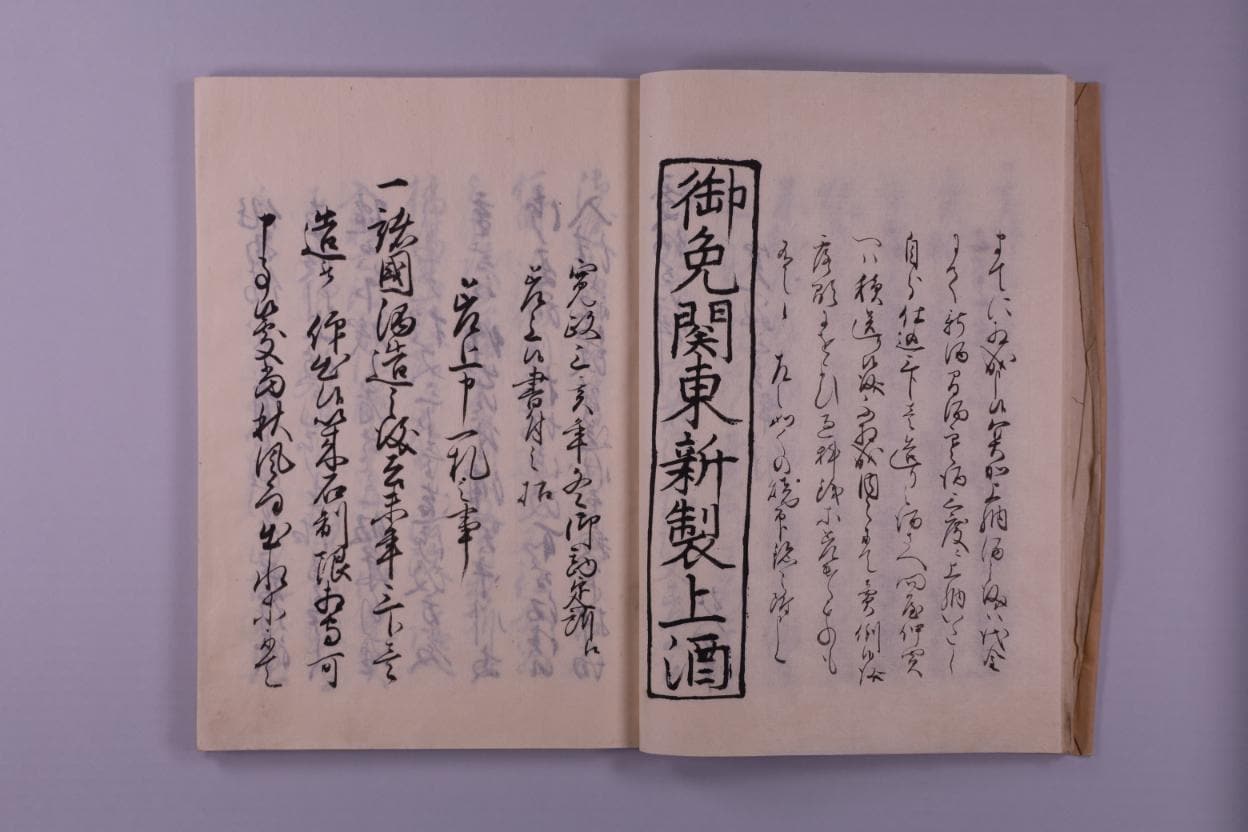
Horikiri Family Document No. 552 “Shuzo Dogu Kakiage Hikae (copy of sake production tools survey report)” mentions the katte zukuri decree. This decree, promulgated in 1804, allowed sake production of any volume within the individual brewer’s capacity, regardless of past shuzomai-daka. A historical document sent by sake brewers to the local governor, Asaoka Hikoshiro, in 1804 shows the jitsuzomai-daka (actual rice volume used for sake production) for each brewer. Thereafter, the jitsuzomai-daka was referred to as the criterial shuzomaidaka rice limit for each sake brewer. According to that document, there were 12 sake brewers in Nagareyama Village with shuzomai-daka reaching 8,050 koku (1,449,000 liters) in 1804. This was when the sake production industry in Nagareyama was at its peak during the Edo period. Horikiri Monjiro’s shuzomai-daka, which was previously 511 koku (91,980 liters), increased to 1,100 koku (198,000 liters), and that of Akimoto Sanzaemon grew from 480 koku (86,400 liters) to 700 koku (126,000 liters). In this early part of the 19th century, the Horikiri family and Akimoto family are thought to have begun brewing mirin. The 20 Year History of Noda Shoyu Co., Ltd. explains that they developed mirin “because the sake production industry declined around the mid Bunka era (1804–18).” It would be necessary to re-examine the situation to determine why the sake industry declined.
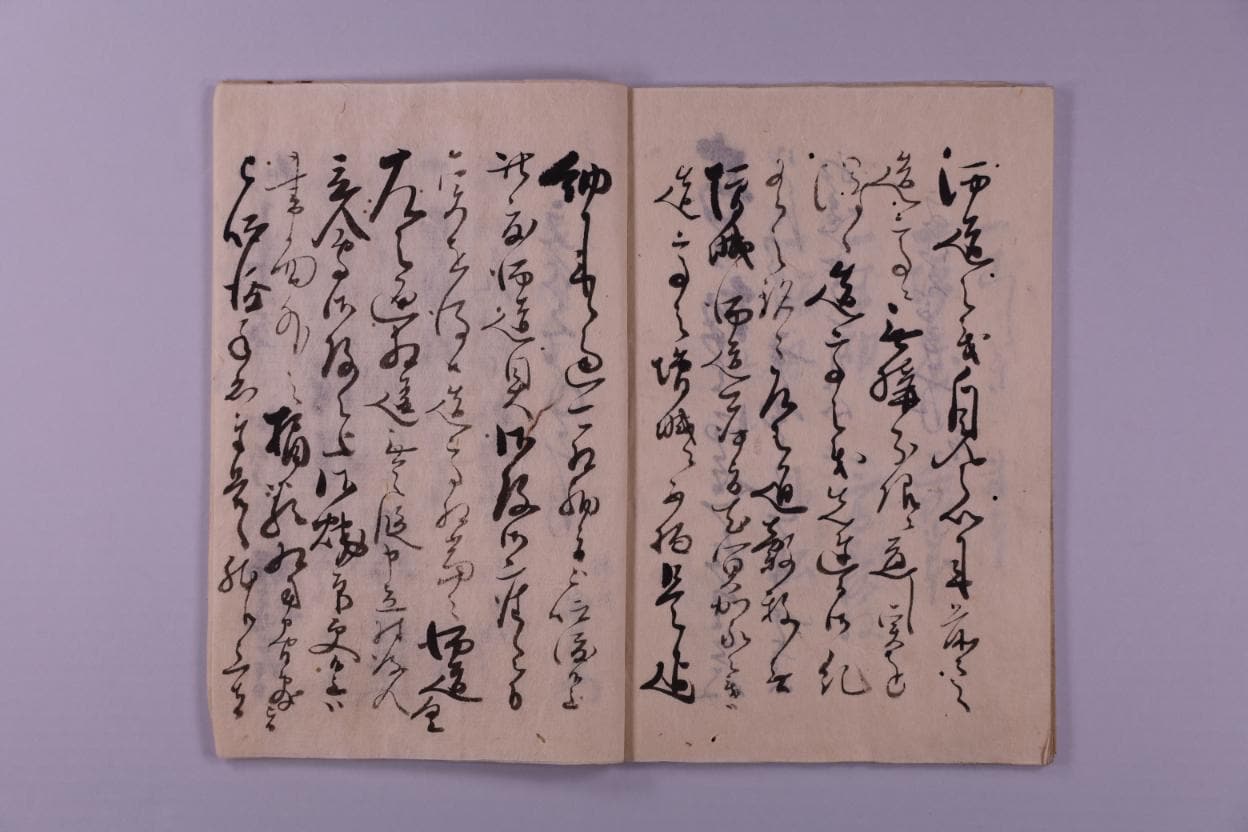
This document reads “Hereafter, sake production depends on one’s capacity regardless of former volumes of production.”
It is not possible to fully understand the transition of sake production volume, as no record of actual volumes of sake production during the Bunka era remain. However, Horikiri Family Document No. 609 “Oboe” (memorandum) is a record of what percentage of shuzomai-daka rice limit individual brewers used for actual production of sake in 1806. Of the 12 brewers in Nagareyama, Ichibei was replaced by Kyuzaemon as Ichibei’s shuzokabu licenses were transferred to Kyuzaemon in 1806. The other 11 remained unchanged. Sanzaemon and Monjiro used 100 percent of their shuzomai-daka, Juzaemon, Rinzo, Kyuzaemon, Yoshitaro, Eisuke and Rihei used 80 percent, Iemon and Sen’emon produced in breweries other than their own. Either Gorobei or Sajiemon used 80 percent and the other used 100 percent. The shuzomai-daka in Nagareyama was 8,050 koku (1,449,000 liters) in 1804 and around 6,400 koku (1,152,000 liters) in 1806. The decrease of roughly 1,600 koku cannot be considered great decline in the industry, but shuzomai-daka from the mid Bunka era to the years of the Bunsei era (1818–30) are unfortunately not known.
As a part of the Kansei Reforms, shipments of kudari zake arriving in Edo ports from 11 provinces (including Settsu Province, which included Itami, Ikeda, and Nada) were restricted to 409,000 barrels in 1792, and new shipments arriving from other provinces were prohibited. However, with the promulgation of the katte zukuri decree in 1804, the restriction on kudari zake shipments from Kansai arriving in Edo was lifted and a huge volume of quality sake entered, delivering more than one million barrels in 1817 and the largest volume of 1,224,000 barrels in 1821. It would be reasonable to consider that, rather than being spurred by a decline in the sake production industry, the Horikiri and Akimoto families began to brew mirin, which eventually became the main business of these families, under the circumstances described above.
Although shuzomai-daka in Nagareyama Village during the Bunsei era after the Bunka era have not been found, they appeared steadily in the early years of the Tenpo era (1830– 44), with 7,182 koku (1,292,760 liters) in 1830, 5,553 koku (999,540 liters) in 1831, and 7,650 koku (1,377,000 liters) in 1833. With the occurrence of the great Tenpo famine, however, sake production restrictions were promulgated almost every year after 1833. Shuzomai-daka for the years from 1833 to 1838 do exist. The annual average volume of sake production during this period declined to roughly 3,500 koku (630,000 liters), which led shuzokabu licenses in Nagareyama Village to be consolidated. According to a survey in 1839, there were only eight sake brewers in Nagareyama Village.
In the meantime, how many people were needed to operate a sake production business? Horikiri Family Document No. 583 Shuzo Kiroku has a record of the number of people engaged in sake production. Following the decree to limit sake production to one-third in 1838, this document was submitted to an officer in charge of policing in the Kanto region to report the original shuzomai-daka and jitsuzomai-daka for one-third sake production, as well as to report the number of people engaged in sake production and a breakdown of their duties, under the title of Shuzonin Chakuto Narabini Kanainin-betsu Kakiage Oboe.
At that time, there were eight brewers in Nagareyama. While the total shuzomai-daka in the village was 7,650 koku (1,377,000 liters), the jitsuzomai-daka was 2,549 koku 9 to 9 sho 6 go (458,999 liters) in total of the eight brewers due to one-third sake production limits. The number of people engaged in sake production for each brewer and their jobs are as summarized in Table 5. The largest employer was Horikiri Monjiro, who had 35 people working in his brewery. Of these, 18 were in-house servants or apprentices and 17 were temporary employees handling sake production, including seven assigned to rice polishing. The toji (master brewer) was Heibei. The second largest employer was Akimoto Sanzaemon, who had 32 people working in the brewery. Of these, 16 were in-house servants or apprentices and 16 were temporary employees handling sake production, including seven assigned to rice polishing. The toji was Gensuke. The smallest employer was Eisuke (Uragura). He had 16 people working in his brewery, of whom eight were inhouse servants or apprentices, and eight were temporary employees handling sake production, including four assigned to rice polishing. The toji was Jinsuke.
In this year of reporting, 203 people were engaged in the sake production business, working for eight brewers. On average, 25 people worked in the brewery, of whom 14 were in-house servants and 10 (including 5 for rice polishing) temporarily employed during the sake production period. With no other historical sources to compare, we cannot know whether the manpower structure was a special arrangement that corresponded with the one-third production limit or whether it was the same as in years of normal production.
More recently, Taisho Hachinen Sho-Kojo Yoran (Directory of Factories, 1919) has indicated production volume, number of employees, etc. of Manjo Mirin & Soy Sauce Brewery and Appare Mirin Brewery. The former had 43 and the latter had 25 male operatives and apprentices. Although the environment for mirin brewing was different for that time, including the introduction of mechanical power, the comparison helps us speculate as to the scale of the mirin brewing business before modernization.
| Brewer | Shuzomaidaka(koku) | Total employees | In-house servants | Seasonal (temporary) workers | Rice polishers | Toji |
|---|---|---|---|---|---|---|
| Rihei | 700石 | 24人 | 14人 | 10人 | (4人) | Bunkichi |
| Yoshitaro | 1100石 | 26人 | 15人 | 11人 | (5人) | Gensuke |
| Eisuke | 700石 | 16人 | 8人 | 8人 | (4人) | Nisuke |
| Kyuzaemon | 1200石 | 22人 | 9人 | 13人 | (5人) | Bunzo |
| Monjiro | 1350石 | 35人 | 18人 | 17人 | (7人) | Heibei |
| Juzaemon | 900石 | 28人 | 16人 | 12人 | (6人) | Komakichi |
| Sanzaemon | 1400石 | 32人 | 16人 | 16人 | (7人) | Gensuke |
| Gorobei | 300石 | 20人 | 20人 | - | - | - |
| Total | 7650石 | 203人 | 116人 | 87人 | (38人) |
There were eight brewers in Nagareyama Village in 1839. This decreased to three, Monjiro, Sanzaemon and Yoshitaro, during the period from the Ansei era (1854–60) to 1860, when the sake production industry in Nagareyama entered the doldrums from the last years of the Edo period to the first year of the Meiji era. Shuzokabu licenses came to be concentrated between Monjiro and Sanzaemon, with shuzomai-daka rice limit of Monjiro being 3,650 koku (657,000 liters) and that of Sanzaemon being 1,700 koku (306,000 liters). Though, during the period after 1860, decrees to restrict sake production to half or one-third of the usual were promulgated, Mojiro’s mirin production almost doubled in volume during the Tenpo era (1830–44), owing to increased shuzomai-daka.
Horikiri Family Document No. 630, quoted below, shows Monjiro’s shuzomai-daka became 3,650 koku in 1860. It is a copy of the document addressed to Kashiwagi Shogoro and Fujisawa ?nosuke (the first part of the second name is unreadable), assistant officers to Hayashibe Zentazaemon, with the cover reading “Shuzomai-Daka Brewer Monjiro, Nagareyama Village, Katsushika District, Shimousa Province.”
下総国葛飾郡流山村 酒造人 |
|||
| 一 | 酒造米高千百石 | 百姓 | 紋次郎 |
| 一 | 酒造米高弐百五拾石同国同村久左衛門名代之御鑑札 | 同 | 右同人 |
| 一 | 酒造米高七百石同国同村栄助名代之御鑑札 | 同 | 右同人 |
| 一 | 酒造米高七百石同国同村重左衛門名代之御鑑札 | 同 | 右同人 |
| 一 | 酒造米高九百石 | 同 | 右同人 |
| 五口 | |||
| 合酒造米高三千六百五拾石 | |||
| (中略) | |||
| 右は当申年酒造御改メニ付奉書上候処書面之通相違無御座候以上 | |||
| 葛飾郡 | |||
| 下総国葛飾郡流山村 | |||
| 申ノ十一月 | 酒造人 | ||
| 百姓 紋次郎 | |||
| 同所 | |||
| 年寄 喜太郎 | |||
| 林部善太左衛門様御手代 | |||
| 柏木正五郎様 | |||
| 御同人様御手訴 | |||
| 藤沢□之助様 | |||
The changes in brewers in Nagareyama Village and transitions in their sake production are summarized in Table 6 at the end of this article.
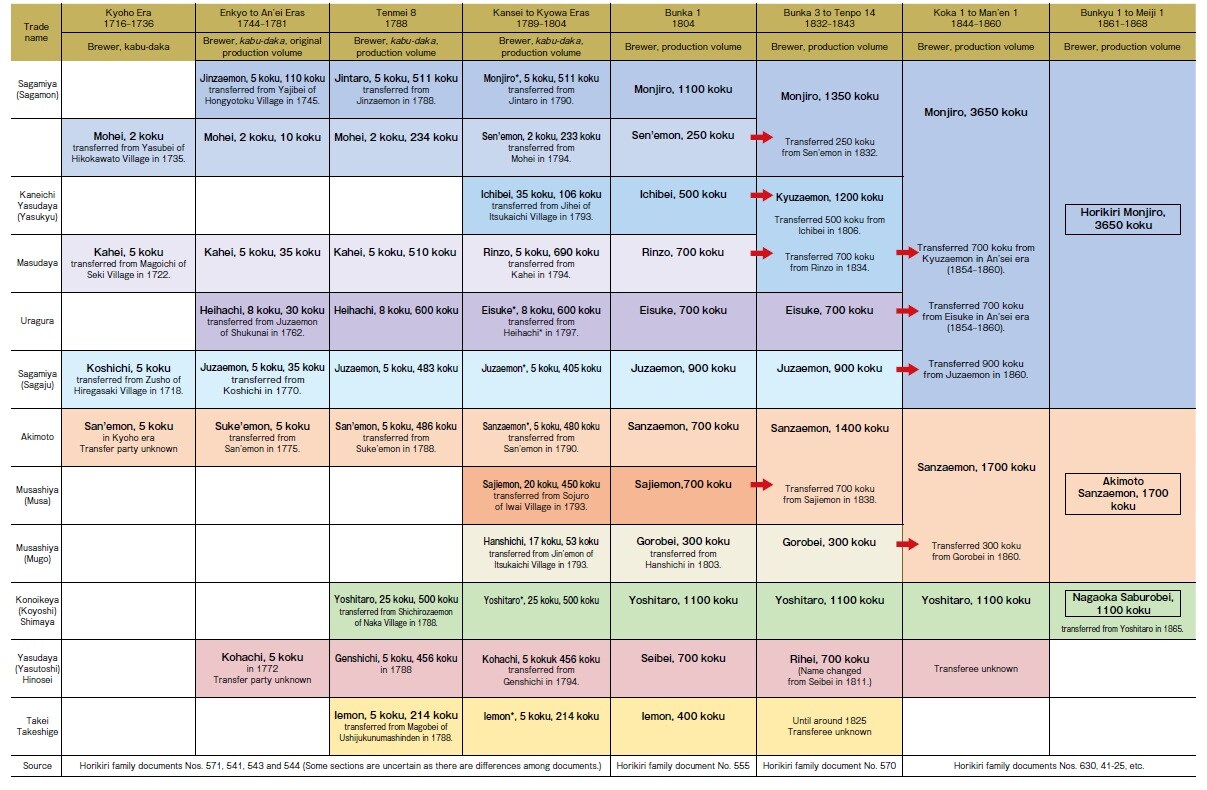
Start of the Horikiri Family Sake Brewing Business
There are several theories as to when the Horikiri family entered the sake brewing business: 1766, during the Tenmei era (1781–1789), and 1795. Most recently, the 1766 theory has been adopted, based on The 20 Year History of Noda Shoyu Co., Ltd. and other sources. Horikiri Family Document No. 7-1-5 Manjo Mirin no Enkaku (the History of Manjo Mirin), written by Monjiro VI around 1894, supports the 1766 theory by reporting, “My ancestor Horikiri Monjiro started the research and development of mirin in 1766.” A document supporting the Tenmei era theory is Nagareyama An’nai (Guide of Nagareyama), published by Shimizu Rinzo in 1916, which states, “Horikiri Monjiro and Akimoto Sanzaemon started their business 136 years back in history, that is, during the Tenmei era.” The 1795 theory is supported by Nagareyama, published by Horie Ginzan in 1909, which claims, “Horikiri Monjiro started the business in October 1795.”
As is inscribed on Monjiro I’s gravestone, the Horikiri family moved from the present-day Banshomen, Misato City, Saitama Prefecture in 1766, and founded Nagareyama Sagamiya. The 20 Year History of Noda Shoyu Co., Ltd. writes that they established a sake brewery and called it Sagamiya-gura, and regards 1766 as the inception of their sake brewing business. As stated earlier, Monjiro I was only 5 years old at this time, and therefore someone who was capable of brewing sake must have moved from Banshomen along with Monjiro.
The volume of sake production, for which the first year is assumed to be 1766, is unknown due to the absence of historical sources. Sometime thereafter, though, there is a historical document, Horikiri Family Document No. 22-36 Taru no Kayoi (Ledger of Barrels) of 1789, from which the sake production volume before mirin brewing commenced can be determined. Given that sake production started in 1766 and mirin brewing started in 1814, this document was written 23 years after the start of sake production and 25 years before that of mirin. This book was prepared by Yanoya Denzo, a barrelcontainer wholesaler in Reiganjima who had business with the first Monjiro. It has entries of quantities and amounts owed and paid for barrels, straw mats, and large and small sen that Monjiro purchased from October 1788 to December 1790.
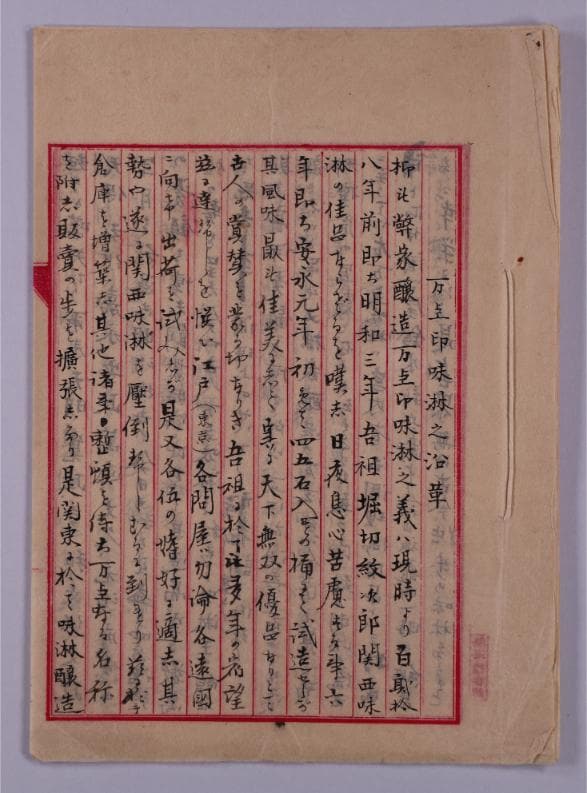
Accounting in the ledger was closed by the end of each calendar year. The brewer year ran from July 1 to June 30 of the following year. During the period from September 12, 1789 to April 11, 1790, purchases included 1,867 barrels and 760 straw mats, and 4,500 large and small sen (for what purpose we don’t know), totaling 102 ryo and 1 bu in the amount of money owed. Given that the barrels were 72-liter barrels and all purchased barrels were used, we can estimate that 746 koku and 5 to (134,370 liters) of sake was produced in 1789. Later, in 1836, Horikiri Family Document No. 576 Tenpo 7 Sarudoshi On’aratame Shinajina Shitagaki (1836 Year of the Monkey, Examined Items Draft) notes Kome 900 Koku Nari, Kono Oke-su 63 Bon Zukuri, Kono Da-su 1800 Da Nari (rice 900 koku [162,000 liters], brewed in 63 tanks, with 1,800 horse-loads of sake produced). According to this description, 1 koku 6 to (288 liters) of sake could be made from 1 koku (180 liters) of rice. Therefore, the rice volume used for sake production in 1789 could be assumed to be roughly 467 koku (84,060 liters). The following year, Horikiri Monjiro obtained sakekabu license with a shuzomai-daka rice limit at 511 koku 5 to (92,070 liters). It can be assumed that roughly the same scale of sake production had been carried out.
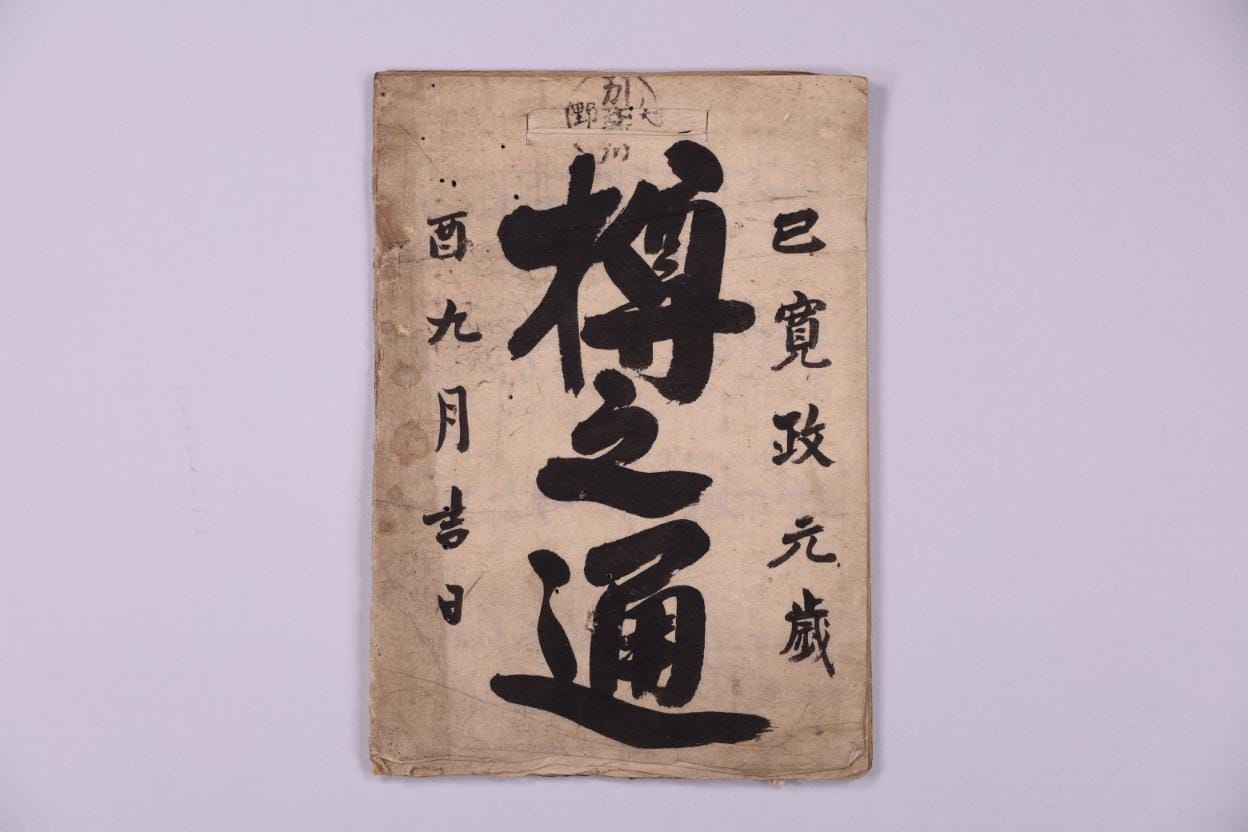
Start of the Mirin Brewing Business
There are several theories regarding the start of the mirin brewing business, with dates at 1772, 1773, 1802 (when the word “mirin” is first written in a Horikiri family document), and 1814. Currently, the 1814 theory is favored. Yet, none of these theories seem to have solid historical sources of support except for the 1802 theory.
In Manjo Mirin no Enkaku, mentioned in the previous section on the starting year of sake brewing, the 1772 theory is described as: “A trial production was conducted using a 45 koku (8,100 liters) capacity tank for the first time in the year of 1772.” The 1773 theory is based on Dainihon Chimei Jisho (Japan Geographical Dictionary) authored by Yoshida Togo in 1903. It says “Monjiro from Nagareyama has endeavored for years to produce excellent mirin and succeeded in 1773.”
The 1802 theory is based on the word “mirin” appearing on the back cover of Horikiri Family Document No. 547- 1, Shuzo Taru-su Kakiage-cho (Sake Production Barrel Quantity Survey Report). The reason the 1814 theory is favored today is the description in The 20 Year History of Noda Shoyu Co., Ltd. that reads, “Monjiro II (childhood name Inomatsu) made a trial production of shiro mirinshu with support from the Takanashi family in Noda at age 27, and started its sale in 1814.”
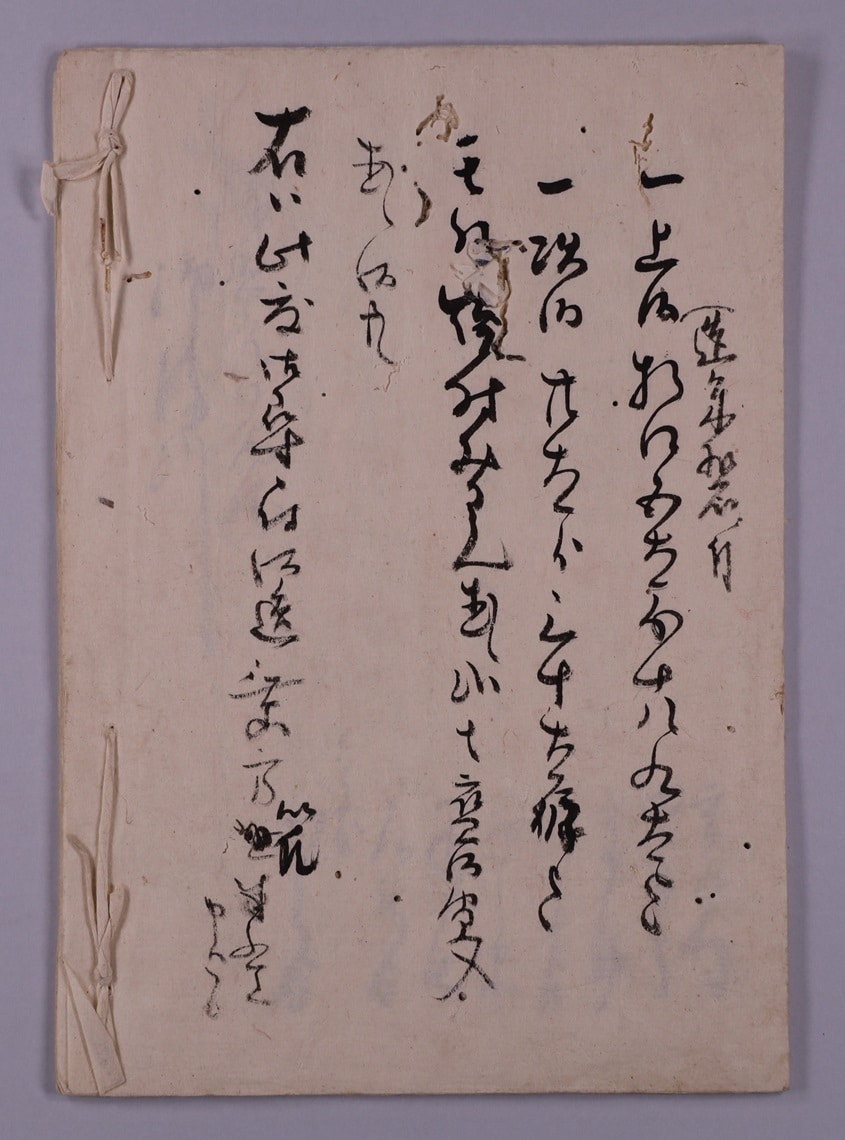
It was probably after the Bunka era (1804–18) when mirin brewing started, and then, in the course of time, the family’s main business shifted from sake production to mirin brewing. It was after the Kanto gomen joshu production policy (in which Monjiro participated) that resulted in failure. There are several Horikiri family documents titled Shuzo Kiroku (sake production record), and also accounting books named Tsuketate-cho and Tanakanjo-cho prepared annually. Yet, the only two historical sources from the Bunka era known to exist are Horikiri Family Document No. 37-32 Tsuketate no Oboe (Note of Tsuketake Accounts) of 1813 and No. 18-4 Tanakanjo Motocho of 1816. Therefore, it is difficult to pinpoint the exact year mirin brewing started.
Notwithstanding the lack of historical sources, the word “mirin” can be found for the first time in the section “Bunsei 1 Nen Tora no Shuzo Tanakanjo (1818 the Year of the Tiger, Sake Production Tanakanjo) in the Tanakanjo Motocho ledger, which has records of accounts and others from 1816 to 1848. In earlier records, Tsuketate no Oboe of 1813 and the 1816 and 1817 sections in the Tanakanjo Motocho, there are no descriptions of mirin to be found.
In the above referenced 1818 section in the Tanakanjo Motocho ledger, there is writing in red, “Konotoshi Yori Mirin Zukuri Hajime” (Mirin production starts this year), that can be confirmed as a description of mirin. From this description, we may posit that mirin brewing started in that year. Another word, “Mirin Kosen,*” can be seen in 1818. In the following year, 1819, descriptions of “Jo-shochu 36 Koku Mirin Jikomi” (High-quality shochu, 36 koku, Mirin preparation) and “Mirin Kosen” have been spotted. In 1820, there are entries, “Mi no Aki Mirin Kosen” (Autumn in the Year of the Snake, Mirin commission) and “Uma no Haru Mirin Kosen” (Spring in the Year of the Horse, Mirin commission). Other similar entries can be found in 1821 and 1822. After 1823, there are entries in the section of sales, such as Hitotsu Onajiku 36 Ryo 2 Bu to 10 Monme Nari Mirin 400 Da Hodo, (1. 36 ryo 2 bu and 10 monme (a price), Mirin roughly 400 horse-loads), by which we can estimate that a large volume of mirin was sold.
At any rate, continued study will be needed to conclusively pin down the first year of mirin brewing based on various historical sources in the future.
※ Kosen generally refers to commission or brokerage in the modern age.
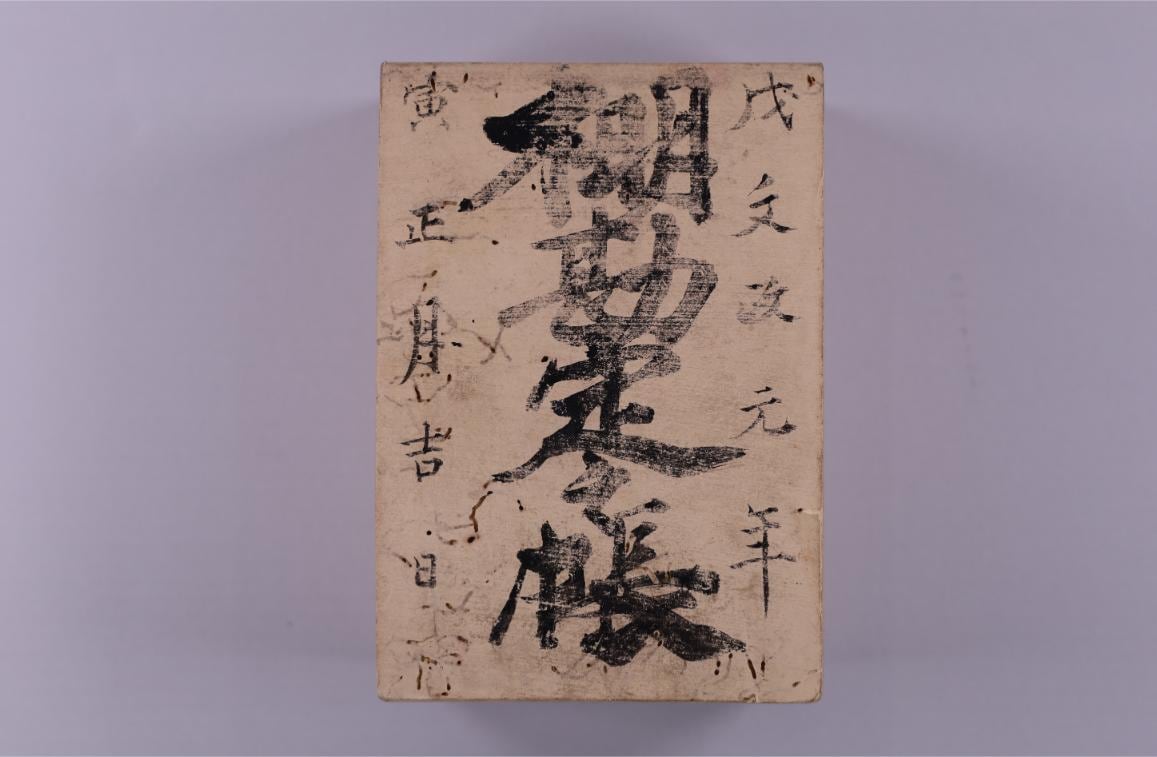
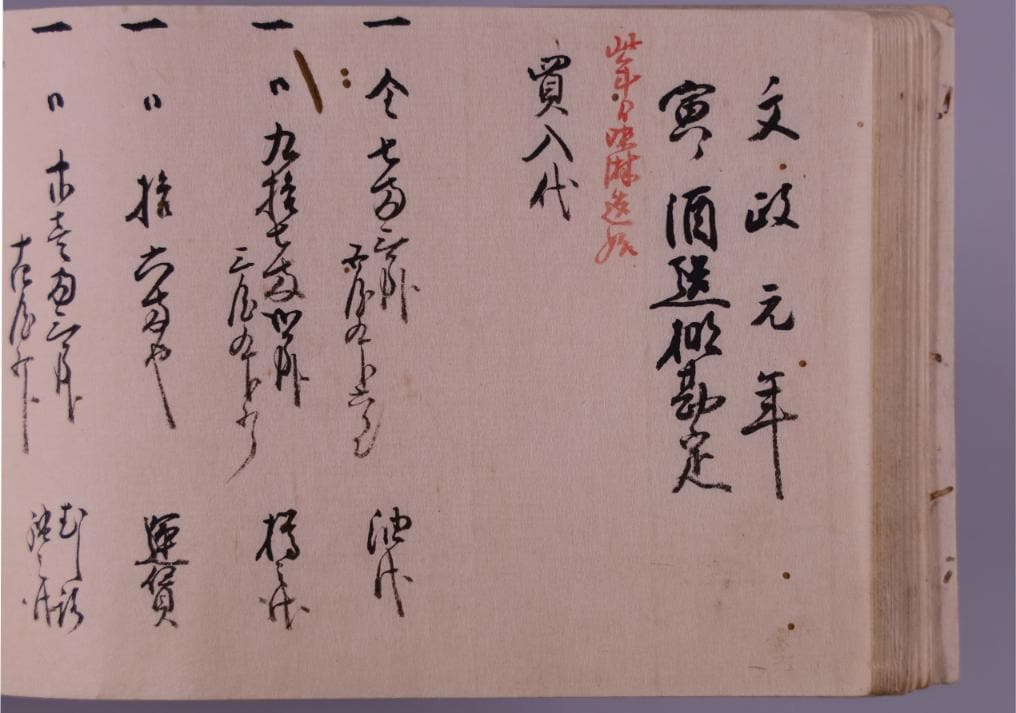
Birth of the Manjo Mark
Of the several varieties of mirin brewed by the Horikiri Monjiro family, the representative product is Manjo mirin. Regarding the origin of the Manjo mark, Noda Shoyu Kabushiki Kaisha Sanjugonen-shi (The 35 Year History of Noda Shoyu Co., Ltd.) states that “as Nagareyama mirin-shu was praised as an Edo specialty and finally got to be used by the Imperial Court,” Monjiro II composed the following two tanka poems to express how proud he felt of such an honor:
おもいきやかもす味淋をかくまでにかしこき方にめさるべしとは 関東の誉れはこれぞ一力で上なき味淋醸すさがみや
The book further states that, as the trademark of mirin was to be decided, the name Manjo mirin was selected based on the above tanka. Yet, the exact year the use of the Manjo mark started cannot be gleaned from The 35 Year History of Noda Shoyu Co., Ltd. As such, other historical sources will be referred to in this section when examining when the Manjo mark was first used.
It was either 1814 or 1818 when Monjiro II put mirin on the market. So far, the oldest article on which the Manjo mark has been confirmed is a label from 1846 housed in the Nagareyama City Museum. It was found in the storehouse of an established family in Miwanoyama Village, just north of Nagareyama Village. It reads “Kisei Mirin Hokuso Nagareyama Sagamiya Monjiro” (Proprietary brewing method, Mirin, Nagareyama in the Shimousa Province, Sagamiya Monjiro), “Kanto Jomirin Ganso” (Originator of Kanto Premium Mirin), and “Koka San’nen Kaikoku” (Label revised in 1846), as well as having “Manjosen” written in red. Further, Horikiri Family Document No. 224 “Hand-drawn Samples of Sake, Mirin, and Hon’naoshi Seal Marks” of 1852 (introduced earlier) has an entry of “Manjo, Brewed by the Originator of Kanto Premium Mirin, Sagamiya Monjiro. The Best in Edo. Large Barrel,” with “Hisei Jo-Mirin” (Secret Brewing Method, Premium Mirin) written in red.
How far can we go back to see the birth of the Manjo mark? In the 1834 section of Horikiri Family Document No. 18-4 Tanakanjo Motocho ledger, in which tsuketake accounts were entered from 1816 to 1848, we can find the word “Manjo” for the first time in “Mi no Aki Shikomi no Bun Hitotsu Manjo Jirushi Mirin 5 Da Orihiki-bun” (For preparation in autumn in the Year of the Snake, 1. Manjomark mirin 5 horse-loads, Orihiki-bun). In the section of “Tenpo 8 Tori-doshi Shichi-gatsu Tsuketatesho” (July 1837 the Year of the Rooster, Tsuketatesho), there are entries of “Yamayama Jirushi Mirin 22 Da Daikin 132 Ryo Nari” (Yamayama-mark mirin, 22 horse-loads [2,772 liters], price 132 ryo) and “Manjo Jirushi 26 Da Katauma, Daikin 185 Ryo 2 Bu” (Manjo-mark 26 and a half horse-loads [3,339 liters], price 185 ryo 2 bu). From the above descriptions found in the historical sources, it can be understood that the Manjo mark was in use from 1834, and thereafter, several mirin marks, including “Manjo” and “Yamayama,” were used in developing the mirin brewing business.
During the Tenpo era (1831–45), of the shuzomai-daka (rice volume used for sake production) of the Horikiri family, mirin-producing rice volume exceeded 50%. It was probably around this time when Nagareyama mirin came to be widely known in Edo, Kyoto and Osaka.
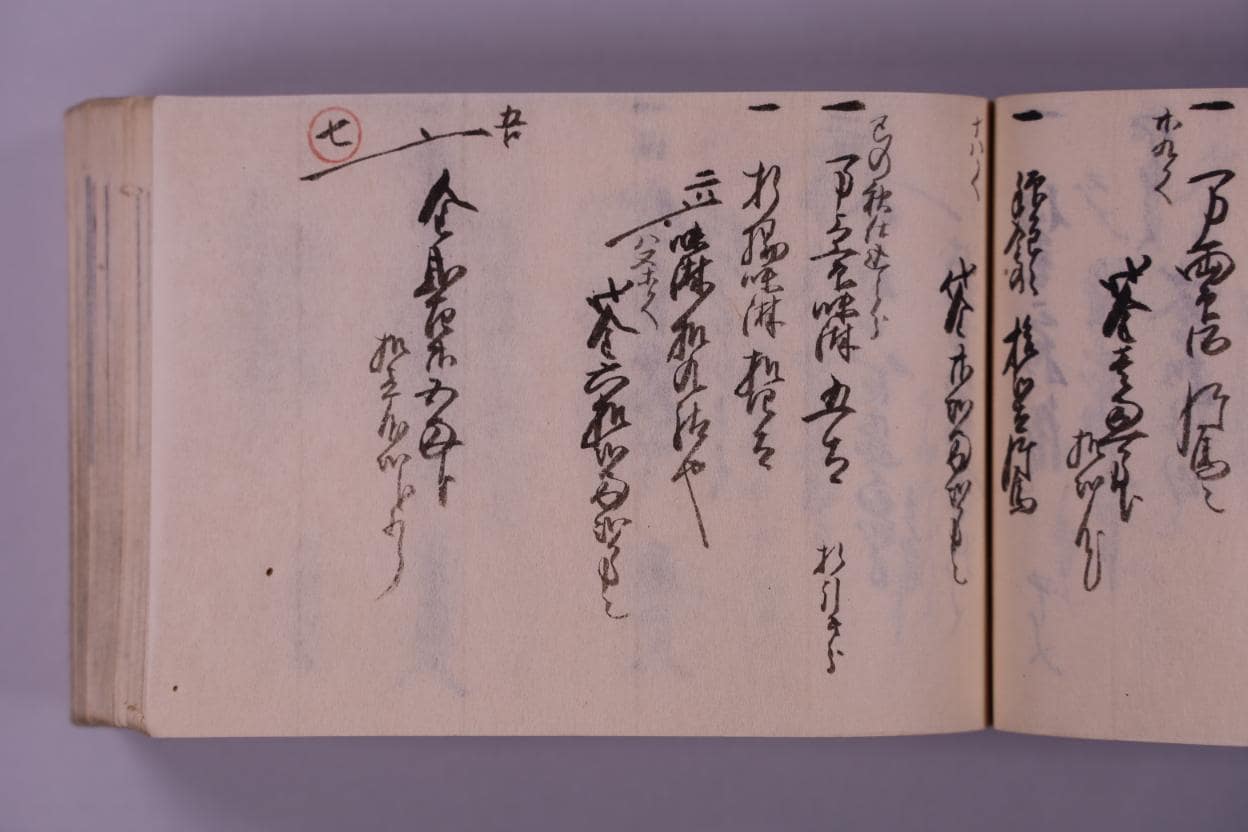
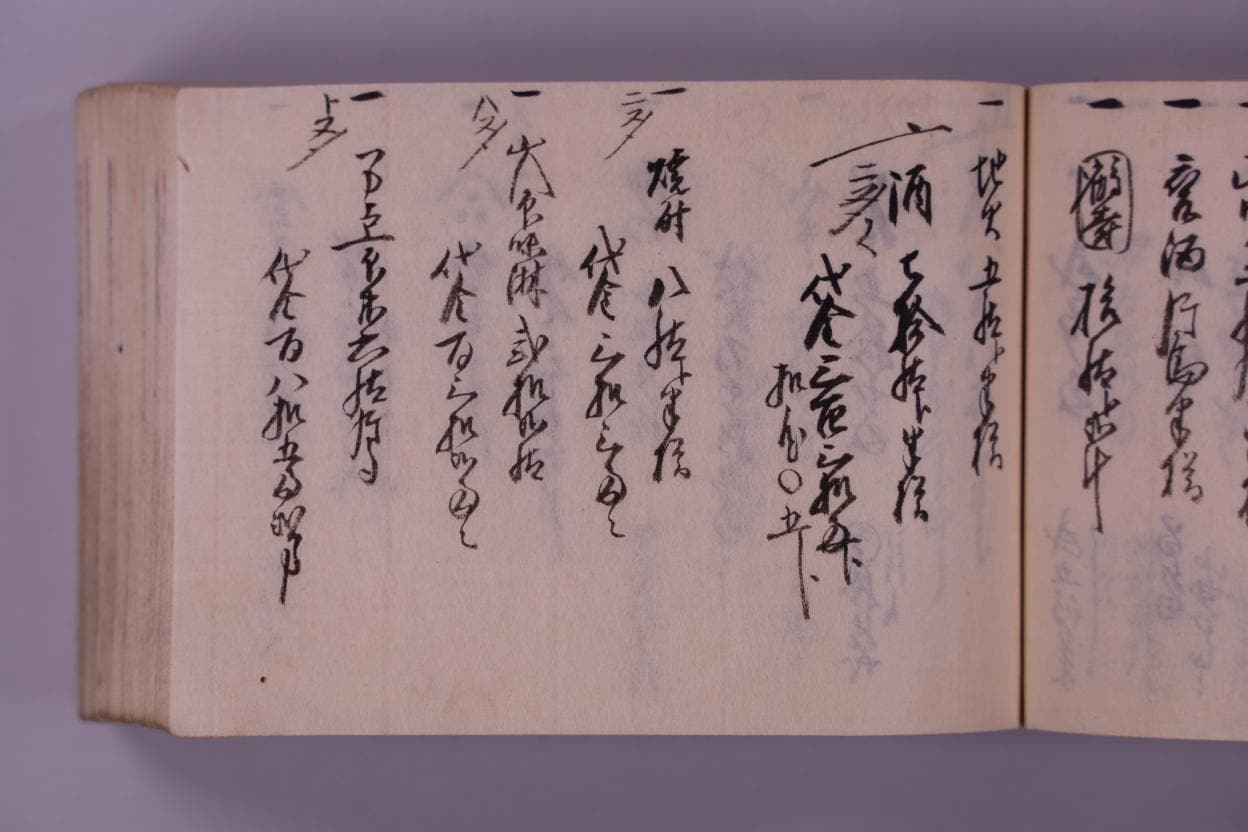
Sales Network of Manjo Mirin
Manjo mirin was put on the market in the beginning of the 19th century. By what sort of sales network was it brought to Edo? The names of the wholesalers and other descriptions written in the Kanjo-cho accounting books of the Horikiri family documents introduced earlier will give us some clues.
In the early years of 1813 and 1824, there were the written names of customers, namely Tamagawaya Toemon of Yushima-Yokocho, Tamagawaya Chozaemon of Kanda-Hatagocho 1-chome, Uchidaya Iemon of HonjoMotomachi, Uchidaya Seiemon of Yushima-Yokocho, and Yanoya Denbei and Yanoya Yasujiro of ReiganjimaYokkaichicho. They all were soy sauce and vinegar wholesalers among the Tokumi Don’ya.* Although the transaction details are unknown, sake was likely the main part of their business. During the Tenpo era (1830–44), when mirin brewing picked up, new transactions started with buyers including Ozawaya Tetsugoro of MinamiKayabacho, Sanagiya Shobei of Minamishinbori 1-chome, Iseya Tarobei of Higashi-Minatocho 1-chome, and Takasakiya Choemon of Koamicho 3-chome, showing active business with Edo wholesalers. From 1845 to 1867, business started with buyers including Ejimaya Yaemon of Minami-Kayabacho, Ichiki of Kanda-Hatagocho, Yamamoto Choemon and Omiya Taemon of Reiganjima-Shiroganecho, Nuriya Hikokichi of MinamiShinbori 1-chome, and Iseya Seibei of Kanzaemon-Yashiki. The business logo of Sagamiya of the Horikiri family reads “Kaneka.” Here, let’s look closely at Yanoya, who shared the same business logo. The 35 Year History of Noda Shoyu Co., Ltd. shows, among the genealogy of the Horikiri family, that Bunjiro, the first son of Uemon, was engaged in farming in present-day Togasaki, Misato City, Saitama Prefecture, that the second son Seizaemon began brewing sake and miso in Banshomen, Misato City in the Kyoho era (1716–36), and that the third son Tobei opened a sake shop in Edo Kan’emon (Kanzaemon) Yashiki, also in the Kyoho era, and changed the trade name to Sagamiya. Tobei later changed his family name to Yano. The second son Seizaemon was the first Horikiri Asaemon. The Horikiri Asaemon family was the head family of the Horikiri family in Nagareyama (as described earlier).
Regarding Tobei, who is said to have opened the Sagamiya sake shop during the Kyoho era, his name can be found as “Sukiyabashi, Yanoya Tobei, 1813, Soy Sauce and Vinegar Wholesaler” in the Comprehensive Data List of Edo Merchant Families and Merchants. However, as the business locations are different, we cannot confirm whether he and Yanoya Tobei of Kanzaemon Yashiki were the same person. Later, in 1824, Edo Kaimono Hitori An’nai (Solitary Guide to Shopping in Edo) had a description that read, “Tokumi Shoyu Su Don’ya Kanzaemon Yashiki Yanoya Tobei” (Tokumi Soy Sauce and Vinegar Wholesaler, Yanoya Tobei of Kanzaemon Yashiki), for which the business logo was also Kaneka. Although the generations might have changed, it was most likely a wholesaler that Horikiri Tobei had established.
It is believed that Horikiri Tobei, who established a sake store called Sagamiya during the Kyoho era, joined Yanoya at some point and came to operate a soy sauce and vinegar wholesale business under the name Yanoya Tobei. Yanoya Denbei and Yanoya Yasujiro, who had business with Horikiri Monjiro from early on, also used the same business logo of Kaneka. We know that Yanoya and the Horikiri Asaemon family were relatives because of a mention in Horikiri-ke Kako Reibo (Horikiri family register of deaths) owned by the Horikiri Asaemon family. Besides those mentioned above, the Yanoya family also had Yanoya Shobei and Yanoya Gihei, who had business with Horikiri Monjiro.
Horikiri Family Document No. 10-289 Sashiire Mosu Nenpu Shomon no Koto (pledged yearly installments signed deed) tells us that Yanoya Denbei and Yasujiro, as relatives, acted as guardians for Shobei. Thus, it is understood that the Horikiri Asaemon family, Yanoya Denbei family, Yanoya Yasujiro family, Yanoya Shobei family and Yanoya Gihei family were all related. As to the relationship between the Horikiri Monjiro family, Horikiri Asaemon family and Yanoya Tobei family, Saikatsu no Sake Bunka (Sake Culture in the Saikatsu Area) mentions that it is assumed the Horikiri family already had their network established within the family, from material production to brewing and selling, including farming, sake brewing, shochu brewing, mirin brewing, and distributors in Edo.
According to Horikiri Family Document No. 22-36 Taru no Kayoi (Ledger of Barrels) of 1789, a document from before the family started brewing mirin, Monjiro I purchased sake barrels from Yanoya Denzo. Yanoya Denzo was one of the barrel container wholesalers among Tokumi Don’ya, with a store set up in Reiganjimacho, and he also used the same business logo of Kaneka as Yanoya and Sagamiya. Therefore, Yanoya Denzo might also have been a part of the family. Aside from what was indicated in Saikatsu no Sake Bunka, it can be understood that the family network, including the ensured procurement of barrels indispensable to the brewing business, had already been established before Monjiro II started selling mirin. When it was put on the market, the mirin was most likely sold through this network that included Yanoya.
※Tokumi Don’ya or Tokumi Doiya was a federation of wholesalers’ associations, each organized by wholesalers of the same trade, formed in Edo.
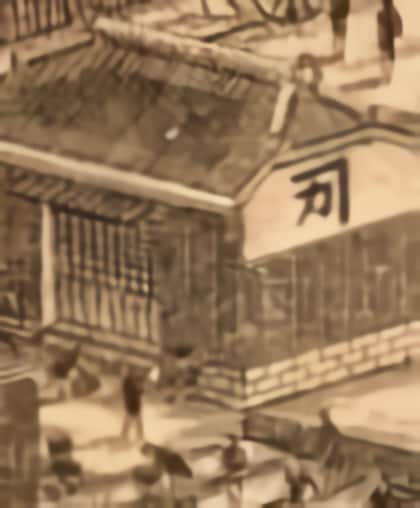
Author’s Comment
In this issue, I introduced some of the Horikiri family documents housed in the KIIFC and explained the reason and the timing of the start of the Manjo mirin brewing business, as well as the sales network and other details.
The Horikiri family documents contain more than 11,000 items and are valuable historical sources from which we can obtain a real picture of the sake production industry in Kanto, constituting the Edo jimawari (Edo and surrounding area) economic zone, and understand the development of the mirin brewing industry, the traditional industry of Nagareyama. I hope these documents will be utilized by many researchers and serve the further progress of this study.
- Noda Shoyu Kabushiki Kaisha Nijunen-shi (The 20 Year History of Noda Shoyu Co., Ltd.), Noda Shoyu Co., Ltd., 1940
- Noda Shoyu Kabushiki Kaisha Sanjugonen-shi (The 35 Year History of Noda Shoyu Co., Ltd.), Noda Shoyu Co., Ltd., 1955
- Saikatsu no Sake Bunka (Sake Culture in the Saikatsu Area), Group of Persons in Charge of Cultural Property in Saikatsu Area, 2005
- Kinsei Shuzo-gyo to Kanto Gomen Joshu no Tenkai (Development of EarlyModern-Age Sake Brewing Industry and Kanto Gomen Joshu), Rissho University Research Society of Paleography, 2002
- Horino Shuhei, 2014, Chokkatsu-ken Kencho Shozaichi no Kino (Functions of Prefectural Capital of Government-controlled Prefecture), Study on History of Nagareyama City No. 22, Nagareyama City Board of Education
- Matsumoto Noriko, 2015, Edo-jidai no Shuzo-gyo (Sake Brewing Industry in the Edo Period), Narashien No. 60, The Historical Association of Nara Women’s University
- Narazaki Muneshige, 1998, Hokusai-ron (Views on Hokusai), Sumida Hokusai Kenkyu Sosho 1, Sumida Ward Cultural Foundation
Asaba Aoi and Shiihashi Yuto
Curator at the Kikkoman Institute for International Food Culture