Use of Soy Sauce in the Edo Period as Shown by Genten Gendaigoyaku Nihon Ryori Hiden Shusei
Use of Soy Sauce in the Edo Period as Shown by Genten Gendaigoyaku Nihon Ryori Hiden Shusei
1.Introduction
Soy sauce is indispensable to Japanese cuisine. It has been said that its prototype, kokubishio (grain-based hishio, fermented seasoning), was originally brought over from China. The word “hishio” can be seen on a wood panel thought to date back to the Asuka Period (592–710). In the Nara Period (710–794), Daizenshiki, the bureau responsible for cooking and serving food at the imperial court, was established and included a section in charge of making hishio and ancestral miso (fermented soybean paste). During the Heian Period (794–1185), varieties of hishio appear to have increased to include liquid versions. In the formal banquet cuisine*1 of aristocrats, hishio was included among the four seasonings, next to salt, vinegar, and sake, served to each guest to allow them to season their own food. During the late Heian Period and into the Kamakura Period (1185–1333), due to the rise of samurai warriors, hishio production declined and miso came to be mainly used for its convenience of being easily carried in its solid form. Miso was used as namemiso (miso mixed with some other food) and in miso soup. In the Muromachi Period (1336–1573), irizake*2 emerged, as well as miso-based seasonings such as namadare, taremiso and ninuki, *3 which were similar in use to present-day soy sauce. When the Edo Period (1603–1868) began, the government stability achieved by the Tokugawa shogunate allowed the soy sauce industry spread nationwide. Around this time, soy sauce production began in Noda as well as Choshi in the Boso Peninsula (where soy sauce craftsmen from Yuasa in present-day Wakayama Prefecture moved). Jimawari (locally produced) soy sauce flourished in the Kanto region, and this likely led to the various seasonings noted above being replaced by soy sauce. During the Edo Period, urban culture blossomed and numerous cookbooks were published. In this article, we look at the transition of how soy sauce was used in food preparation during the Edo Period, based on Genten Gendaigoyaku Nihon Ryori Hiden Shusei (19 volumes of the Corpus of Japanese Cuisine Secrets: translation of original into modern Japanese). Details of data compiled for analysis and comparisons between the chronological divisions of historical eras will also be examined.
- ※1Banquet cuisine was developed as a social courtesy among the aristocrats in a society governed by court nobles. The emphasis in cuisine was placed on how aesthetically food was cut, assorted, and presented. Dishes were served unseasoned, and guests helped themselves to seasonings of salt, vinegar, sake, and hishio, served in four individual containers.
- ※2Liquid obtained by filtering a mixture of sake, umeboshi (pickled Japanese apricot), and dried bonito shavings, to which tamari was sometimes added.
- ※3Namadare: Liquid obtained by collecting drippings from a cloth sack containing a mixture of roughly one part miso and three parts water. Taremiso: Liquid collected in the same manner as above from a sack containing a boiled-down mixture of miso and water. Ninuki : Liquid prepared by boiling dried bonito in namadare.
2.Method of Study
Genten Gendaigoyaku Nihon Ryori Hiden Shusei is a collection of 49 cookbooks spanning roughly 220 years, from Ryori Monogatari (A Story of Cooking, 1643) published in the early Edo Period to Shinpen Ikoku Ryori (New Edition Foreign Dishes, 1861). Of these cookbooks, we analyzed the 44 books in which seasonings are mentioned (Table 1). Next, assuming that soy sauce would have replaced other seasonings, 3,046 recipes using soy sauce, miso, vinegar, irizake, and/or tamari were extracted. As soy sauce and miso are noted under many different names and varieties, the details of seasonings extracted from the books are shown in Table 2.
Table 1 Genten Gendaigoyaku Nihon Ryori Hiden Shusei (19 volumes)Early period
| 1643 | Ryori Monogatari | Edo |
| 1674 | Edo Ryori-shu | Edo |
| 1689 | Gorui Nichiyo Ryori-sho | Kyoto |
| 1697 | Wakan Shojin Ryori-sho | Osaka |
| 1714 | Toryu Setsuyo Ryori Taizen | Osaka |
Middle period
| 1728 | Ryori Komoku Chomi-sho | Edo |
| 1745 | Den Enmigen-shu | Unknown |
| 1750 | Ryori Sankaikyo | Kyoto |
| 1759 | Hassentaku Enshiki-ki | Nagasaki |
| 1764 | Ryori Chinmi-shu | Kyoto |
| 1769 | Ogasawara Isokairyu Ryori Hyakkajo Shikakemono Densho | Unknown |
| 1771 | Shinsen Kaiseki Shippoku Shuko-cho | Edo |
| 1772 | Fucha Ryori-sho | Kyoto |
| 1773 | Ryori Irohabocho | Edo |
| 1771~1792(1) | Ryori Hidenki | Edo |
| 1781 | Tofu Hyakuchin | Osaka |
| 1783 | Tofu Hyakuchin Zokuhen | Osaka |
| 1784 | Tofu Hyakuchin Yoroku | Osaka |
| 1784 | Shippokushiki | Kyoto |
| 1785 | Manbo Ryori Himitsubako Zenpen | Kyoto |
| 1785 | Manbo Ryori Kondateshu Jokan | Kyoto |
| 1785 | Shincho Ryori Yuchin Himitsubako | Kyoto |
| 1785 | Daikon Isshiki Ryori Himitsubako | Kyoto |
| 1785 | Shokoku Meisan Daikon Ryori Hidensho | Kyoto |
| 1785 | Tai Hyakuchin Ryori Himitsubako | Kyoto |
| 1789 | Imo Hyakuchin | Kyoto |
| 1795 | Hamu Hyakuchin | Kyoto |
| 1800 | Manbo Ryori Himitsubako Nihen | Edo |
Late period
| 1801 | Ryori Hayashinan Shohen | Edo |
| 1801 | Ryori Hayashinan Nihen | Edo |
| 1802 | Ryori Hayashinan Sanpen | Edo |
| 1802 | Meshi Hyakuchin | Osaka |
| 1803 | Shirotobocho Shohen | Osaka |
| 1805 | Shirotobocho Nihen | Osaka |
| 1805 | Ryori Hayashinan Shihen | Edo |
| 1806 | Ryori Kanbenshu | Osaka |
| 1818 | Gohonshiki Ryori Shimuke | Sendai |
| 1819 | Shojin Kondate-shu | Kyoto |
| 1820 | Shirotobocho Sanpen | Osaka |
| 1822 | Edo Ryuko Ryoritsu Shohen | Edo |
| 1825 | Edo Ryuko Ryoritsu Nihen | Edo |
| 1826 | Edo Ryuko Ryoritsu Sanpen | Edo |
| 1832 | Geiniku Chomi-kata | Edo |
| 1835 | Edo Ryuko Ryoritsu Shihen | Edo |
| 1846 | Konnyaku Hyakuchin | Osaka |
| 1846(2) | Mizu Ryori Yakikata Tamagozaiku | Unknown |
| 1861 | Shinpen Ikoku Ryori | Edo |
Unknown
| Unknown | Soke Ryoritsu | Unknown |
| Unknown(3) | Nanban ryorisho | Unknown |
- 1The year Ryori Hiden-k i was published has not been established.
“Detailed research by Kozo Kawakami has been reported, in which he estimated the year of publication would be from around 1771 to around 1792.”
Quoted from the commentary on p. 243 of Genten Gendaigoyaku Nihon Ryori Hiden Shusei Vol . 4. - 2It is not clear whether 1846 refers to the year the author completed writing Mizu Ryori Yakikata Tamagozaiku or the year it was submitted by the author.
- 3It would be reasonable to think that Nanban Ryorisho was published around the time of the isolation policy of the Tokugawa shogunate.
Table 2 Seasonings noted in cookbooks
| Soy sauce (reads shoyu or sometimes joyu in Japanese) | Shoyu, usui shoyu, usujoyu, usukuchi (light-colored) shoyu, terijoyu, kijoyu, namani shoyu, nama no nikaeshijoyu, nikaeshijoyu, sumashi, katsuo no dashijoyu (soy sauce with bonito broth), dashijoyu (soy sauce with broth), dashijiru no shoyu, sato joyu (soy sauce with sugar), karashi joyu (soy sauce with mustard), togarashi joyu (soy sauce with chili pepper), kosho joyu, shoga joyu (soy sauce with ginger), wasabi joyu, sansho joyu, goma joyu, kurumioroshi joyu, sanbaizu * |
| Miso | Miso, akamiso (red miso), shiromiso (white miso), koimiso (thick miso), misoshiru (miso soup), yakimiso (roasted miso), usumiso, nakamiso, wamiso (same as nakamiso), sashimiso, nukamiso (rice-bran paste), jindamiso (same as nukamiso), sansho miso (miso with grated sansho leaves), shoga miso (miso with ginger), wasabi miso (miso with wasabi), nerimiso (miso with sugar and sake), taremiso, misozu, akamiso no tamari, ao-zansho miso (miso with sansho’s green berries), ao-miso, ume miso, kasu miso, karashizu no akamiso, karamiso, kinome miso (miso with grated sansho leaves), kurumi miso (miso with walnuts), karashi miso, kosho miso, goma miso (miso with sesame seeds), kurogoma miso (miso with black sesame seeds), sato (sugar) miso, tade (smartweed) miso, chidori miso, nanban miso, fuki miso, fukusa miso, misokasu, yuzu miso, karashi sumiso (vinegared miso with mustard), karashi miso, togarashi miso (miso with chili pepper), mugikoji (barley koji) miso, surimiso, dengaku miso, horo miso, kakemiso, miso no ninuki, sumiso (vinegared miso), tadezu miso (vinegared miso with grated smartweed leaves), sunuta |
| Vinegar (reads su or sometimes zu in Japanese) | Su, shogazu (vinegar with ginger), misozu, aozu, irizu, umasu, karashizu (vinegar with mustard), karashizu no akamiso, karashizu, koshozu, komezu (rice vinegar), sanbaizu, shirozu (apricot vinegar), sushio, tadezu, wasabisu, awasezu, karashisumiso, sunuta, nikaeshizu, kuroryosu, kenchinzu, shogazu, shirogomazu (vinegar with white sesame seeds), yuzu no su (yuzu juice) |
| Irizake | Irizake, tamari irizake |
| Tamari | Tamari, dashi-tamari, akamiso no tamari |
Dishes were classified by cooking method, seasonings, and ingredients, and a database was created. Cooking methods were separated into 13 classifications: sashimi, ae-mono & namasu (dressed), dried, boiled and soaked in sauce, pickled, soup,boiled, steamed, roasted, simmered, deep fried, kneaded, and rice. Ingredients were classified as vegetables, meat, fish & shellfish, cereals, or soybean products. With the passage of time, the characteristics of the cookbooks change and the proportions of seasonings vary. Because of this, the study was divided into three time periods for analysis. As advised by Mr. Ryoichi Iino, the periods were defined as the early period from 1603, when Tokugawa shogunate was established, to 1715, which was before the Kyoho Reforms; the middle period from 1716, when the Kyoho Reforms began, to 1800; and the late period from 1801 to 1867, when governing power was returned to the emperor.
3.Seasonings Used in Ryori Monogatari
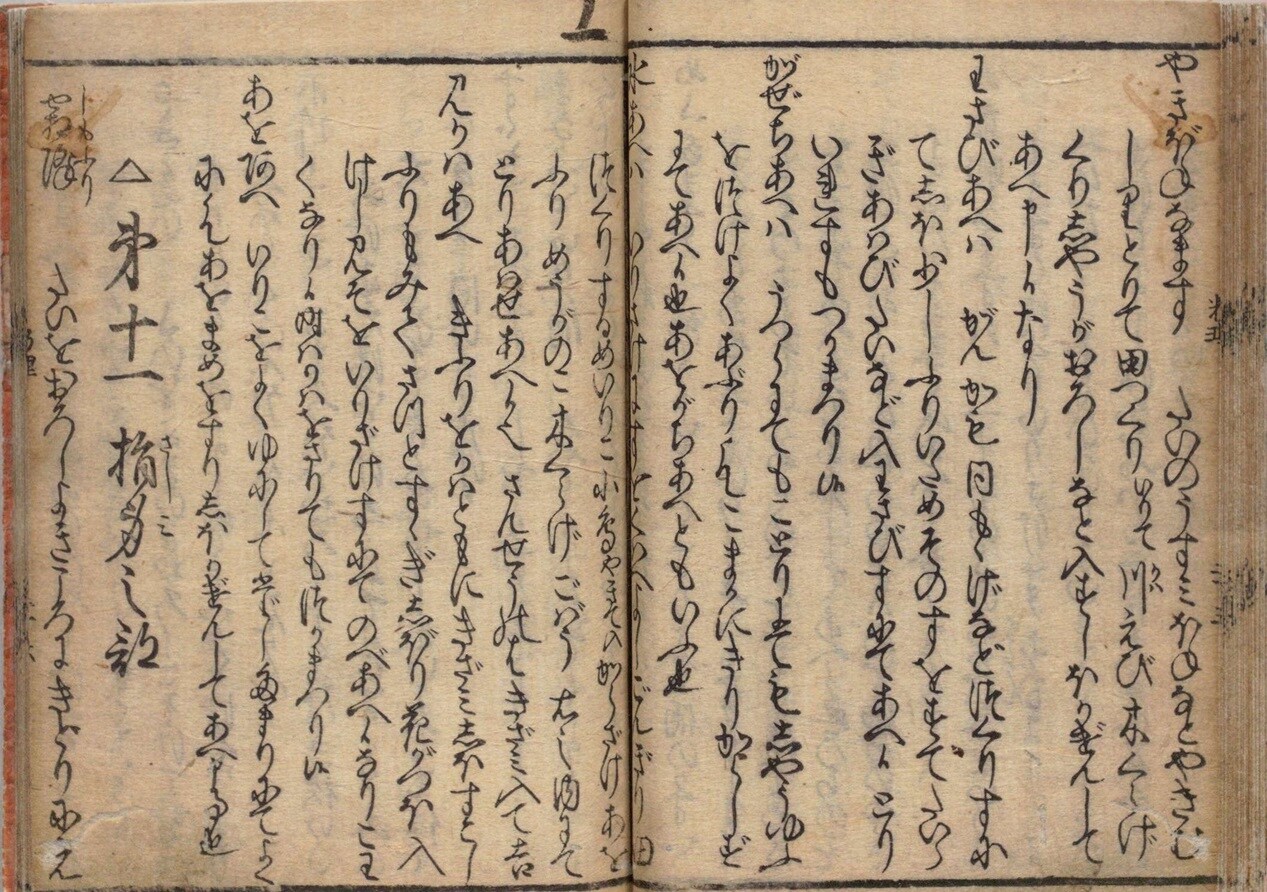
Source: National Archives of Japan Digital Archive
To start with, the seasonings used in Ryori Monogatari, representing the early Edo Period, were analyzed. Published in 1643, this was the first cookbook that did not cover the menus and manners of ceremonial cuisine, but instead described the ingredients and seasonings used in detail.
Of the 260 dishes introduced in Ryori Monogatari, soy sauce was used in only 12 (4.6%), indicating that soy sauce was not at all the staple of Japanese cooking that it is today. The dishes that used soy sauce included five dressed dishes, one pickled dish, three roasted dishes, and three simmered dishes. Photo 1 is the first recipe in which soy sauce is mentioned in Ryori Monogatari. The reproduction and modern-language translation are quoted from Genten Gendaigoyaku Nihon Ryori Hiden Shusei.
Modern translation: Gazechi-ae may use a quail or other small bird. Coat the meat with soy sauce and grill it well. After finely chopping it, dress it with vinegar with mustard. This dish is also called Aogachi-ae.
The preparation of this dish involves two steps, first coating the meat with soy sauce and then grilling it to bring out the palatability with the savory aroma of soy sauce, and thereafter dressing it with a vinegar with mustard sauce.
Ryori Monogatari also has the following description of how to make masaki soy sauce:
Roast and grind into flour one to (approx. 18 liters/to) of pearled barley and three sho (approx. 1.8 liters/sho) of pearled wheat. Boil one to of soybeans and mix it with barley and wheat flour. Cover the mixture with Japanese elder leaves and let it stand to prepare koji mold. When the koji has grown to maturity, let a mixture of four sho of koji and brine (eight sho of salt in two to of water) stand for 30 days.
The soy sauce recipe is purposely included in the cookbook, which suggests that soy sauce was not yet popularized. For dishes in which soy sauce was used, Table 3 shows how soy sauce was used in combination with other seasonings. The two dishes seasoned only with soy sauce were simmered abalone and simmered konjac.
| Cooking Method | Seasoning | Dishes |
|---|---|---|
| Dressed | Soy sauce + sake + vinegar with mustard Soy sauce + sake + vinegar Soy sauce + vinegar with mustard |
3 1 1 |
| Pickled | Soy sauce + vinegar | 1 |
| Roasted | Soy sauce + vinegar Soy sauce + sugar + mirin (sweet cooking rice wine) Soy sauce + sugar + mirin + sake |
1 1 1 |
| Simmered | Soy sauce + broth + sake Soy sauce only |
1 2 |
Irizake was used in 26 dishes (10%). Dishes using irizake included sashimi*4 (46%), and dressed dishes (38%) (Fig. 1). Ryori Monogatari describes 28 sashimi dishes, of which 11 use irizake, 9 use vinegar with ginger, and 3 use vinegar. It is therefore known that in the early Edo Period, sashimi was eaten not with soy sauce but with irizake or with vinegar and ginger.
- ※4Sashimi includes raw food dishes that are only topped with seasoning.
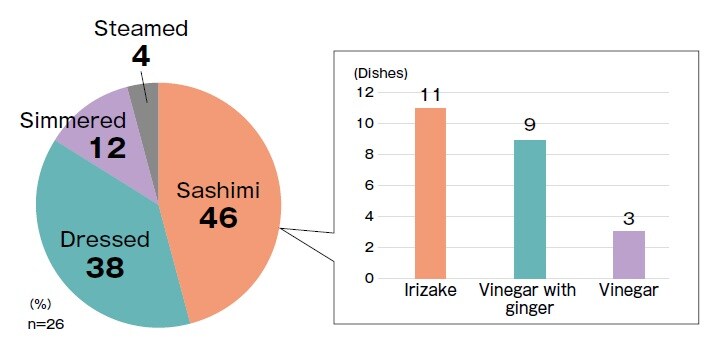
Dishes that used vinegar most were dressed dishes (45%), followed by simmered dishes (31%). Vinegar was used even in simmered dishes. 67% of the recipes using miso were soup dishes.
Cooking methods that frequently appear are (in descending order of frequency) soups, simmered dishes, and dressed dishes, with no appearance of deep-fried or kneaded dishes in the early Edo Period. Focusing on soups, simmered dishes, and dressed dishes that frequently appeared, we analyzed the ingredients and seasonings used.
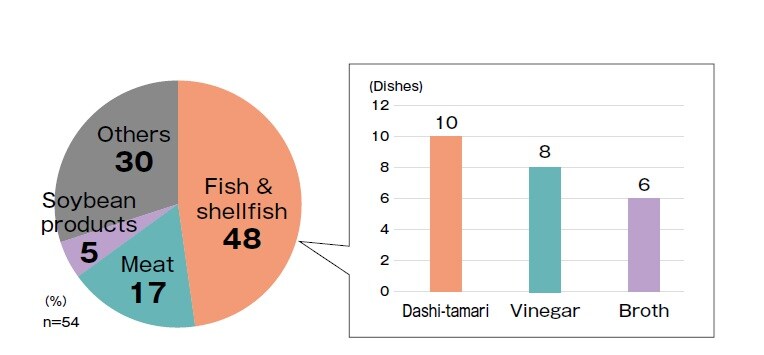
The ingredients most used in soups were vegetables and fish & shellfish (28%), followed by fish & shellfish only (23%) and vegetables and meat (16%). Miso and nakamiso were used in half of the vegetable and fish & shellfish soup dishes. Fish & shellfish accounted for 48% of simmered dishes (Fig. 2). Of the 29 simmered fish & shellfish dishes, the most-used seasoning was dashi-tamari (10 dishes), followed by vinegar (8 dishes) and broth (6 dishes). What dashi-tamari was like then is unknown at this point. Dishes using dashi-tamari were niae, sake no iriyaki (seasoned and roasted salmon), tai surugani (roasted and simmered sea bream), sakura iri (simmered round slices of octopus), tako no surugani (simmered octopus), and nibitashi (simmered vegetables or roasted and simmered fish).
The most-used ingredients for dressed dishes were found also among fish & shellfish dishes (53%). Of 39 dishes in this category, vinegar and salt were used in 10 dishes each, and irizake was used in 7 dishes.
Seasonings used in Ryori Monogatari were mainly irizake, salt, miso, and vinegar. Only 4.6% of the dishes used soy sauce, showing that the usage of soy sauce in cooking was marginal.
4.Comparison between periods in Genten Gendaigoyaku Nihon Ryori Hiden Shusei
Changes in the use of seasonings throughout the early, middle, and late periods were examined (Fig. 3). In the early period, miso was used most, followed by vinegar, soy sauce, irizake, and tamari in descending order. The use of soy sauce increased in the middle and late periods, while the use of irizake and tamari greatly declined. Cooking methods did not see many changes between the periods, with many dishes being roasted or simmered. Dressed dishes and soup dishes are often seen in the early period, though they decreased in number as the years approached the late period.
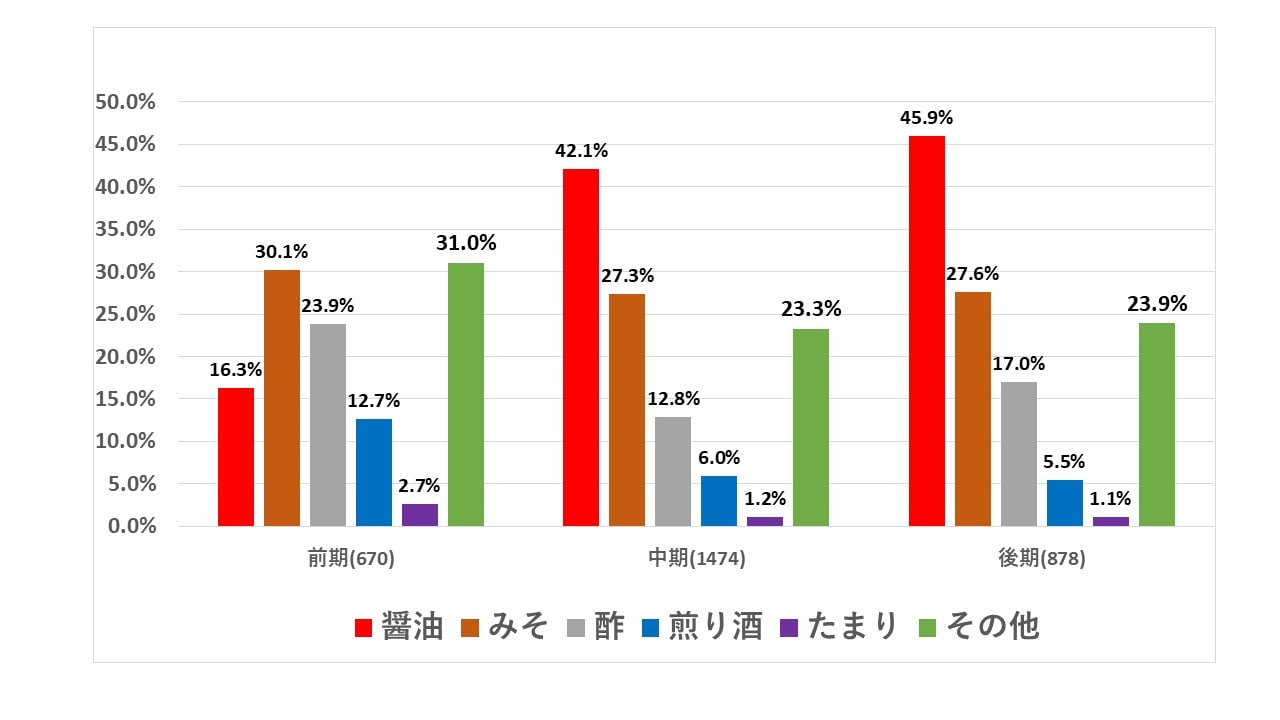
( ): Number of dishes
1)Comparison of Cooking Methods by Seasoning
i. Soy sauce
Soy sauce was often used in both roasted and simmered dishes. In the early and middle periods, sashimi dishes that used soy sauce were quite rare but became common in the late period (Table 4). The use of soy sauce in deep-fried dishes and rice dishes was prominent in the late period, especially as these cooking methods were rarely used in the early and middle periods. In the middle and late periods, a greater number of dishes used soy sauce and sake together.
| Sashimi | Dressed | Dried | Boiled and soaked in sauce | Pickled | Soup | Boiled | Steamed | Roasted | Simmered | Deep fried | Kneaded | Rice | |
|---|---|---|---|---|---|---|---|---|---|---|---|---|---|
| Early period 16.3% (109/670) |
0.9% (1) |
10.1% (11) |
0.0% (0) |
0.0% (0) |
2.8% (3) |
3.7% (4) |
3.7% (4) |
2.8% (3) |
27.5% (30) |
44.0% (48) |
4.6% (5) |
0.0% (0) |
0.0% (0) |
| Middle period 42.1% (621/1474) |
0.6% (4) |
4.3% (27) |
1.1% (7) |
1.1% (7) |
3.1% (19) |
6.6% (41) |
2.7% (17) |
6.1% (38) |
20.9% (130) |
41.7% (259) |
6.8% (42) |
0.2% (1) |
4.7% (29) |
| Late period 45.9% (403/878) |
7.7% (31) |
5.5% (22) |
1.7% (7) |
2.0% (8) |
0.5% (2) |
4.0% (16) |
5.7% (23) |
5.2% (21) |
20.6% (83) |
29.3% (118) |
10.9% (44) |
0.0% (0) |
6.9% (28) |
ii. Miso
The use of miso did not change much between the periods, as it was used in around 30% of dishes in all three periods. However, the way it was used changed over time. In the early period, it was used in soups at a high ratio of 34.7%, which declined to 18.4% in the middle period and further to 7.9% in the late period. On the other hand, the ratio of its use in simmered dishes slightly increased from 21.3% in the early period to 28.1% in the late period.
iii. Vinegar
Vinegar was not often used in sashimi in the middle period. It was used with 12.8% of the sashimi dishes in the early period, 5.3% in the middle period, and 18.4% in the late period. Its use in pickled dishes was highest in the middle period, with 5% in the early period, 15.5% in the middle period and 6.1% in the late period.
iv. Irizake
Dressed dishes showed the most significant changes in the use of irizake. It was used in 39.5% of these dishes in the early period but fell to 6.3% in the late period. Its use increased in deep-fried dishes in the late period, perhaps because deep-fried dishes emerged in the late period. In general, dishes using irizake decreased in the middle and late periods compared to the early period, and those using irizake in the late period note that soy sauce may be used. This suggests that either of these two seasonings could have been chosen, depending on personal preference.
v. Tamari
Tamari was used in simmered dishes and roasted dishes, though there were as few as 45 simmered dishes noted as using tamari across all three periods. The results of dividing the number of simmered dishes using tamari by the total number of such dishes showed that tamari was used most in the early period, in 9.7% (18/185 dishes) of the simmered dishes in the early period, 3.9% (17/434 dishes) in the middle period, and 4.3% (10/231 dishes) in the late period.
2)Comparison of Seasonings by Cooking Method
Analysis was conducted focusing on sashimi, simmered dishes, and dressed dishes.
i. Sashimi
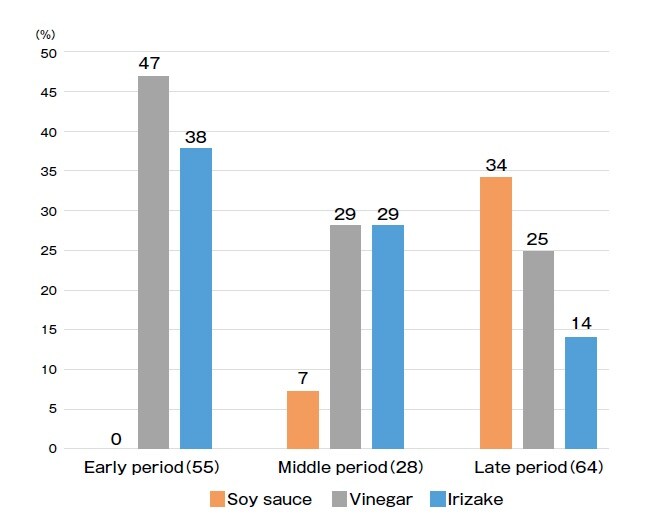
In the early period, fish & shellfish sashimi was eaten with vinegar and irizake, with no soy sauce (Fig. 4). The first sashimi dish using soy sauce was Sadoimo-jiru Tai, introduced in the middle period’s Tai Hyakuchin Ryori Himitsu-bako (One Hundred Delicacies with Sea Bream Box of Cooking Secrets), published in 1785. Slices of sea bream were dipped lightly in a sauce of grated yam mixed with soy sauce, sake, and broth and then served with a topping of grated yam. In the late period, the use of soy sauce increased to 34%, 80% of which was for whale meat sashimi dishes introduced in Geiniku Chomi-kata (Whale Meat Cookbook) published in 1832.
ii. Simmered dishes
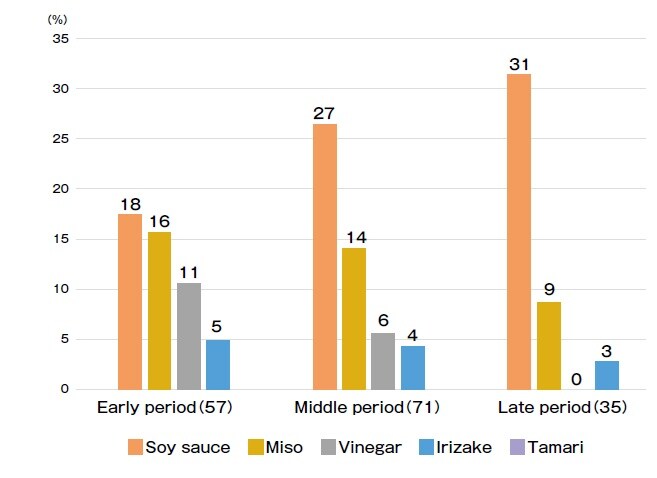
Only 7% of the simmered fish & shellfish dishes used soy sauce in the early period, though this increased to 25% in the middle period and 29% in the late period (Fig. 5). In the early period, salt, broth, and sake were used together with soy sauce, and it was characteristic for vinegar, miso, and irizake to be used more frequently than soy sauce.
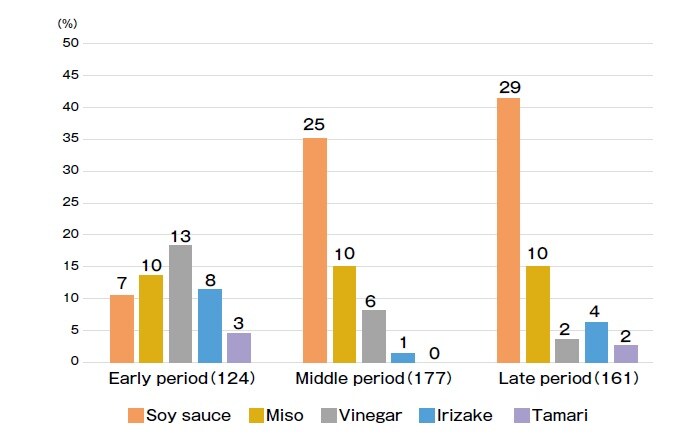
Clearly, for both simmered dishes and sashimi dishes of fish & shellfish, the use of irizake decreased and the use of soy sauce increased from the middle period. On the other hand, soy sauce was used in simmered vegetable dishes at a ratio of 20 to 30% throughout the three periods (Fig. 6).
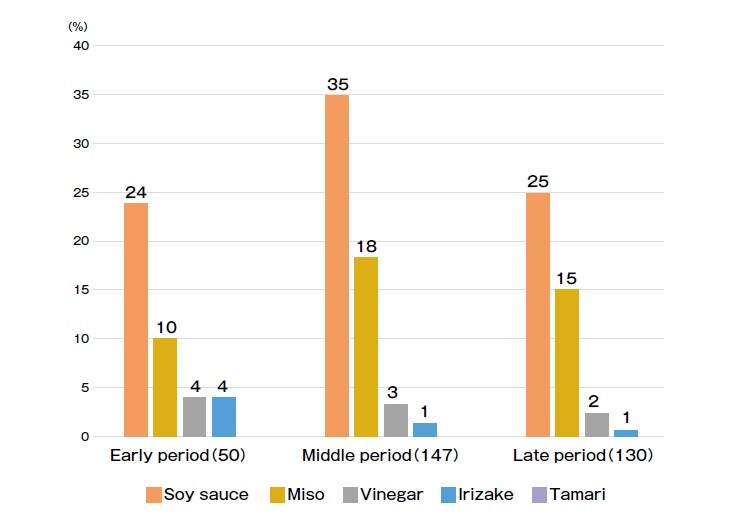
There were dishes using soy sauce alone in the early and middle periods, while there were 6 dishes using soy sauce along with mirin seen in the late period. In simmered vegetable dishes, tamari was not used, nor were vinegar and irizake much used. For simmered meat dishes, while the use of soy sauce increased, the use of other seasonings, namely, miso, vinegar, and irizake, decreased (Fig. 7). The kinds of meat most used in the early and middle periods were fowl such as crane, duck, and chicken. By referring to Hassentaku Enshiki-ki, published in Nagasaki, we can see that boar meat and pork offal were used in the middle period. In the late period, there were many simmered animal meat dishes seasoned with soy sauce and sake. Out of 17 simmered meat dishes in the late period, 12 were in the book titled Shinpen Ikoku Ryori, which introduced Chinese dishes that frequently used animal meats. Presumably, soy sauce was used to counter the smell of animal flesh.
iii. Dressed Dishes
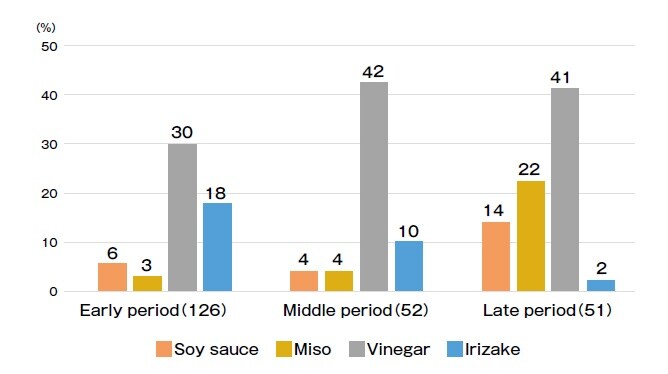
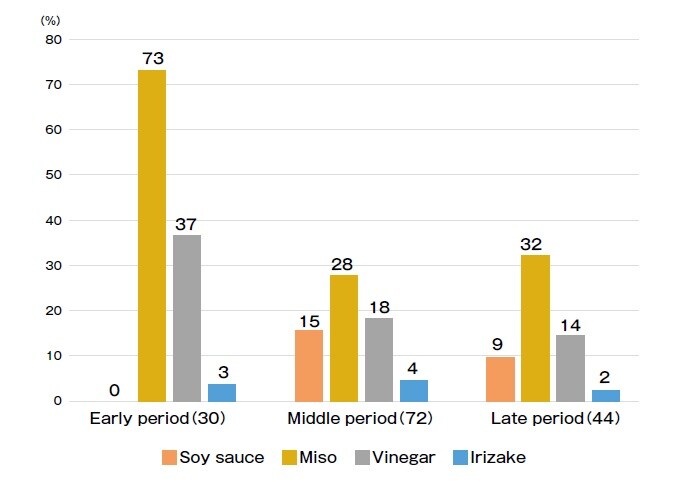
Dressed dishes of fish & shellfish as well as those of vegetables were compared and analyzed (Fig. 8 and Fig. 9). The most frequently used seasonings were vinegar in the former and miso in the latter.
5.Conclusion
Ryori Monogatari, published in the early Edo Period, revealed that the first dish that used soy sauce was a dish of fowl coated with soy sauce, roasted, and dressed with vinegar with mustard. In that book, there were just 12 dishes that used soy sauce (4.6%), as the main seasonings were salt, miso, and vinegar. Fish & shellfish sashimi was eaten not with soy sauce, but with irizake and vinegar with ginger, while soup dishes of vegetables and fish & shellfish were seasoned with miso. Simmered dishes of fish & shellfish were mostly seasoned with dashi-tamari and dressed dishes of fish & shellfish were seasoned with vinegar and salt.
Analyses of changes in the use of seasonings carried out by dividing the cookbooks contained in Genten Gendaigoyaku Nihon Ryori Hiden Shusei into three eras of early, middle, and late periods found that miso was most used in the early period, followed by vinegar, soy sauce, irizake, and tamari in descending order. In the middle and late periods, the use of soy sauce became prominent, followed by miso and vinegar. The use of irizake and tamari decreased as they were replaced by soy sauce.
Soy sauce was mainly used in sashimi dishes, roasted dishes, and simmered dishes, while many dishes used it in tandem with sake and vinegar. In the late period, simmered dishes emerged that used soy sauce and mirin in combination.
Cookbooks naturally vary depending on the time and place of publication, and each has its own characteristics. This article reported on analyses conducted by dividing the Edo Period into three shorter periods. We would like to look deeper into the transitions over time by using a more detailed breakdown of the periods, including such times as when locally-produced jimawari soy sauce came to be distributed. In addition, there are cookbooks describing nanban cuisine (cuisine brought by the Spanish and Portuguese) and Chinese cuisine. Not to mention there is Manbo Ryori Himitsubako, which contains recipes for entertainment more than for eating, such as kimigaeshi tamago (boiled egg with the yolk and white reversed). We also would like to analyze such books by dividing them according to their characteristics.
| Acknowledgements For this study, we received a research grant from Kikkoman Corporation. We also are grateful to Noda City Museum, Nanko Resthouse, Minamigurasyouten Co., Ltd., Yamashin, Inc., The Mizkan Museum, and Mr. Ryoichi Iino, who taught us how to break up the periods of time. |
- Matsushita, S. (2012). Edo Ryori Dokuhon . Chikuma Gakugei Bunko. Chikumashobo Ltd. (in Japanese)
- Ehara, A. (2009). Dentoshoku no Minaoshi to Ikashikata. In M. Iwata (Ed.), Shoku no Bunka Forum 27 Dentoshoku no Mirai (pp.184–189). Domesu Publishers Inc. (in Japanese)
- Oe, T., Katayose, M., Hosomi, K., Morishita, T., Irie, K., Oshima, E., Kawarazaki, Y., Konishi, H., Hasegawa, T., Higami, S., Sawada, S., and Yamamoto, N. (2001). Edoki ni-okeru Mirin no Ryori eno Riyo: Mirin no Shokubunka to Hensen (Use of Mirin in Japanese Cooking during the Edo Period: Culture of Dietary Habits and Changes), Journal of Cookery Science of Japan, 34(1), 25–39. (in Japanese)
- Okubo, H. (2012). Edo no Shoku-kukan: Yatai kara Nihonryori e (p.31, 65, 71). Kodansha Ltd. (in Japanese)
- Kikkoman Corporation. Shoyu no Rekishi o Himotoku. https://www. kikkoman.co.jp/soyworld/subete/history.html (in Japanese)
- Iino, R. (2016). Sushi, Tempura, Soba, Unagi: Edo Yondai Meibutsu-shoku no Tanjo . Chikuma Gakugei Bunko. Chikumashobo Ltd. (in Japanese)
Born in Oita Prefecture, Ms. Utsunomiya is a licensed cook as well as a professor at the Department of Japanese Culture, Faculty of International Cultural Exchange, Gakushuin Women's College. The major themes of her work are field studies in Asia (rice cultural sphere) since the 1990s on the transformation of food culture; research on school lunch menus and New Year’s dishes for the preservation and inheritance of traditional Japanese cuisine; and research on the regional characteristics of soy sauce