
Searching for the Origin of Mirin
Searching for the Origin of Mirin
Introduction
What is mirin? The dictionary defines it as a type of sake made by brewing a mixture of shochu spirits and steamed glutinous rice, with koji mold added, and then pressing the mash to remove the lees. Compared with the widely known brewed alcoholic beverage called sake, mirin presents us with a newer type of ‘sake.’ Why is it called a new type of sake? Because the emergence of the distilled alcoholic beverage called shochu is new.
Without shochu, there is no mirin. The current liquor tax law of Japan categorizes mirin not as brewed or distilled liquor but as mixed liquor. Mirin could not be created without shochu, which is made by distilling brewed sake. Though we might assume that a new alcoholic beverage would have a well-known origin, we are left with two theories regarding the origin of mirin. One presents a Japanese-origin while the other suggests it was introduced from overseas. The former theory is still advocated, while the latter theory has less support. Why? This article explores the origin of mirin by examining diverse Chinese characters seen as expressing mirin in the literature of the Ming and Qing dynasties.
Huya Cannot Surpass Komai Nikki
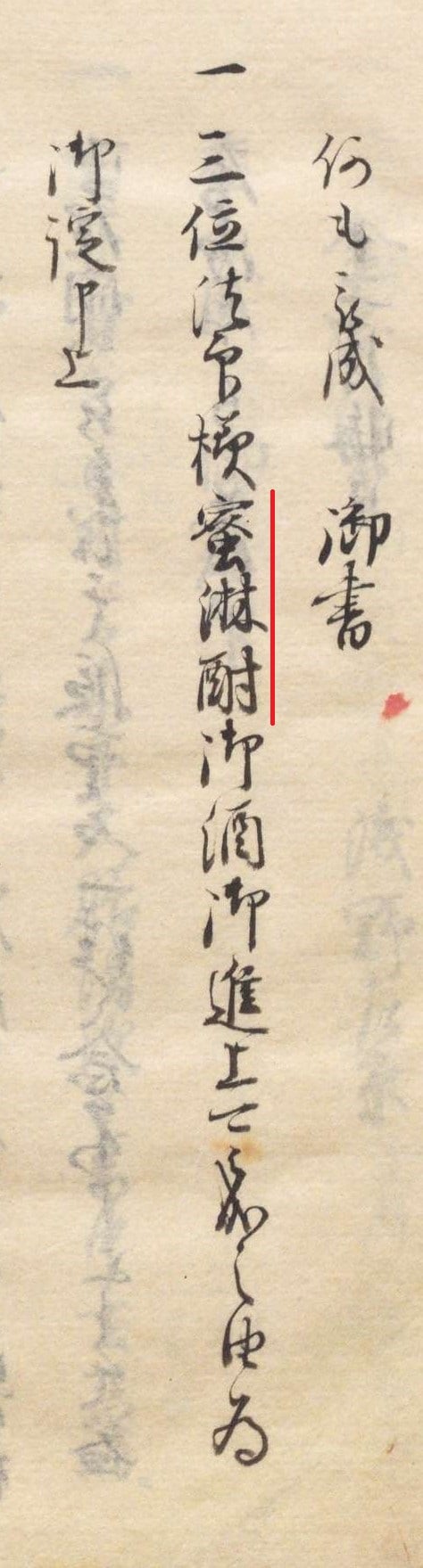
The first mention of ‘mirin’ in Japan is believed to be found in Komai Nikki (Komai Diary), dated from 1593 (Figure 1). It is written that mirin was presented as a gift to Toyotomi Hideyoshi (1537–1598), who then ruled Japan.
Mirin also appears in Taikoki, a biography of Toyotomi Hideyoshi that is referenced as a record of the period during Hideyoshi’s rule of the country. Mirin appears as one of the wines Christian priests offered to common people in their missionary activities. Although Taikoki, written by Oze Hoan during the Kanei era (1624–1644) of the Edo period (1603–1868), was not a contemporary document, it tells us that mirin was used as a rare foreign item that was sought after by people of Hideyoshi’s era.
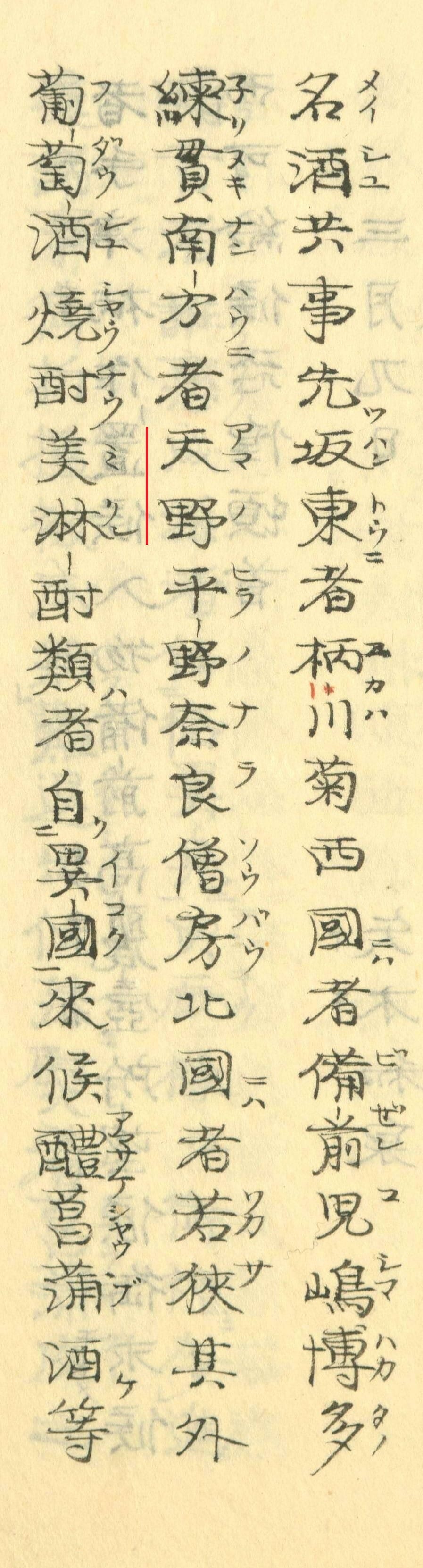
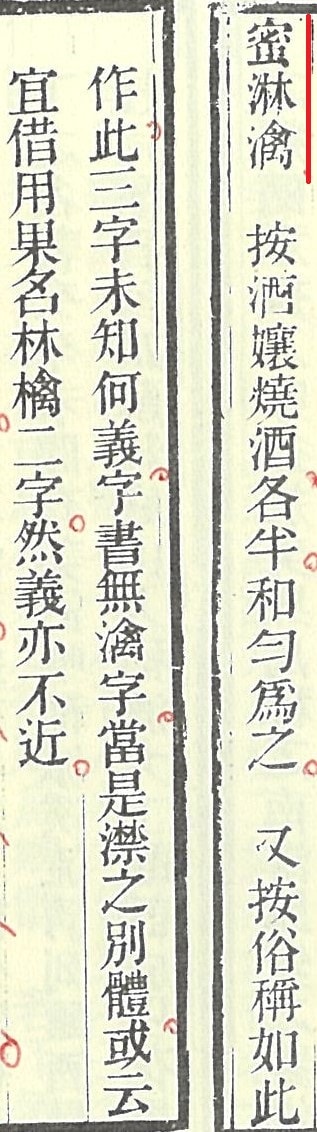
Furthermore, mirin appears in Teitoku Bunshu (Collection of Teitoku’s Writings), written by Matsunaga Teitoku (1570–1653). It is a record of 1650 (Figure 2) and declares, ‘wine, shochu spirits, mirin, and other such liquors were brought in from foreign countries.’ This provides support for the claim of mirin’s overseas origin. However, why then is the overseas-origin theory not dominant? The major reason is the lack of Chinese literary materials other than Huya that can be referred to as support (Figure 3).
The Poor State of Chinese Literary Materials
In his 1976 book, Osamu Shinoda commented, ‘Huya is interesting… This nine-volume book authored by Wang Yuezhen in the 3rd year of Guangxu, 1877, is a catalog that describes the products of Huzhou, a prominent city in northern Zhejiang province. Volume 8, which describes alcoholic beverages, tea, and local dishes, is not simply a food journal of the Huzhou area but is an important source regarding the culinary history of a specific region in the late Qing dynasty (1636–1912).’ Mirin appears as a topic in Volume 8 following shaojiu (distilled spirits) under the category of zaoniang (brewing).
The format of the book involves compiling relevant passages for each entry from earlier texts (primarily local journals, with about 50 cited works in Volume 8 alone), accompanied by annotations from the author-editor. However, for mirin, there are only two annotations. Would this be because no description concerning mirin was found in earlier literature? The author-editor might have known the name only as a kind of alcoholic beverage. The first annotation states that mirin is made by mixing equal parts of sake koji mold and shaojiu (shochu spirits). However, mirin cannot likely be made with this half-and-half mixture. The second annotation states, ‘It is commonly referred to as that and these three characters (蜜淋檎) are used, but we don’t understand what they mean. The character ‘檎’ is not found in dictionaries. Is it a variant form of ‘澿’? Some say that the two characters ‘林檎’ are borrowed, but that does not make sense.’ The author of Huya, a text that is referred to as the prime source used in searching for the origin of mirin, does not appear to have much knowledge of mirin.
Even if the author lacks knowledge, a document can still provide some meaningful value if the author devotes himself to keeping records. However, Huya cannot compete with Komai Nikki, as there are roughly 300 years between the publication in 1593 of Komai Nikki and of Huya in 1877. Komai Nikki is far older, and makes it obvious that the overseas-origin theory does not hold up to scrutiny. Furthermore, mirin is a uniquely Japanese alcohol and an essential seasoning in Japanese cuisine, and the absence of reports of mirin in modern China makes the Chinese origin theory even more untenable. If mirin had been brought from overseas, there should be some current evidence of it at the claimed source.
From the Literary Resources of the Qing Dynasty
In the following, the characters meaning ‘mirin’ have been picked up from literature written in the Chinese language in reverse chronological order.
(1)Yuu’ensha Joudan
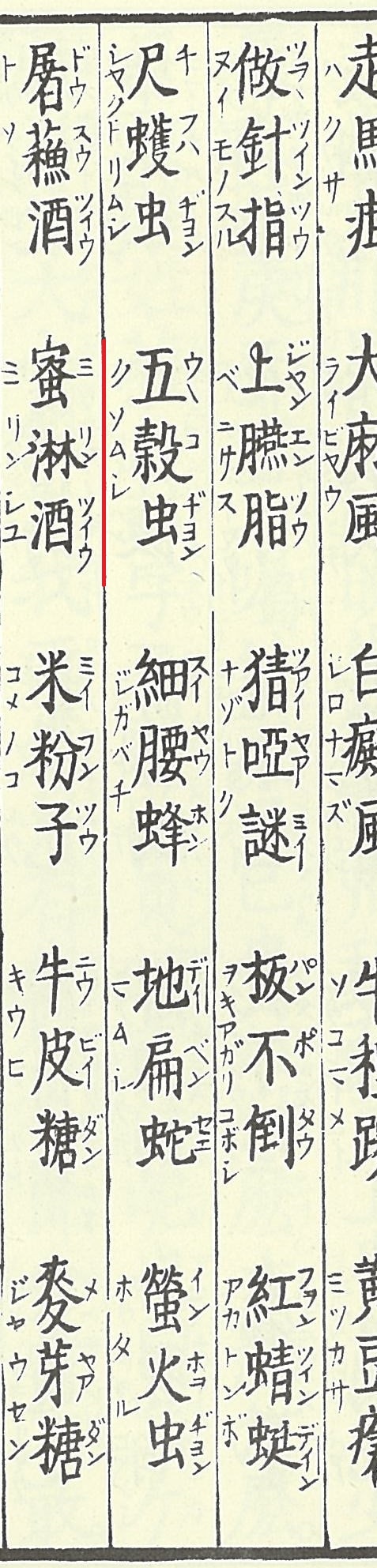
Mirin appears in a volume published in 1770, roughly a hundred years earlier than Huya (Figure 4). This appears in a book called Yuu’ensha Joudan (Everyday Language at Yuu’en Group), which is now included in Towa Jishoruishu (Kyuko Shoin). Although it was not a Chinese publication, it was a Chinese language study book from the Edo period. Chinese language learning during the Edo period was initially limited to interpreters in Nagasaki’s Dejima and Zen monks, but it later spread to Edo and became common among Confucian scholars. Each Chinese word here, written in three Chinese characters, has its Chinese pronunciation on its right and its meaning in Japanese on its left, both written in Japanese katakana. Following entries on insects are five food names, including twotypes of alcohol: toso and mirin. Toso is prepared by soaking a spicy mixture of medicinal herbs, called tososan, in mirin, to be consumed in celebration of the New Year. Perhaps it was served at New Year gatherings of Chinese language students. The publication year of Yuu’ensha Joudan falls within the Qianlong era (1736–1796).
(2)Kikou Bunkenroku
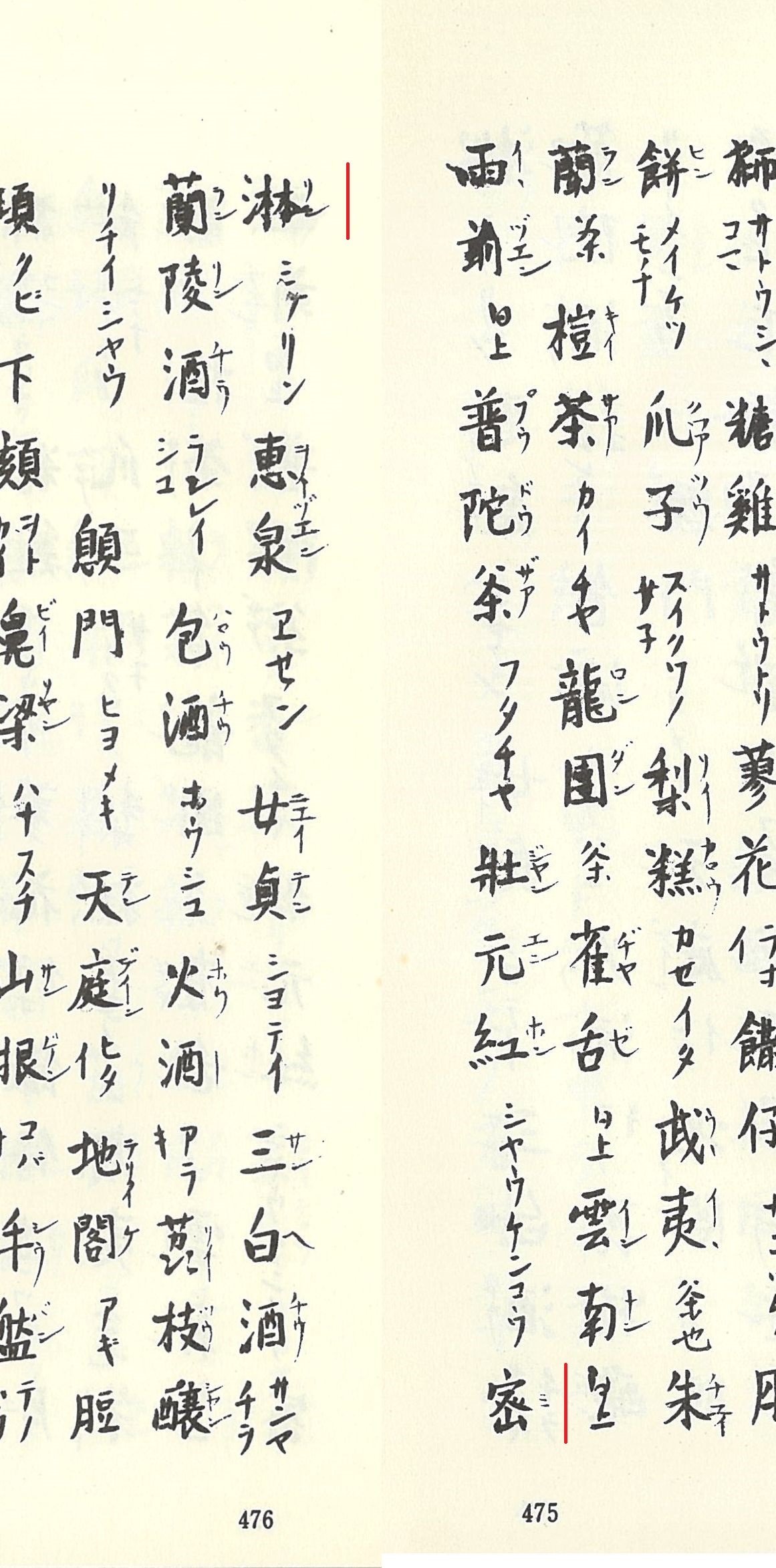
Mirin is also seen in a manuscript entitled Kikou Bunkenroku (Record of Observations in Nagasaki) (Figure 5). This is a textbook featuring Chinese language usage observed in Nagasaki around 1723–36. Being up to date is vital to conversation textbooks, so this would likely be filled with the latest Chinese language in use in Nagasaki at the time. Words are categorized by meaning, such as insects, foods, and names of human body parts. Nine types of alcohol are listed at the end of the food category. Mirin appears after zhuangyuanhong (状元紅), followed by huiquan (恵泉), nyzhen (女貞), sanbaijiu (三白酒), lanlingjiu (蘭陵 酒), baojiu (包酒), huojiu (火酒), and lizhiniang (茘枝醸). The Chinese pronunciation is provided to the right of each word, written in Chinese characters, with the Japanese translation below the word. The combination of zhuangyuanhong and mirin is also seen in Wenzhou Fangyan Cidian ( Wenzhou Dialect Dictionary) to be mentioned later, and they are considered to be products that differ in the percentage of alcohol contained within. Huiquan , appear ing together with sanbaijiu in Tiehua Xianshi, the next literary source to be discussed, is a choice sake. Nyzhen and lanlingjiu a re also seen in Suiyuan Shidan (The Way of Eating) written by Yuan Mei, a Qianlongera poet, in which the former is referred to as nyzhen of Suzhou and is rated poorly, while the latter is referred to as lanlingjiu of Changzhou and rated highly. Bothare products of Zhejiang.
(3)Tiehua Xianshi
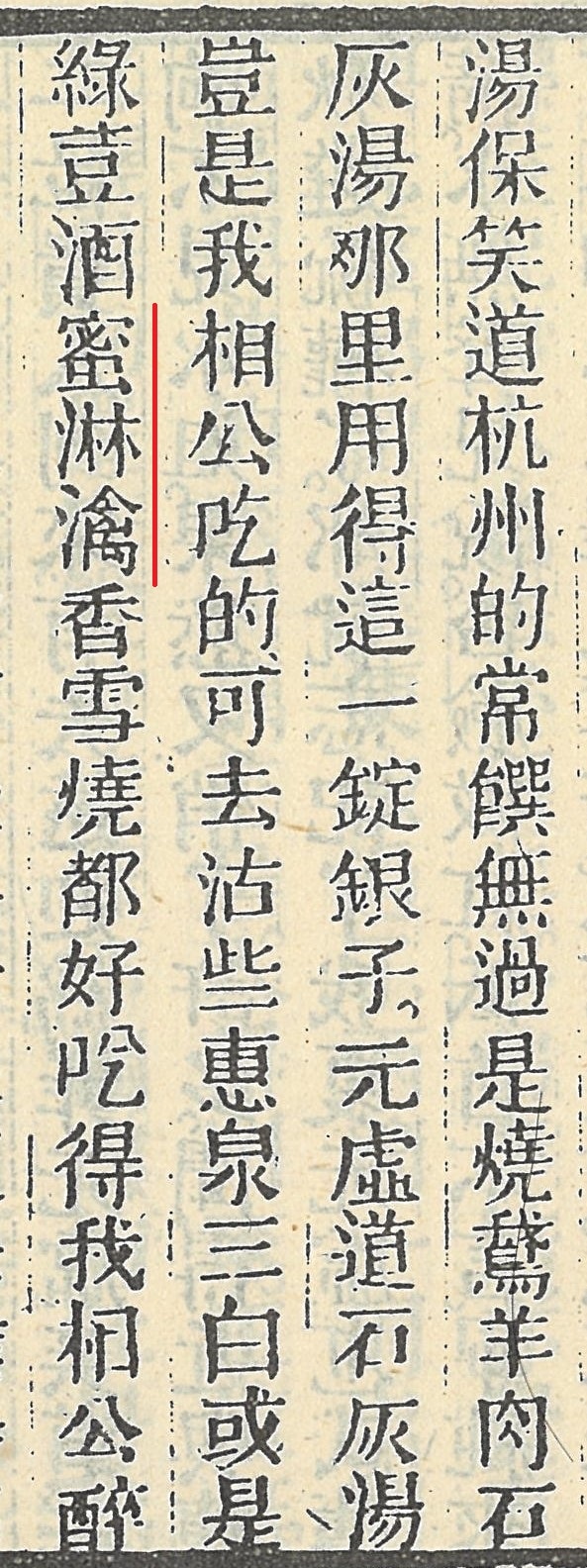
Although it is noted that the book was authored and edited by Yunfeng Shanren, this is a pseudonym and the year of publication cannot be identified. In his book Zhongguo Xiaoshuo Shilue (A Brief History of Chinese Fiction), Lu Xun stated that Tiehua Xianshi is a sentimental novel of the Ming period (1368–1644). However, it appears more like a work of the Kangxi era (1662–1723) based on the described contents and style. Mirin appears in Chapter 9 of Tiehua Xianshi (Figure 6). With punctuation added, the text reads, ‘石灰湯豈是 我相公吃的、可去沽些 恵 泉 三白,或是緑荳酒、蜜淋漓、香雪焼都好.’ An attendant is presenting his complaint about a meal in Hangzhou. “Such a dish as shuhuitang (石灰湯) should not be served to our young master. Huiquan (恵 泉) or sanbai (三白) would be good. If they are not available, ludoujiu (緑荳酒), milinli (蜜淋漓), or xiangxueshao (香雪焼) will do.” Huiquan and sanbai were highly regarded alcoholic beverages that are also seen in Kikou Bunkenroku (mentioned earlier), while mirin and the other two alcoholic beverages are evaluated as being relatively inferior.
(4)Minxiaoji
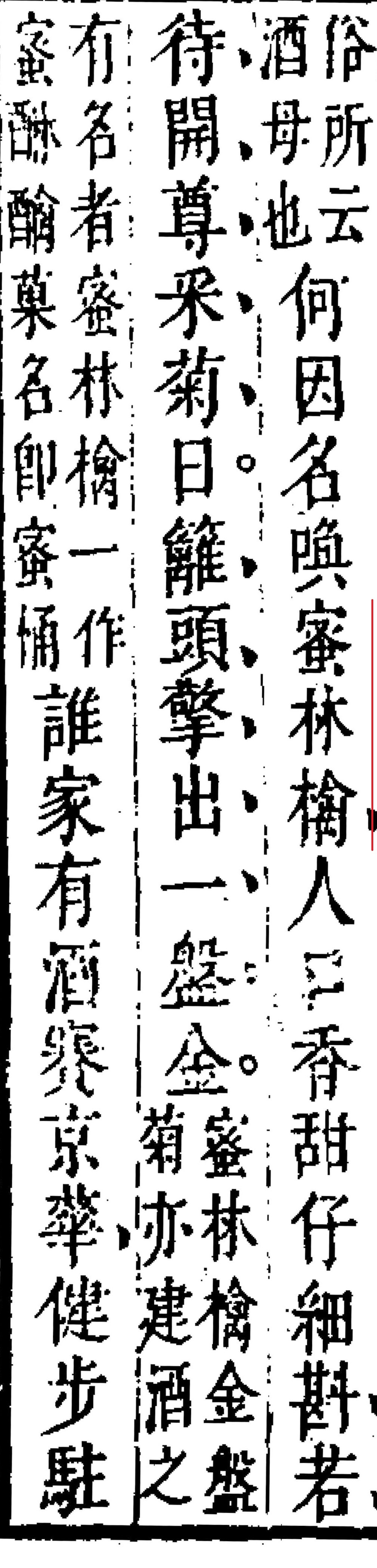
The first relevant document in the Qing period in which mirin is seen is Minxiaoji (Fujian Notes) (Figure 7). Its author, Zhou Lianggong (1612– 1672), wrote poems describing what he saw and heard during his eight years posted in present-day Fujian province. The author, who came from Nanjing, seems to have felt the name ‘mirin’ was an odd name for a type of alcohol. He described it as something sweet and fragrant that one can savor and deeply appreciate. He also left an annotation to comment that the characters having 酉 as the left radical (called “torihen” in Japanese) are sometimes used, and that the meaning of mitong (蜜桶) is unknown but does not refer to apples. The combination of mirin and jinpanju (金盤菊) appears in Shishi Tongkao, a resource that will be discussed later. Both are sweet liquors and seem to have been a kind of medicinal wine in which fruits and/or flower petals were used.
From the Literary Resources of the Ming Dynasty
The Ming dynasty defeated the Yuan dynasty (1271–1368) and ruled China from the Muromachi period (1336–1573) in Japan up to the beginning of the Edo period through the Azuchi-Momoyama period (1573–1603). Many of the books that have been maintained to this day were published during or after the Wanli era (1573–1619) of the late Ming period.
(5)Kezuo Zhuiyu
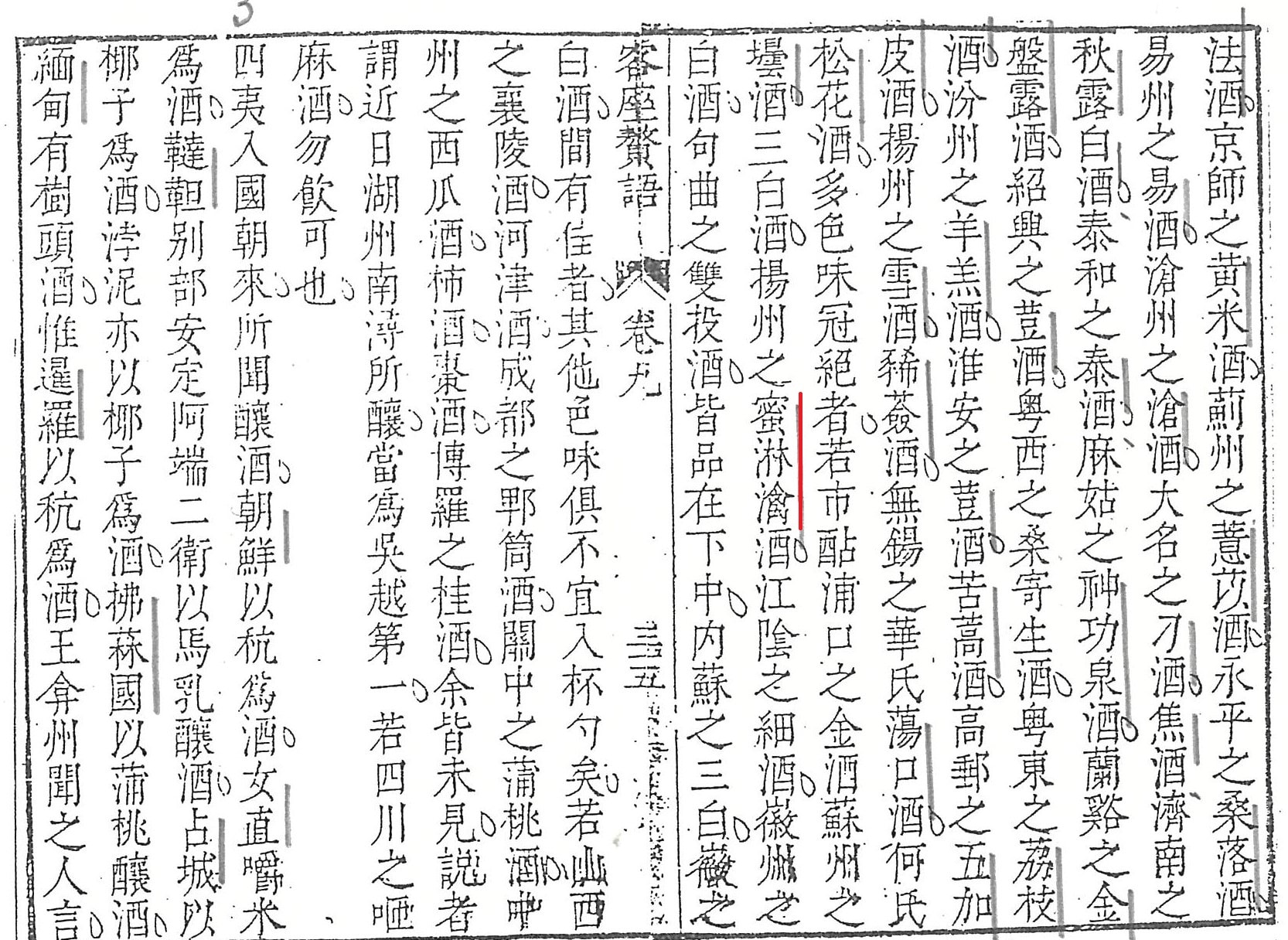
Published in the 45th year of the Wanli era, Kezuo Zhuiyu by Gu Qiyuan has three stories about alcohol (Figure 8). These are records from 1617. The second story, which mentions mirin, includes a great many alcoholic products and their production areas. The alcoholic beverages are divided into three groups, with 24 beverages from 20 locations being evaluated as high grade, and seven beverages from six locations ranked as medium to low grade. Mirin is included in this second group and described as a product of Yangzhou. Regarding eight alcoholic beverages from the last five locations, the author states that he has heard the names but not tasted them. We can see that a distribution system had been put into place and that the nationwide manufacture and sale of alcoholic products was underway in the last years of the Ming dynasty. The third story reports that alcohol was imported from foreign countries, including Nyzhen and Tatar in the north, Joseon in the east, Yuzhen and Folin in the west, and Vietnam, Borneo, Siam, and Burma in the south. Tributary missions from the south are related to matters discussed later.
(6)Shiwu Ganzhu
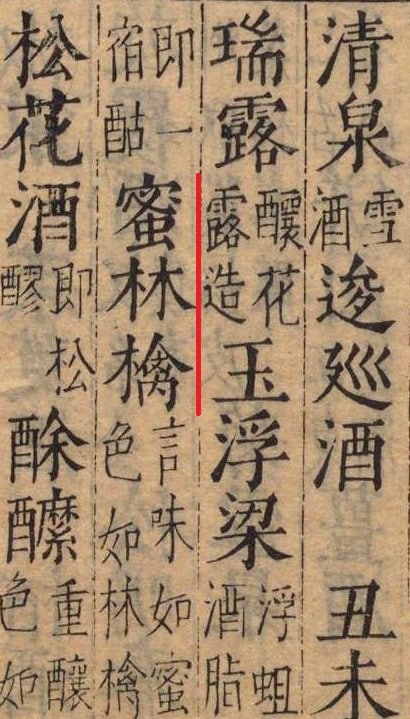
Shiwu Ganzhu, published in 1604, is an encyclopedic reference book compiled by Huang Yizheng. Volume 14, Table 6 lists 38 alcoholic beverages, each represented by two to four Chinese characters, among which mirin is included (Figure 9). Under their names, remarks of varying lengths are provided. For mirin, the remark reads, ‘It is said that it tastes like honey, and its color is like an apple.’ However, this appears to be a superficial note based on the Chinese characters' literal meaning. No evaluation like that done in Kezuo Zhuiyu is given. It seems that the compiler has not tasted mirin, and did not think it necessary to do so. For him, mirin was just one of the many alcoholic beverages found in old literature, and his comments were perfunctory.
(7)Shishi Tongkao
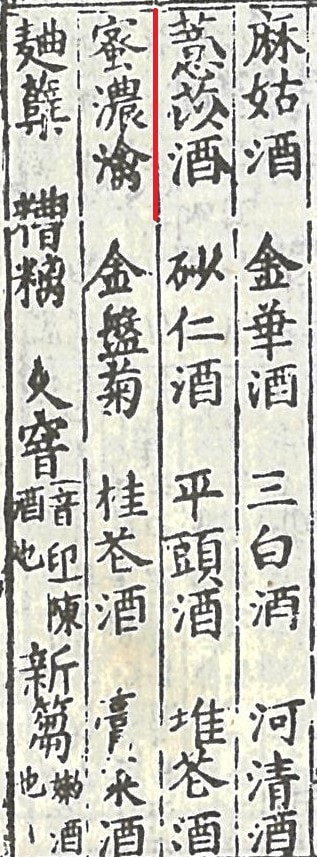
Althought he names of the compiler and publisher of this text are provided, there is no mention of the year of publication. However , earlier studies unanimously note that Shishi Tongkao (A Comprehensive Study of Worldly Affairs) was published during the Wanli era. Volume 2, Page 16b of Shishi Tongkao has 26 two or three-character names that describe alcoholic beverages, among which mirin is included (Figure 10). However, it uses the character nong (濃) rather than lin (林) that we have seen so far. One possible reason for this might be that, in Anhui province where the compiler was from, the use of L and N were often mixed. Another explanation could be that nong (濃) was used to express the sweetness and strong flavor of mirin. The combination with jinpanju listed immediately after mirin is as stated in the aforementioned Minxiaoji. Of the 26 names of alcoholic beverages, 12 are three-character names, of whom 10 three-character names, excluding mirin and jinpanju, consist of two characters + the character jiu (酒). Jinpanju (金盤菊) also consists of two characters + the character ju (菊). Mirin, meanwhile, consists of mi (蜜) + two characters, which indicates its unique character. For the three-character names in the aforementioned Shiwu Ganzhu, many of the third characters are either jiu (酒) or chun (春). This has been common among alcohol names since the Tang period (618–907).
(8)Tongya
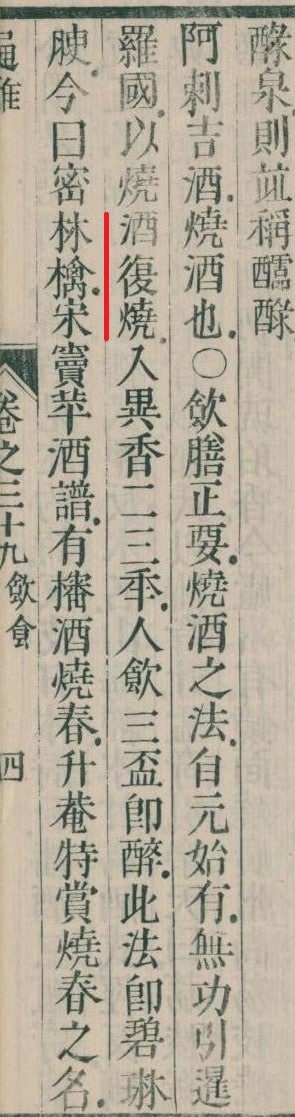
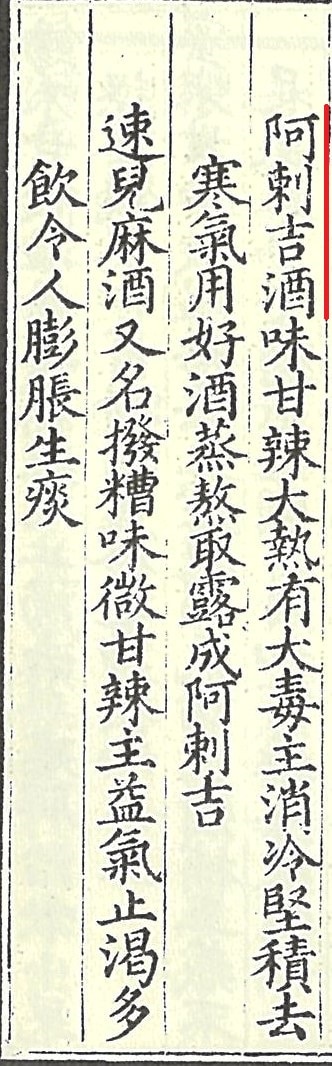
If we are to discuss Tongya, written by the late Ming and early Qing thinker Fang Yizhi (1611–1671), it should ideally be included among the Qing dynasty sources in the previous division. However, it has been placed before the Wanli era sources because it may cite a fragment from Yinshan Zhengyao (Proper and Essential Things for the Emperor's Food and Drink). The section containing mirin (sweet rice wine) is shown in the illustration (Figure 11). Regarding Yinshan Zhengyao, Noriko Miya wrote in her paper in 2002, ‘It is a cookbook, medicinal text, and herbal book of the Yuan period. Mongolian dishes and the dietary regimen of that time are described with illustrations. Hu Sihui presented it as a tribute to Emperor Wenzong of the Yuan dynasty in 1330. The book was not published and was kept in a storehouse of precious items during the Yuan dynasty. It was eventually reprinted and published by order of Emperor Jingtai in 1456. This Jingtai edition was then brought to Japan. In the 20th century, Sibu Congkan Xubian included a photocopy of the Jingtai edition in possession of Seikado Bunko in Japan. It is also shown in Chugoku Shokkei Sosho (Synopsis of Chinese Recipes).’ The image in this article was taken from Chugoku Shokkei Sosho.The problem is the text that is considered as being cited by Tongya is not seen in the Jingtai edition contained in Chugoku Shokkei Sosho (Figure 12). When compared, Yinshan Zhengyao as cited by Tongya and that contained in Chugoku Shokkei Sosho are so different that they seem to be from different books. In 2002, Miya further stated in her paper, ‘In the meantime, there is also an edition published in the Ming period and an abridged copy that differ from the Jingtai edition, and some remaining volumes from the edition published in the Yuan period. No copy of the edition published in 1475 shortly after the Jingtai edition exists today, and the fact that it existed at all has largely been unknown until recently. However, a faithful abridgment of that edition has been reported.’ There arises a possibility that Yinshan Zhengyao in Chugoku Shokkei Sosho is the Jingtai edition (1456), and Yinshan Zhengyao cited in Tongya is either the Chenghua edition (1475) or its abridgment. This raises the possibility that the Chenghua edition is an edition published in the Yuan period (1330) of a lineage that is different from the edition published during the Jintai era, and this is what was cited in Tongya. If this hypothesis is correct, mirin was referred to in Yinshan Zhengyao (1475) cited in Tongya, which would be a case of mirin being used in Chinese and predating its use in Komai Nikki of 1593. However, this is only a hypothesis and greatly differs from the empirical textual analysis of Qing dynasty documents examined thus far. In addition, if it was in fact written during the Yuan dynasty, the writer would have referred to the country as Da Yuan (Great Yuan) or Ben Chao (this dynasty), not simply as Yuan. Although the country name on the printing block may have been changed at the time of publication during the Chenghua era of the Ming dynasty, the citation theory of Yinshan Zhengyao in Tongya needs to be considered carefully. Nevertheless, there is no doubt that mirin is referred to in Tongya.
From Modern Chinese Dialects
Another strike against the introduced-from-China theory is the absence of reports of mirin in modern China. Therefore, ‘descendants of mirin’ are sought in the following.
(1)Hanyu Fangyan Dacidian
A massive dialect dictionary was compiled based on the collection of dialects from ancient and modern texts, using approximately 500,000 data cards, containing about 15 million characters and 200,000 entries. This effort, the five-volume Hanyu Fangyan Dacidian (Chinese Dialect Dictionary), was compiled collaboratively by Fudan University and Kyoto University of Foreign Studies. In this voluminous work, mirin appears only twice. The aforementioned No. 6 Shiwu Ganzhu is cited in Zhenhai Xianzhi, published in the fifth year of the Guangxu era (1879) in the Qing dynasty, and a term that seems to be a descendant of mirin is seen in Baiyangcun Shange (Baiyang Village Folk Songs) (Figure 13). No detailed information is provided to explain what kind of alcoholic beverage it is or what its alcohol content is. It is only described as a sweet and delicious alcoholic beverage made from rice. Yet, the information that it is associated with Wuyu (Wu Chinese) is valuable, as it suggests the possibility that a descendant of mirin may exist in Wuyu.


(2)Xiandai Hanyu Fangyan Dacidian
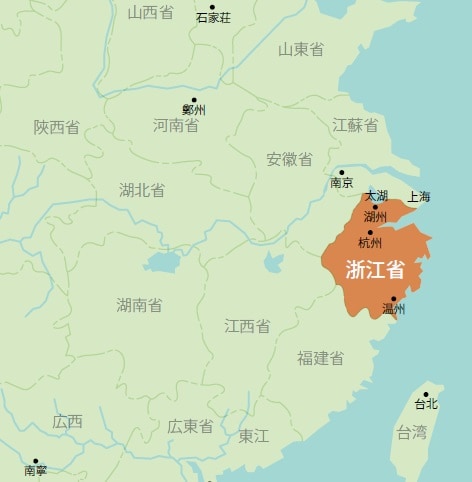
While the dictionary above was compiled based on cards, Xiandai Hanyu Fangyan Dacidian (Modern Chinese Dialect Dictionary) compiles research based on informants. This is another voluminous work, consisting of 42 volumes covering dialect research conducted at 42 sites from Harbin in the north to Hainan Island (Haikou) in the south forming a counterpart to the previous dictionary. By examining the semantic classification index under “Food, Drink, Tobacco, Tea, and Alcohol” at the end of each volume, a term believed to be a descendant of mirin (sweet rice wine) was found in Wenzhou Fangyan Cidian (Wenzhou Dialect Dictionary) only (see Figure 14). Notably, the first character used is not mi (蜜) meaning honey, but mi (米) meaning rice. In modern Chinese, “蜜” and “米” are homophones (though with different tones), and since rice is the raw material of mirin, it was likely written with this character. The only information about alcohol content is a comparison with zhuangyuanhong, though no specific figure is provided. It is noteworthy that it is described as huangjiu (黄酒), a type of Chinese rice wine, while the discussion in this article is based on the idea that mirin is a distilled beverage in which shochu (a distilled spirit) is used. Wenzhou Fangyan Cidian makes no mention of how a huangjiu of greater alcoholic content than ordinary huangjiu (a brewed wine) was produced, or how other beverages of even greater alcoholic content than that were produced, or whether a distillation process was used. The combination with zhuangyuanhong is as shown in the aforementioned Kikou Bunkenroku.Wenzhou is a city located in southern Zhejiang province, adjacent to Fujian province. Wenzhou and Huzhou (featured in Huya), belong to the Wuyu region. However, Huzhou is located in the northern part of the province, on the shores of Tai Hu (Lake Tai), and about a hundred years ago, a Huzhou literatus noted mirin (sweet rice wine) as unknown. How, then, should we consider that its descendant still lives on in Wenzhou today? Even within the same Wu dialect region, the difference can be attributed to variations in food culture, including the geographical distinction between an inland lakeside city and a coastal city on the East China Sea.
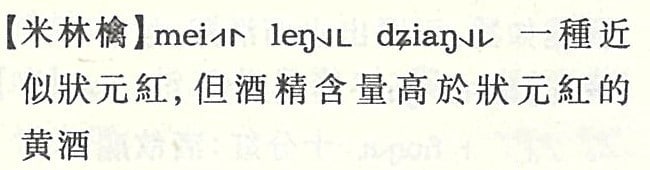
Milinqin (米林檎): Huangjiu, which is close to zhuangyuanhong but with greater alcoholic content
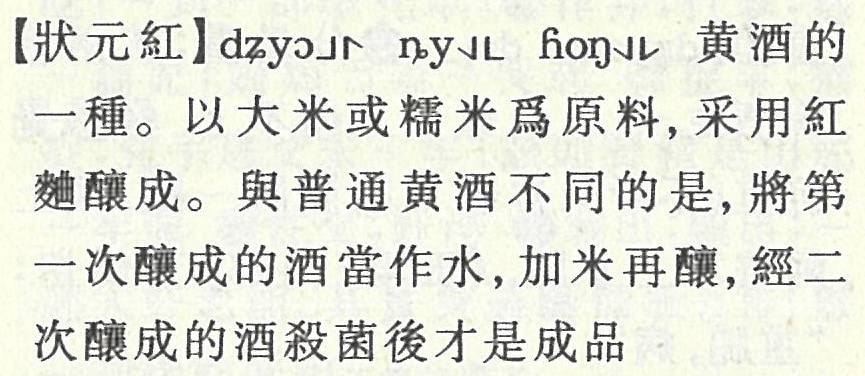
Zhuangyuanhong (状元紅): One type of huangjiu (yellow wine) brewed by fermenting rice or glutinous rice with red koji mold. The difference from ordinary huangjiu is that rice is added to the initially brewed wine and fermented again, and the liquor produced from this second fermentation is sterilized to become the final product.
Closing
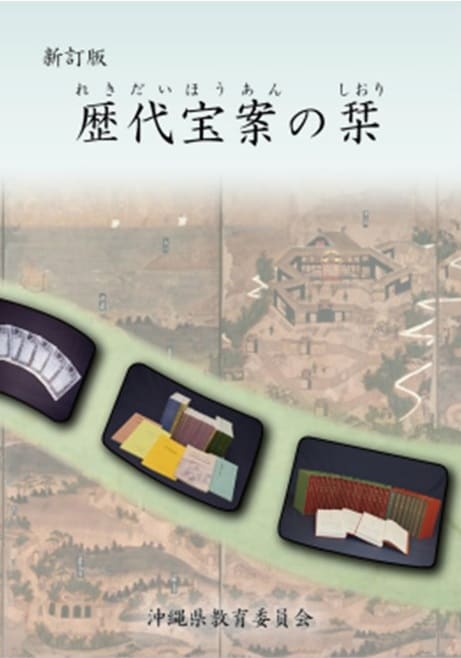
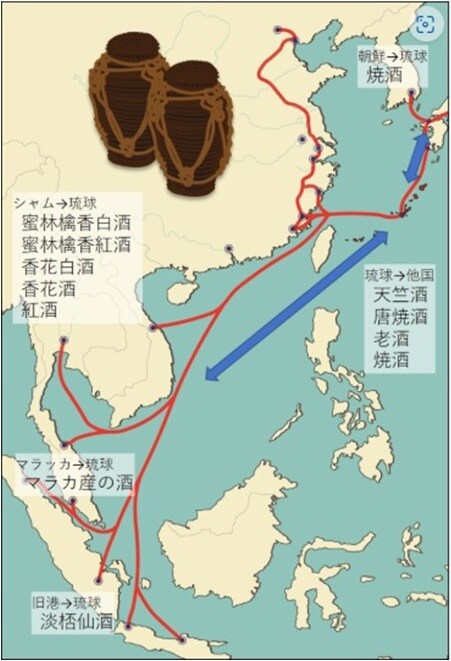
In considering the origin of mirin (sweet rice wine), the hypothesis of a foreign introduction, which had previously been less compelling compared to the domestic origin theory, now seems to carry greater persuasive weight based on the discussions thus far. How did mirin, which appears sporadically in Chinese sources, make its way to Japan? If Chinese individuals (whether merchants or Buddhist monks) brought mirin to Japan, one would expect standardized records in kanji to have been used for such a well-defined product. The fact that various notations are observed suggests that transmission occurred primarily through phonetic means rather than written characters. Furthermore, culture is like water, which runs from higher places to lower places. Since the early 7th century when Japanese missions were sent to Sui China, Japanese delegations traveled to China to learn about the latest knowledge and technologies. However, trade with China was heavily curtailed due to national isolation in the Edo Period and was even limited during the rule of Toyotomi Hideyoshi. A conceivable route could have been via Okinawa, the Ryukyu Kingdom. To liaise with China and Japan, the Ryukyu Kingdom established Ryukyu-kan sites in both Fuzhou and Kagoshima. The geopolitical position of the Ryukyu Kingdom should not be overlooked. In Ryukyu, Rekidai Hoan (Precious Documents of Successive Generations) still-preserved historical records primarily describe political exchanges with China (Ming and Qing) and other countries (Figure 15). It has been stated in earlier studies that mirin (蜜林檎) is mentioned in a letter sent (presumably in 1479) from a high official of Siam addressed to Ryukyu (Figure 16).
To offer a tentative conclusion, it could be said that the origin of mirin lies in Siam, its etymology in China, and its development in Japan.
Addendum
In this paper, the characters used in the sources are, in principle, not converted to printed type; illustrations are employed instead. This is partly because the equivalent printed characters may not be available, but primarily to emphasize the actual forms of the characters as they were used. Tracing back from Huya, nine distinct character forms are presented. However, their pronunciation is not indicated. This is because knowing how they were read (pronounced) is considered to be a fundamental issue. Many of the literary resources referring to mirin use characters with a left radical called ‘sanzui (氵)’ or ‘torihen (酉)’, which indicates liquid or alcohol. Character radicals define the category. In some cases, as seen in No. 5 Kezuo Zhuiyu, the character (酒) meaning alcohol is added. This is a translation technique broadly used in modern Chinese for the adoption of foreign vocabulary, such as kapian (卡片) meaning ‘a piece of paper or card’ and jipuche (吉普車) meaning ‘jeep, a type of vehicle.’
In contrast, the question raised in Huya is important. That is, the third character ‘ ’ is not found in dictionaries. The character was created for Figure 13 thanks to the technological progress, but it is somewhat clumsy. A character resembling ‘禽’ is ‘离,’ which is used in the modern Chinese language as a simplified Chinese version of ‘離.’ A character having ‘sanzui’ on the left with ‘离’ on the right is listed in dictionaries, where it is explained as being used in such words as ‘linli (淋漓)’, and indicates the dripping state of water, sweat, blood, etc.
Linqin (林檎) is a join rhyming compound (a twocharacter phrase where both characters share the same vowel) and liuli (淋漓) is a sosei (an alliterative compound consisting of two characters with a common initial consonant). Both of these words are unbreakable collocations that cannot be used separately. Examples of join include xiaoyao (逍遥) and lianmian (連綿) and those of seosei include fangfa (方法) and cenci (参差).Beverages with unprecedentedly high alcohol content were brought in from overseas (for example, the aforementioned Siam). Strong alcohol was different from brewed alcohol made by applying fermentation. Brewed alcohol, even if produced by undergoing repeated applications of fermentation and brewing, cannot compare to alcohol made by distillation in terms of alcoholic strength. What did people call such a foreign alcohol? It may have been called mi linli (蜜淋漓) as it would have been recognized as a viscous alcohol that was as sweet as honey. If the term ‘mi linli’ was known, there would be no problem even if the third character was written as ‘ .’ Understandably, ‘密’ would be written in place of ‘蜜.’ A problem would arise when a person who was unfamiliar with ‘mi linli’ would have arbitrarily interpreted and rewritten the character. Presumably, this is how mi linqin (蜜林檎) has emerged.
The traditional convention in naming three-character alcohol names relies on two characters (name of the place of production, name of ingredient, etc.) + 酒 or 春 or 酎 (meaning alcohol, spring, and strong liquor, respectively). However, 蜜淋漓 is structured as ‘蜜’ (indicative of the taste that characterizes mirin) + two characters (onomatopoeia or mimetic word). In Fujian province, there is an alcoholic beverage called ‘michenchen (蜜沉沉)’ (Figure 17). The ABB pattern, where an adjective is followed by a repeated character, conveys a vivid, lively impression of the sound. In some cases, 酒 or 酎 is added as a fourth character. In other cases, names consisting of one character + two characters are misinterpreted as two characters + 1 character, resulting in the third character being deleted. An example is shown in Figure 5 Kikou Bunkenroku. Furthermore, there were cases where the third character was deleted and replaced by 酒 or 酎. If we consider the above, we may be able to understand why there have been so many ways of writing ‘mirin.’

This article is based on my lecture titled “In Search of the Origin of the Word, Mirin” in the Kikkoman Food Culture Seminar held on February 15, 2025.
Noriko Miya 2002, Fuzoku Toshokan no Chinpon, Seishu, Vol. 39, No. 3, Kyoto University Library
Osamu Shinoda 1976, Chugoku Shokumotsu-shi, Shibata Shoten
| Period | China | Period | Japan / Ryukyu | |
|---|---|---|---|---|
| 1300 | ||||
| 1330Yinshan Zhengyao | Kamakura(late 12th century-1333) | |||
| Nanboku-cho(1337-1392) | ||||
| Ming(1368-1644) | Muromachi(1336-1573) | |||
| 1400 | 1405-33Zheng He’s expeditions | |||
| Sengoku(1467/1493-1573) | 1479 Rekidai Hoan | |||
| 1500 | 1543 Guns were brought in from Portugal | |||
| Azuchi-Momoyama(1573-1603) | 1549 Christianity was introduced by Francis Xavier | |||
| 1600 | Wanli era(1573-1619) | Shishi Tongkao | 1593 Komai Nikki | |
| 1604 Shiwu Ganzhu | ||||
| Kezuo Zhuiyu | ||||
| Tongya | Edo(1603-1868) | |||
| Qing(1644-1911) | Minxiaoji (Shunzhi era 1644–1661) | 1649 Teitoku Bunshu | ||
| Tiehua Xianshi (Kangxi era 1662–1722) | 1661 Taikoki | |||
| 1700 | ||||
| Kikou Bunkenroku (Yongzheng era 1723–36) | 1713 Wakan Sansai Zue | |||
| 1770 Yuu’ensha Joudan (Qianlong era 1736–1795) | ||||
| 1800 | 1814 Horikiri Monjiro II started to sell shiro mirin. | |||
| Meiji(1868-1912) | ||||
| 1877 Huya | ||||
Graduated from the Department of Literature, Tokyo University of Education, and completed the University of Tsukuba Graduate School. Formerly a part-time lecturer at the University of Tsukuba and Nihon University College of Economics. Director Emeritus at the Society of Testing Chinese Proficiency. The Impact of Chinese Food Culture on Japan: Research on Gyoza Culture in Japan and China (Food Culture No. 27, 2017). Soy Sauce in the Chinese Language (Food Culture No. 31, 2021)