
Katsuobushi dashi (Dried Bonite Broth) that enriches the Edo period cuisine
Katsuobushi dashi (Dried Bonite Broth) that enriches the Edo period cuisine
Introduction
At the press conference in January 2026, the Minister of Land, Infrastructure, Transport and Tourism announced that the number of overseas tourists visiting Japan in 2025 reached a record high of 42.7 million. A survey on consumption trends of inbound tourists shows that food and beverage expenses are ranked second. Washoku, which interests those tourists, is greatly based on the food culture in the Edo period. (1) Washoku developed in the Edo period for three reasons.
①Pursuit of sophisticated taste by ryotei (traditional fine-dining restaurants) focusing on drinking parties (e.g., Momokawa in Nihonbashi, Yaozen in Asakusa, and Hirasei in Fukagawa)
②Development and spread of Koikuchi Shoyu (standard soy sauce) and sweeteners such as sugar and mirin
③Completion of katsuobushi (dried bonito or skipjack tuna) production method and improvement in quality of katsuobushi dashi (broth)
This article will mainly discuss (premium fully aged katsuobushi) completed as improved Izubushi in the late Edo period.(2)
1. History of katsuobushi
Along the Japanese coast, katsuo (bonito or skipjack tuna) are caught twice a year: in spring when the schools first arrive from the southeast (hatsugatsuo — the first catch), and in autumn as they return to their spawning grounds (modorigatsuo — the returning catch).
①Relationship between katsuo and Japanese
Many katsuo bones have been unearthed in shell mounds of the Jomon period (14,000–300 BCE) on the coast along the Japan Current. In the north, katsuo bones have been also found in archaeological sites around Hachinohe, Aomori.(2)
During the Ritsuryo period (late 7th c to 10th c), processed products, katsuo (dried), nikatsuo, and katsuoirori (*), were sent to the capital from production areas as cho (tax) and presented as offerings to deities, emperor, and aristocrats. Katsuo (dried) is raw katsuo cut into fillets and sun-dried. Nikatsuo is sun-dried namari (boiled katsuo). Katsuoirori is a concentrate made from namari broth. No recipes have been found in contemporary literature. Researchers in many different fields are jointly studying them.(4)
In katsuobushi production process, the crucial part is kunkan (smoke-drying) in which namari is dried with smoke of burning hardwood logs and high temperature heat. One of the aims of kunkan is to prevent initial rot by bacteria. This step is called baikan (smoke-drying).
(*) This bonito was used for infusing soups, and we might consider this a precursor to katsuobushi, the bonito flakes used in making dashi today. This bonito was dashi today. This bonito was likely treated with salt and dried until hard.
②Where does kunkan come from?
Is kunkan an indigenous technique of Japan? According to the most prevailing theory, the technique comes from Maldives, an island country in the Indian Ocean 7,000 km away from Japan. A Moroccan travel writer Ibn Baṭṭūṭa, who visited Maldives in 1343, reported that the country exported katsuobushi (katsuo was locally called rainbow trout) to India, Ceylon (Sri Lanka), China, Yaman (Yemen), and Malacca Sultanate (a sultanate that used to be located near Malaysia). Ryukyu Kingdom was trading with Malacca Sultanate. The theory suggests that the kunkan technique was brought to Japan via Ryukyu.(5)
Others argue that there is little relevance, claiming that many other places on the route were rich in katsuo and that there is no evidence katsuobushi was made in the country. Yet another theory suggests that production of katsuobushi began in the two countries independently of each other. I believe doing kunkan is meant for hygiene and pest control when trying to reproduce katsuo (dried) and nikatsuo.(6)
③Katsuobushi culture that flourished in the Edo period
The base of present katsuobushi production process was established during the 270 years (1603-1867) of the Edo period. By the late Muromachi period, katsuo arabushi made by fire drying, the predecessor of the baikan technique, was considered to exist.(5) In the early Edo period (*1), katsuo arabushi made by baikan began to be sold in the quantity as much as the business was profitable. This seems to be likely considering the year of establishment of Ninben (1699, the early Edo period) when it was already trading katsuobushi. Shokoku Katsuobushi Banzukehyo (national katsuobushi raking list)(5)published in the late Edo period (Figure 1) shows Ise and Shima famous for Kumanobushi as referees. Reason for this may be that their katsuobushi was wellregarded at the beginning of the Edo period. Seishu (Isenokuni) was also a referee. It was chosen probably to give authority to the list as Ise Jingu shrine was there.
During the early to mid-Edo period (*1), improved arabushi was developed in Tosa (Kochi). The surface of arabushi was scraped to make hadakabushi. It was then coated with mold once and thoroughly sun-dried. In the late Edo period (*1), Tosa no Yoichi, a katsuobushi artisan from Innan, Kishu (present Wakayama), introduced the production method of improved Tosabushi to Chikura in present Minamiboso and Arari in Nishiizu. Before the improvement, Isebushi was not simmered (shajuku) and thus it had to be coated with mold many times.
Tosa no Yoichi taught shajuku and scraping methods, and improved Izubushi was born. It was made in the same process as present katsuo honkarebushi: repeating shajuku, baikan, scraping, and several cycles of mold coating and sun-drying.
(*1) The Edo period (266 years) is divided into three with every five shoguns. Early (108 years): the first shogun (Tokugawa Ieyasu) to the 5th (Tsunayoshi), mid (77 years): the 6th (Ienobu) to the 10th (Ieharu), and late (81 years): the 11th (Ienari) to the 15th (Yoshinobu).

・ Tosabushi that used to dominate the top ranks is now produced by only one company in the Usa district.
・At present it is produced in Yaizu (Shizuoka), Makurazaki (Kagoshima), and Yamagawa (Kagoshima). These three regions alone produce more than 90% of the national production.
④How did the katsuobushi dashi culture in east and kombu dashi culture in west evolve?
Several factors have influenced the difference in dashi culture between the Western and Eastern Japan.
- Kombu seaweed and katsuo differ in habitat and fishing area. Kombu grows only in Hokkaido, Aomori and Iwate. Katsuo is found and caught along the Japan Current from Okinawa in the south to Miyagi in the north, or to the coast of Iwate depending on the flow of the Japan Current.
- There were many dangerous passages on the eastern route for the navigation technology of the time. Most skippers were reluctant to go directly to Edo, and kombu was normally transported on a safer westbound route to Osaka. Figure 2 shows the western route and the eastern route developed by Zuiken Kawamura in the early Edo period. The route for transporting kombu from Hokkaido was called Kombu Road. (7)
- The shipping wholesalers operating kitamaebune (northern bound ships) were initially running transport business. They later developed into trading firms. They bought kombu in Hokkaido and carried to Osaka via the Seto Inland Sea while selling in Toyama and Tsuruga where kombu was sold for high prices. This business made the kitamaebune shipping wholesalers immensely rich. Kombu supply was concentrated on more lucrative Western Japan.
- Kombu dashi is commonly used for shojin ryori (Japan’s Buddhist cuisine), vegetarian diet as part of religious training.(※2) The number of temples per population is large in Western Japan. That helped kombu dashi spread into the daily life of common people through religious events. Wealth was concentrated in the hands of temples, and they could use expensive kombu.
(※2)Kombu is not produced in China and thus it is not used for original shojin ryori . Temples strictly following the shojin ryori rules introduced from China do not use kombu for their shojin ryori.
- Kombu wholesalers in Osaka paid tax to the shogunate and obtained the exclusive selling right to prevent the entry of newcomers.
- Kombu wholesalers in Edo traded kombu coming via Osaka and accordingly they were too expensive for commoners to readily afford.
- Edo was a city of samurai society. Katsuo was very popular in samurai society partly because its sound was similar to words auspicious for samurai, such as katsu-o meaning a winning man.
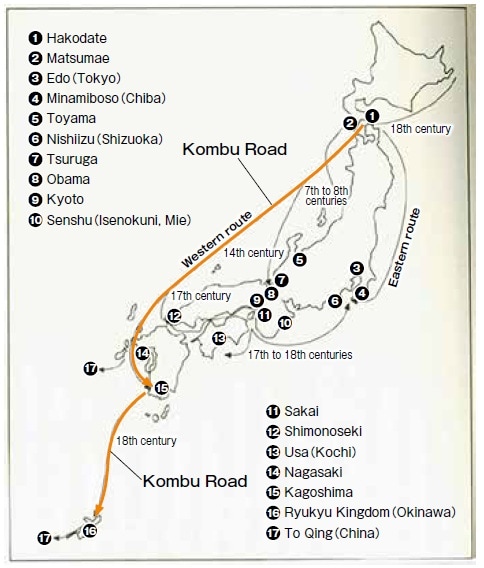
・Although kombu should be exported to Qing China via Dejima in Nagasaki, Satsuma Han (domain) exported as herbal medicine via Bonotsu Port and imported herbs from which Chinese medicine was made. Some point out that the profits gained in this way funded the overthrow of the shogunate. (8)
・This illegal trade was later found out by the shogunate, which led to a major incident known as Karamono-kuzure (collapse of import from China). Merchant ships fleeing from Bonotsu to nearby Makurazaki were used as katsuo fishing boats and Makurazaki grew into a major landing port of katsuo . (5) (8)
Table 1 shows the top 15 prefectures in the number of temples per 100,000 people. Among them, 12 prefectures belong to Western Japan. The table also lists the kombu purchase quantity and amount in the capital of each prefecture. The number in parentheses is the rank among 52 cities surveyed. Unlike katsuobushi, types of preferred kombu vary from region to region and prices vary with the type. If including the capitals with purchase quantity and amount above national average, the table indicates that the proportion of temples in Western prefectures correlates with either kombu purchase quantity or amount or both.
| Temple (organization/corporation) | |||
|---|---|---|---|
| Ranking | Prefecture | Total | per 100,000 people |
| National average | 76,634 | 61.3 | |
| 1 | Shimane | 1,292 | 237.7 |
| 2 | Shiga | 3,204 | 227.3 |
| 3 | Fukui | 1,672 | 222.1 |
| 4 | Yamanashi | 1,484 | 185.1 |
| 5 | Wakayama | 1,585 | 175.5 |
| 6 | Toyama | 1,521 | 149.7 |
| 7 | Yamagata | 1,477 | 141.9 |
| 8 | Nara | 1,803 | 138.1 |
| 9 | Mie | 2,347 | 134.7 |
| 10 | Saga | 1,069 | 133.5 |
| 11 | Niigata | 2,755 | 128.0 |
| 12 | Ishikawa | 1,352 | 120.9 |
| 13 | Kyoto | 3,051 | 119.6 |
| 14 | Oita | 1,236 | 111.7 |
| 15 | Yamaguchi | 1,418 | 108.0 |
| Kombu | ||
|---|---|---|
| City |
Purchase quantity | Purchase amount |
| National average | 214 | 798 |
| Matsue | 335(4) | 962(12) |
| Otsu | 232(16) | 1,170(5) |
| Fukui | 320(6) | 1,478(2) |
| Kofu | 154(40) | 578(46) |
| Wakayama | 113(52) | 650(39) |
| Toyama | 330(5) | 1,663(1) |
| Yamagata | 420(3) | 1,222(4) |
| Nara | 172(34) | 890(7) |
| Tsu | 217(22) | 629(42) |
| Saga | 150(43) | 670(7) |
| Niigata | 296(9) | 783(25) |
| Kanazawa | 232(17) | 984(10) |
| Kyoto | 167(37) | 1,014(9) |
| Oita | 227(20) | 739(31) |
| Yamaguchi | 147(45) | 678(36) |
Note: Sakata in Yamagata, Niigata and Teradomari in Niigata, Akamagaseki (Shimonoseki) and Mitajiri in Yamaguchi were main ports of call of kitamaebune .
2. How katsuo honkarebushi is made from katsuo
Figure 3 shows the production process of katsuo honkarebushi. This production process is the result of the predecessors’ efforts and wisdom on how to improve the shelf life and flavor while reducing moisture in katsuo.
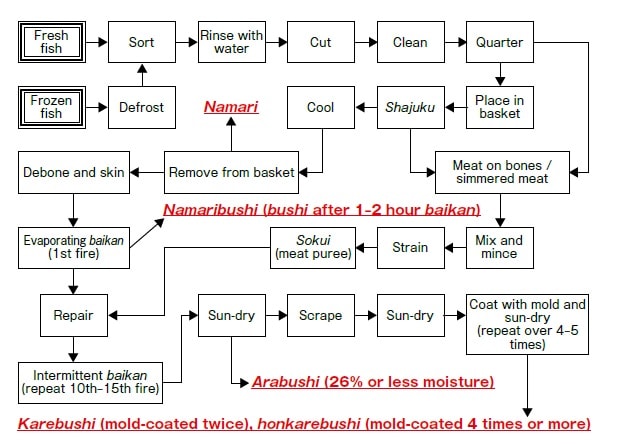
Photo 1 shows katsuo fillets (for honbushi) and finished katsuo honkarebushi. It takes about four to six months to make katsuo honkarebushi when 4.5-kg raw katsuo is used.
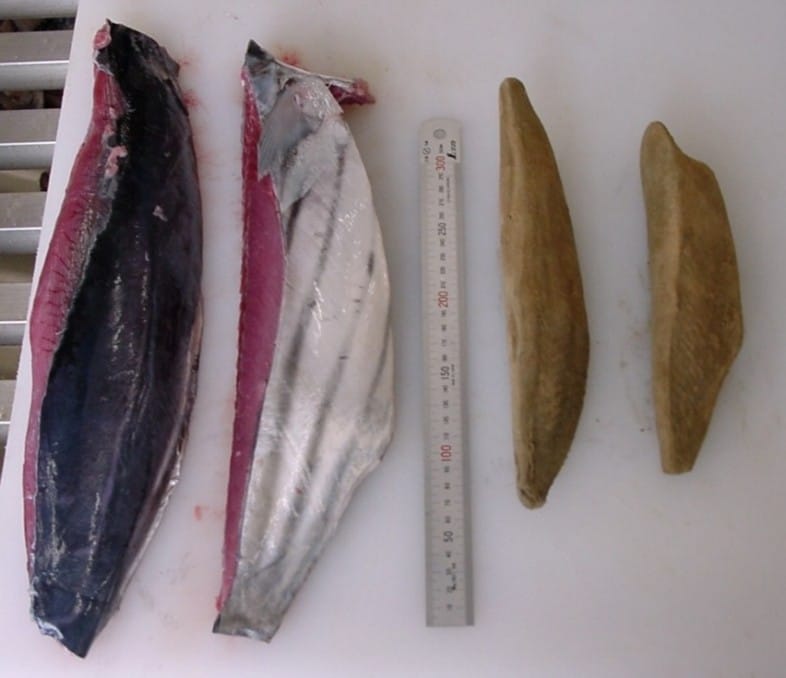
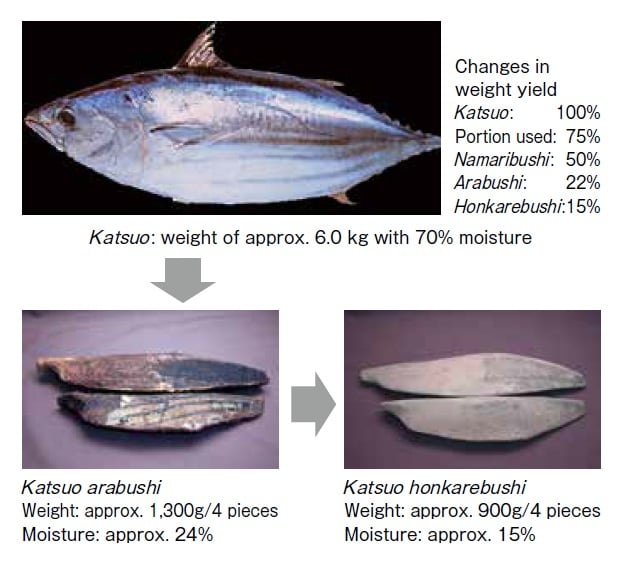
Figure 4 shows changes in weight of raw katsuo cut into fillets ➡ namari ➡ arabushi ➡ honkarebushi. Yield in proportion to raw katsuo is reduced from 1/5 of arabushi to 1/6 of honkarebushi. In other words, a price rise in raw fish by 100 yen per kg equals a rise of 500 yen in arabushi and 600 yen in honkarebushi.
- 1After katsuo is filleted, shajuku is performed. The shajuku temperature needs adjustment according to the freshness and size of katsuo. When 4.5 kg or heavier katsuo is quartered (fillets for honbushi), they are placed into water at approx. 80°C, the temperature is raised to around 90°C, and the fillets are boiled for 90 minutes. Shiagebushi, which is namari made by shajuku and cooled, will be sold in the form of bushi (fillet) after skinning (partly leaving skin near the tail) and deboning. Namaribushi is namari subjected to baikan for two to three hours.
- 2Early stages (1st to 3rd fire) of baikan (*3) involve drying using high-temperature smoke and hot air. Baikan is repeated continuously till the 5th to 6th fire. After that, baikan is performed not every day but at intervals while the surface moisture of bushi fillets is checked. This is called intermittent baikan. When the moisture content is reduced to 26% or less, the katsuo arabushi is complete.
- 3The surface of katsuo arabushi is covered with smoke components from baikan. Removing this surface layer by scraping with a grinder or a special knife and sun-drying once again result in katsuo hadakabushi. This scraping process ensures growth of beneficial katsuobushi mold on the surface.
- 4A suspension of purely cultured beneficial katsuobushi mold is applied to katsuo hadakabushi. The hadakabushi is then placed in a mold coating chamber with temperature and humidity kept constant. This starts the fermentation process in which the moisture is reduced, and the flavor is improved with the help of important microorganisms.
- 5After the first mold coating, the bushi will be covered with well grown beneficial mold, then sun-dried for a day. This is the first mold-coated bushi.
- 6The first mold-coated bushi is placed in the mold coating chamber again to grow the beneficial mold. This time, a mold suspension is not applied. The bushi with mold grown again is called the second moldcoated bushi. When the first khaki mold begins to turn brownish, the second mold coating is completed. The bushi is taken out from the mold coating chamber and sun-dried for a day. This completes the katsuo karebushi.
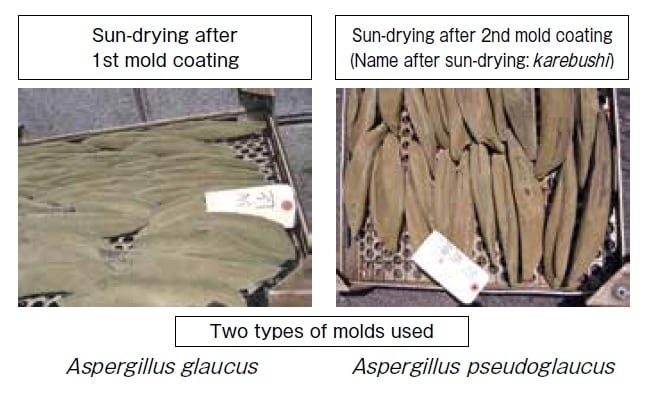
- 7After the second mold coating finishes, the step (6) is repeated. Sun-dried bushi is now called the third mold-coated bushi and, after that, the fourth moldcoated bushi. After the fourth, we call bushi as katsuo honkarebushi at Ninben. Katsuo honkarebushi is not specified in detail by the Japanese Agricultural Standards (JAS). Individual companies use their own standards.
(*3) Baikan (smoke-drying)
- Day 1 of baikan is called the 1st fire (or evaporating baikan) and Day 2 the 2nd fire. When a Yaizustyle dryer is used, baikan is performed till 11th or 12th fire for total duration of approx. 80 hours. In a kyuzokko (drying tower for mass production), baikan is performed to 12th or 14th fire and the whole baikan process takes about 100 hours. A high fat content in katsuo slows moisture reduction and increases the baikan duration.
- Smoker fuels used for baikan are logs of welldried oak, Japanese oak, konara oak, sawtooth oak, and other broadleaved trees. In the past, trees in local mountains were used, which gave distinct characteristics of each production area. Today, similar logs are used all over the country. The characteristics of bushi mainly come from difference of baikan facilities used.
- Baikan is a very important process in katsuobushi production. Not only does it impart smoky flavor to katsuobushi but also it is proven to provide diversified effects such as antioxidation, rot resistance at an early stage, and production of pyrazines by high temperature.
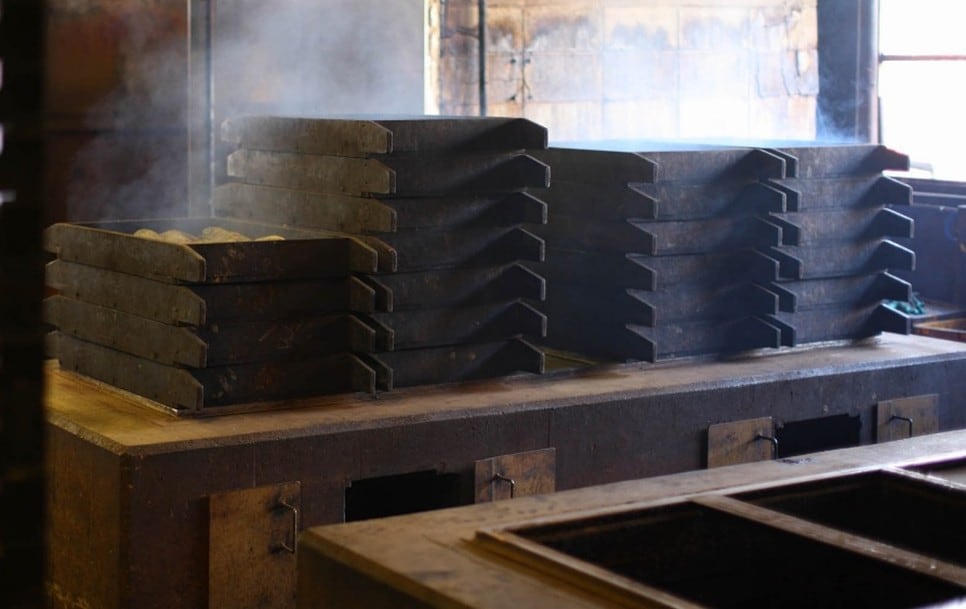
Tebiyama-style baikan method
Namari fillets are placed in steamers and put over a fire bed with burning logs to expose the fillets directly to smoke and hot air. This baikan method is considered to have been used since the early Meiji period (1868-1912). It is still used in several regions including Nishiizu and Ise.
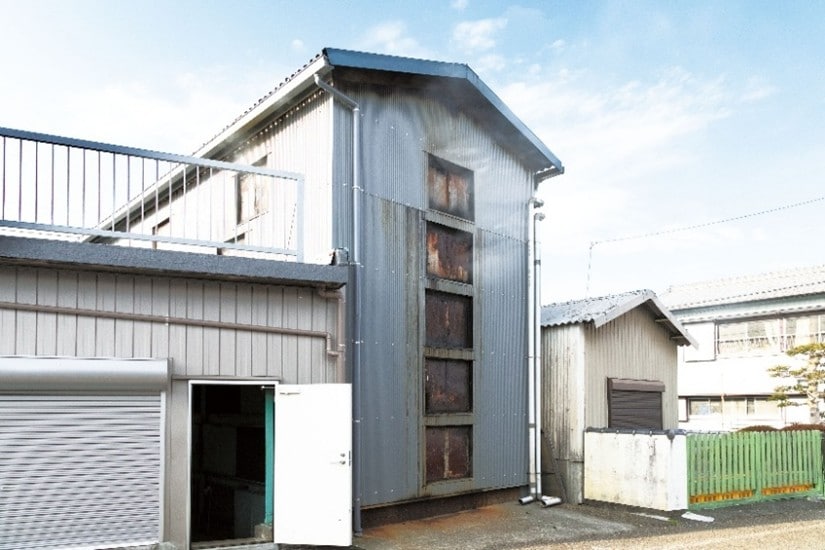
The tower is divided into five layers: baikan is started with fillets placed in the first layer, then they are moved away from fire to the second, then to the third layers, and finally to the fifth layer for adjustment.
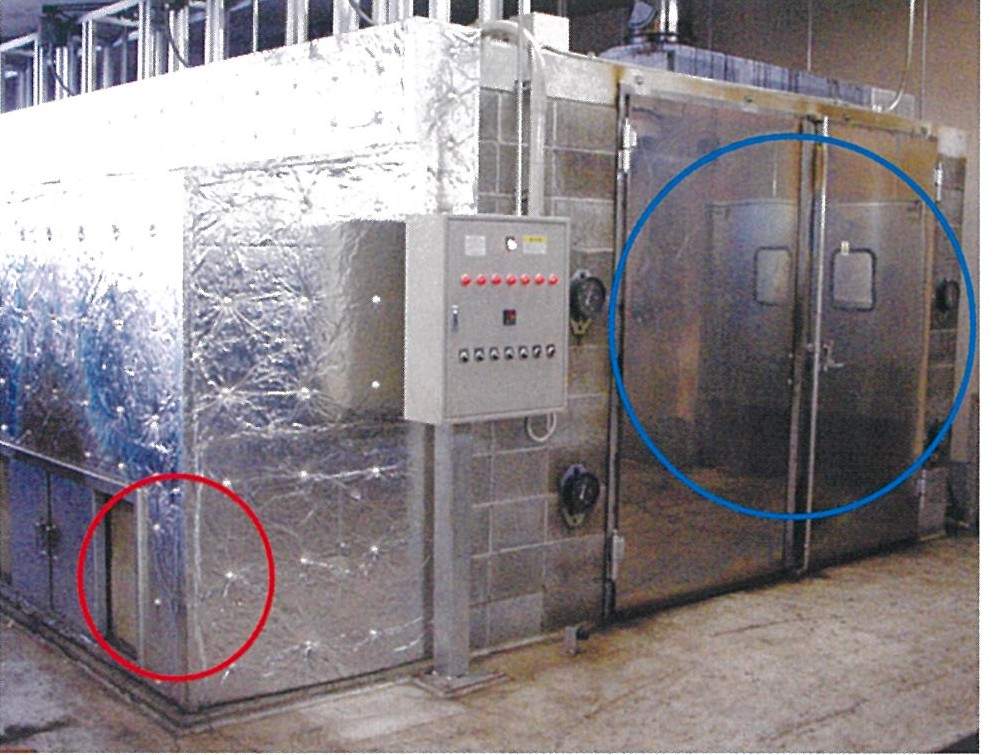
The fire bed is in the place marked with a red circle. Smoke and heat are sent by a fan into the baikan chamber with a blue circle mark.
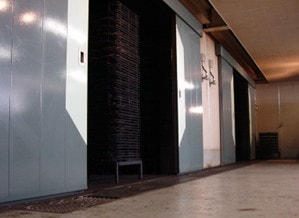
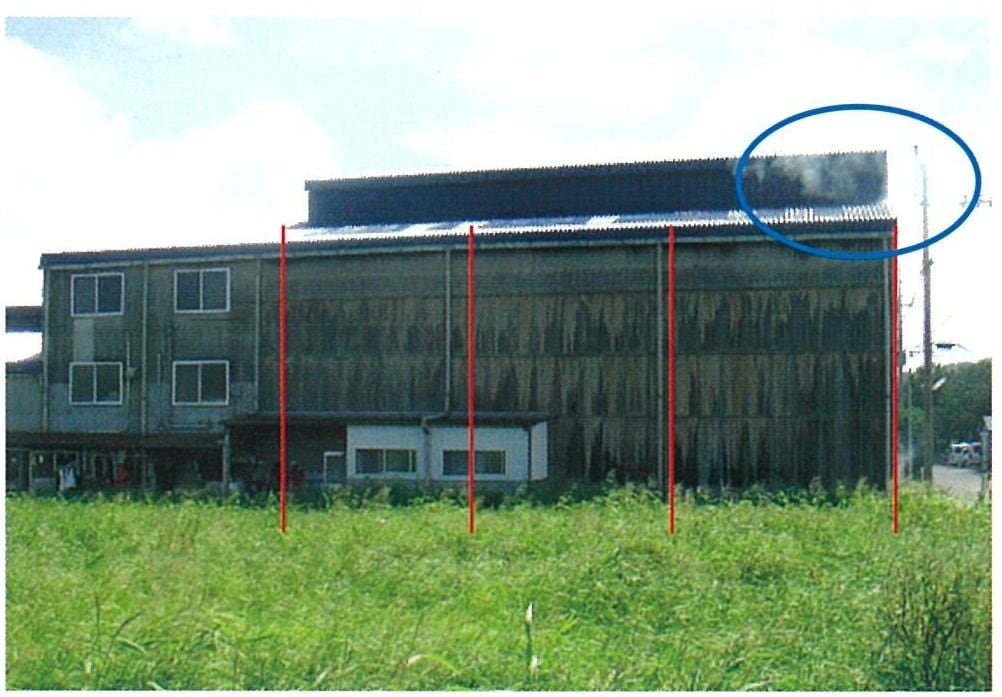
It is a three-story building with a basement. Logs are burned in the basement and baikan is performed on the first, second, or third floor depending on how much bushi is dried. The kyuzzoko shown in the photo is divided into three blocks (red lines) to adjust production. The rightmost block is in operation (blue circle mark).
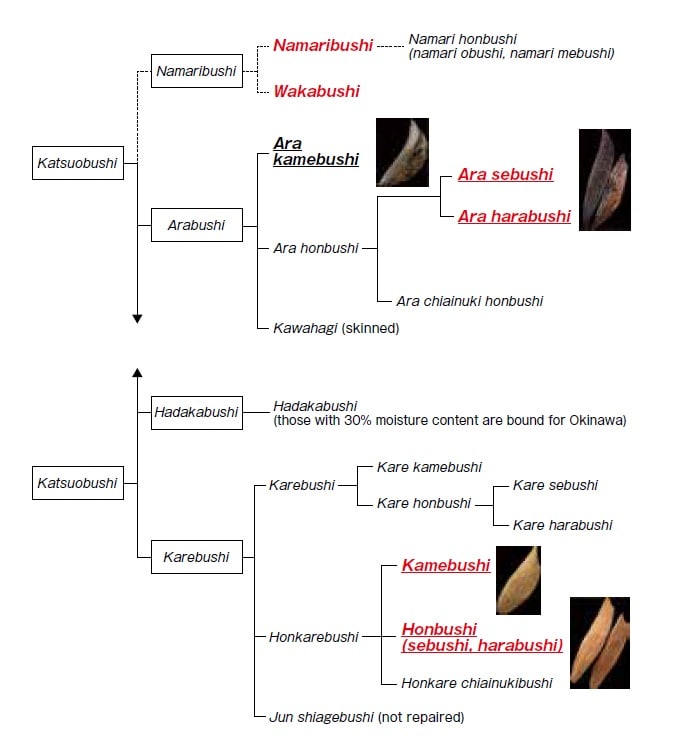
・Katsuobushi at different steps of production process is sold as different products.
・These products are named in accordance with the rule of Japan Katsuobushi Association. Naming rule: Fish name (katsuo or maguro ) + process + form. For example, if fish is katsuo , process is ara , and form is honbushi , it is called katsuo arahonbushi .
Note: As is often the case with traditional food industries, people often follow the conventional business practices and it is difficult to collate bushi -related statistical figures.
3. Science of katsuobushi
①Fat content in katsuo
Katsuobushi is made only from katsuo. Not just any katsuo is suitable. If unsuitable katsuo is used, even if the production process shown in Figure 3 is implemented under perfect conditions, you won’t get good quality katsuobushi. It is first necessary to select katsuo suitable for katsuobushi. Except for premium products, most katsuobushi is made from frozen katsuo caught by overseas purse seiners in southern waters. FADs (fish aggregating devices) leveraging the behavior of katsuo and tuna ensure efficient fishing. However, there is a ban period for fishing using FADs for resource management of tuna. In 2026, FADs are prohibited for 1.5 months in the exclusive economic zone (EEZ) and for 2.5 months on the high seas. During these periods, overseas purse seiners target fatty katsuo in the deep sea and therefore fatty katsuo is mainly used for katsuobushi. Not all katsuo caught in the seas around Japan is suitable as an ingredient of katsuobushi. Table 2 shows the nutritional facts of hatsugatsuo and modorigatsuo, taken from the Standard Table of Food Composition in Japan (8th revised edition).(9)
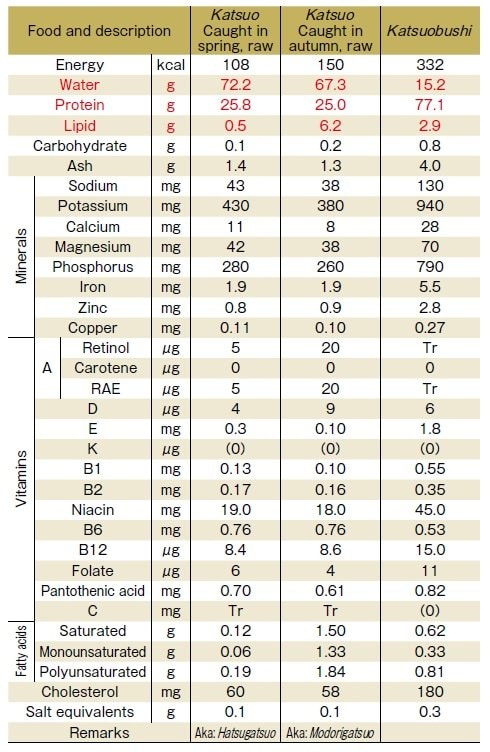
Fat content greatly influences katsuobushi quality. If katsuobushi has a high fat content, a phenomenon called shirata may occur. Katsuobushi with shirata is more likely to crumble when grated into flakes and the flakes are also likely to break into powder. In addition, a report reveals that shirata deteriorates the taste, makes dashi cloudy, and reduces the free amino acid content and inosinic acid content. Raw katsuo caught in autumn (modorigatsuo) has a high fat content of more than 6% and very likely to cause shirata. Modorigatsuo is delectable as sashimi and tataki (seared sashimi) but not fit for katsuobushi. In contrast, katsuo caught in spring (hatsugatsuo) has only a 0.5% fat content and suits katsuobushi. (11、12)
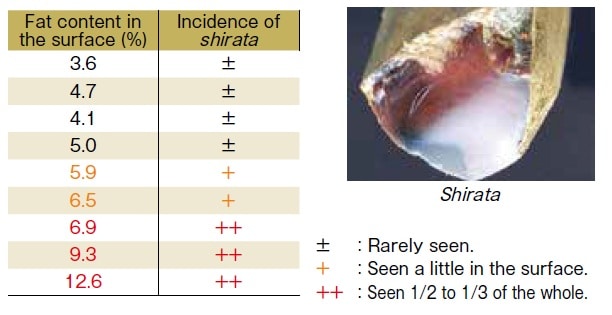
Fat in katsuo is mostly contained as subcutaneous fat and orbital fat and in stomach and intestines. (10) When making katsuobushi, the head and innards are removed but subcutaneous fat cannot be removed completely even by shajuku. Residual fat makes moisture in namari hard to remove during baikan and hinders drying. When selecting katsuobushi in a store, check the skin left near the tail. Avoid katsuobushi with deeply wrinkled skin and choose ones with no or slight wrinkles.
②Changes in inosinic acid quantity
The main umami component of katsuobushi is inosinic acid. Production of inosinic acid is explained based on Figure 6. ATP (adenosine triphosphate), which is energy currency used to move muscles, is decomposed rapidly by nuclease to ADP (adenosine diphosphate), then to AMP (adenosine monophosphate), and to IMP (inosine monophosphate or inosinic acid). Since the decomposition slows down after IMP, IMP accumulates in muscles. Over time, it is further broken down to inosine and then to hypoxanthine. Among these nucleic acid related substances, it is only IMP that has umami. Very fresh katsuo that has just been caught won’t have much of its distinct umami. To make katsuobushi rich in inosinic acid, katsuo needs to be simmered (shajuku) when the accumulation of inosinic acid peaks. This inactivates nuclease and retains inosinic acid. It resembles the aging of tuna and beef.
Therefore, katsuo for katsuobushi is selected, based on the operating area and characteristics of the fishing boat to place a bid for; the fattiness, freshness and size of sample katsuo; the flow of the Japan Current and water temperature distribution; information on future deep-sea fishing, fishing regulations (Western and Central Pacific Fisheries Commission (*4)), and price trends.
(*4) Western and Central Pacific Fisheries Commission (WCPFC) WCPFC is a regional fishery management organization for highly migratory fish stocks in Pacific Ocean west of 150°W including Japan in the northern hemisphere and west of 130°W, east of 141°E, and north of 60°S in the southern hemisphere. The fish stocks include bluefin tuna, bigeye tuna, skipjack tuna, yellowfin tuna, albacore, marlin, and marine sharks.

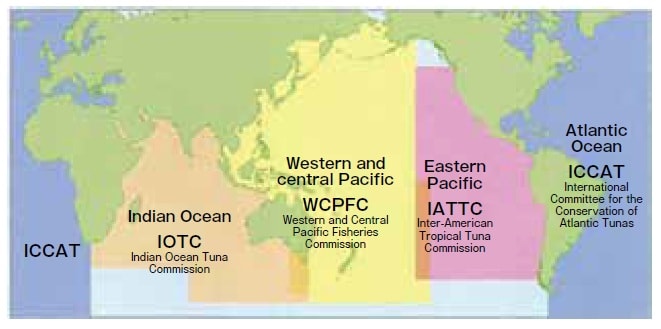
4. Science of dashi
Dashi omission test is a study to identify important components consisting of katsuobushi dashi. First, possible components of katsuo honkarebushi dashi (nitrogen-containing components: free amino acids, nucleic acid related substances (e.g., IMP), organic bases, and peptides, and nitrogen-free components: organic acids and sugars) are identified and analyzed. Using the resulting data, synthetic katsuobushi dashi is prepared. Each component is omitted from each group and the differences in taste indicate the key components. The dashi omission test shows that katsuobushi dashi is made up of the following nine key components.
Histidine, glutamic acid, inosinic acid, lactic acid, creatinine, inosine, hypoxanthine, sodium, and chlorine
The following table shows how the tastes changed when each of the components was omitted. Each taste is marked with + when slightly enhanced and ++ when greatly enhanced for each component. They are also marked − when slightly reduced and −− when greatly reduced. The representative umami of katsuobushi dashi is said to be inosinic acid. But eight other components are also playing an important supporting role.(14)
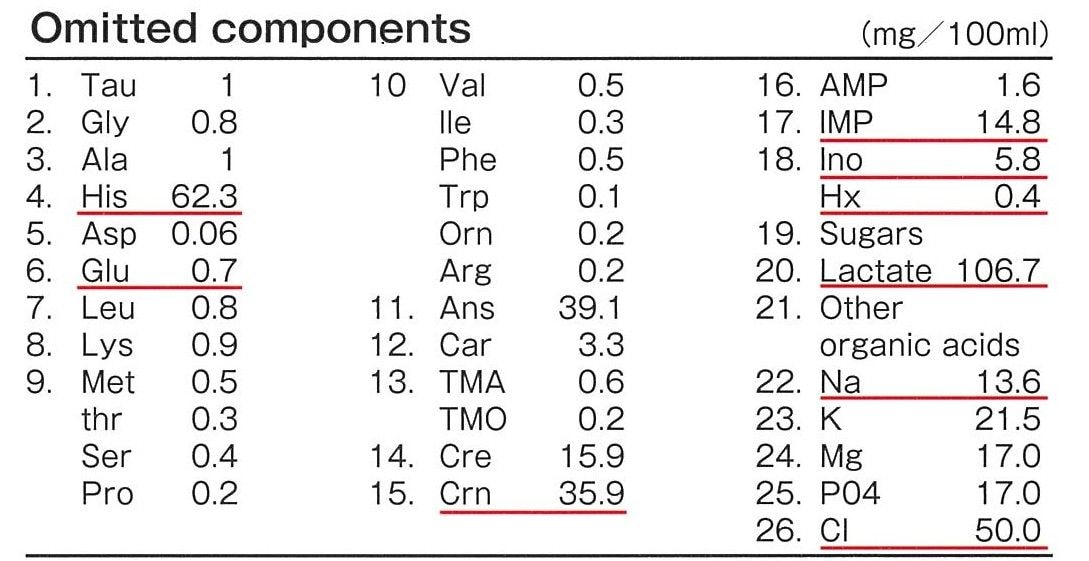
Omitted components
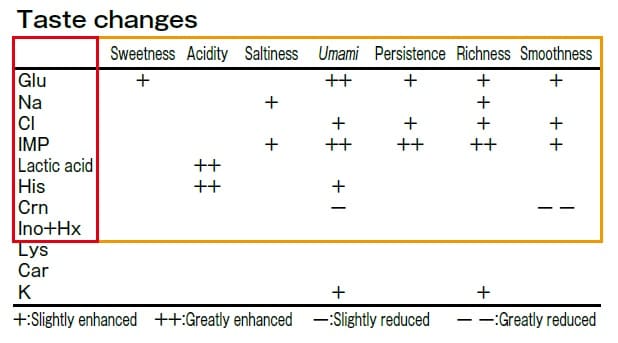
As to the salt reduction effect of katsuobushi discussed below, the studies for selection of relevant components were started based on this omission test result.
5. Science of katsuobushi dashi making
Soft water is used to make katsuobushi dashi just like kombu dashi. Tap water contains chlorine for hygienic reasons. It is recommended that tap water should be dechlorinated with a home water purifier. It is also recommended that soft water should be used. Hard water does not suit the aroma and taste of dashi.
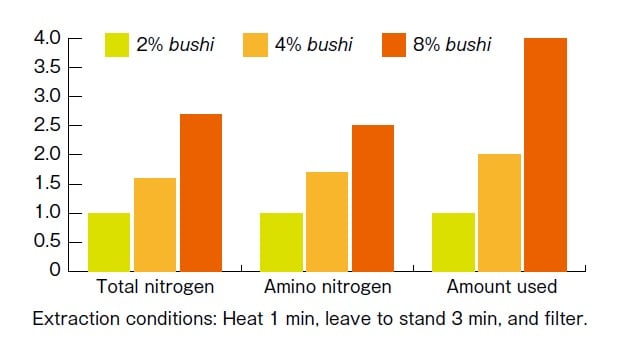
When making dashi using katsuobushi, the extraction efficiency of dashi components varies with the amount and thickness (*5) of flakes used. The extraction efficiencies were obtained by examining the extracted components (total nitrogen and amino nitrogen) in dashi.
(*5) JAS specifies that thin flakes are 0.2 mm or less and thick flakes are over 0.2 mm in thickness.
①Ratio of katsuobushi flakes to water for highly efficient dashi making
Refer to Figure 8. The test was performed using 2% (base), 4% (twofold) and 8% (fourfold) katsuobushi flakes. The result indicates that total nitrogen and amino nitrogen didn’t increase twofold or fourfold. This means dashi components remain in the used flakes. You should make second dashi.(16)
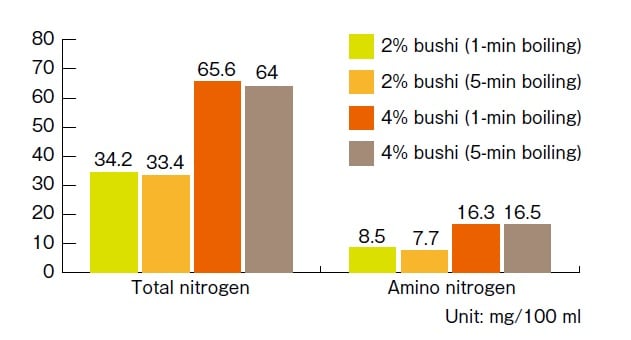
There is no difference in extraction of dashi components between 1 min and 5 min. 1 min is long enough to make dashi . (16)
Dashi yield varies between summer and winter and with pan size and type of stove (gas and induction). Therefore, we recommend the following methods to make quality dashi with high extraction efficiency, constant yield, and little cloudiness.
①Making the first dashi
- When water in the pan comes to boil, turn off the heat.
- Put thin flakes of katsuobushi at 3% of water and leave it to stand for one or two minutes.
- Spread gauze or paper towel on a sieve, strain flakes, and leave to stand for one minute.
- Do not squeeze the flakes.
②Making the second dashi
- Place the used flakes in a pan and add water half that used in making the first dashi .
- After it begins to boil, simmer on low heat for three to five minutes, and turn off the heat.
- Add 1/6 of new flakes used for the first dashi and leave to stand for one or two minutes.
- Spread gauze or paper towel on a sieve and strain flakes.
- Lightly squeeze the flakes.
※Adding new flakes is called oigatsuo in culinary science. This enhances the aroma of the second dashi
③Dashi making time by flake thickness
Sometimes, strong dashi is needed, for instance, to make dipping sauce for soba noodles. Using thin flakes, the required quantity may be so large that flakes may not be well soaked in water. In that case, use thick flakes. Thick flakes are generally 0.8 to 1.0 mm in thickness. They are four to five times as thick as common thin flakes. To ensure high extraction efficiency, it is necessary to add flakes while the water is boiling, adjust the heat, and keep it gently boiling for 40 to 50 minutes.(17)
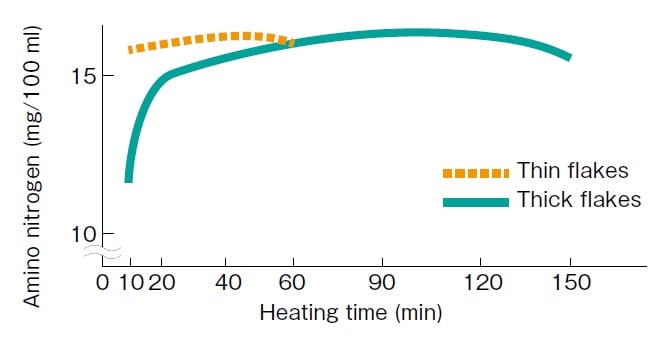
Note: The thickness varies from manufacturer to manufacturer. Ask the manufacturer.
・Because it takes longer to make dashi using thick flakes, amino acid reacts with sugar in dashi and the Maillard reaction produces browning substance (melanoidin). Some experts believe that this substance imparts richness. The same effect may occur to soba sauce base in dotanpo (*6) passed down from generation to generation for tens of years at a long-established soba restaurant.
(*6) Dotanpo is a ceramic container used to heat soba dipping sauce in a bain-marie. In the past, most dotanpo was made of unglazed ceramics.(18)
6. Science of katsuobushi flakes
The expiration period (best-by) of katsuobushi is two years when kept in a package and one year after the package is opened. But, after processed into flakes, the aroma fades and off-odor components are produced rapidly in several days. This is caused by many reactions such as:
- Production of off-odor components including linear aldehydes due to lipid oxidation and degradation
- Dissipation of beneficial volatile components (*7)
- Reduction of hydrogen sulfide by oxidation and change to sulfur(15)
(*7) Katsuobushi is said to have more than 400 types of aroma components. Many beneficial aroma components evaporate at low boiling points.(13)
<Storage of katsuobushi flakes after package is opened>>
After the package is opened, it is ideal to use it up. However, some flakes come in large bags.
- Remove the air inside the bag as much as possible. (If it is a zipper bag, remove the air in the bag and close the zipper.)
- Avoid intense light and store it in a fridge. Do not store in a freezer.(15)
7. Intriguing power of katsuobushi and katsuobushi dashi
Food serves various functions. Primarily it provides nutritional components essential to life, then pleases the palate, and lastly adjusts the functions of the body. This section mainly discusses the functions to please the palate.
①Adhesion of bitterness by katsuobushi flakes
- The bitter substances of bitter melon are triterpenoids. Katsuobushi flakes adhere to these triterpenoids. In stomach acids, triterpenoids are released from the flakes.(19)
②Antioxidant effect of katsuobushi dashi in cooking
- When katsuo dashi was used for simmered sardines, the fishy smell was reduced. The DPPH radical scavenging activity of the broth increased and the TBA value of sardines fell.(20)
③Reduction in acidity and acidic smell by addition of katsuo dashi
- The acidity of lactic acid and the acidic smell of acetic acid decreased in proportion to the amount of katsuo dashi added. Acetic acids derived from aroma components in a dressing and mayonnaise were reduced by 71% and 83%, respectively.(21)
④Improvement to salt y tas te preference and enhancement of saltiness by katsuo dashi(22)(23)
- The aroma of katsuo dashi has an effect of increasing preference for a low-salt saline solution.
- Umami of katsuo dashi has an effect of increasing preference for a low-salt diet.
- Histidine contained in katsuo dashi has an effect of enhancing salty taste.
These three effects of salty taste improvement indicate that using katsuo dashi may help extend health life expectancy in Japan, where the population is rapidly aging.
8. Closing
There are many research reports about physiological functions of katsuobushi dashi. They are published in the literature (24) below.
<Expected effects on human body>
- Alleviate fatigue (mental and physical).
- Control high blood pressure.
- Slow gastric emptying, which helps you feel full longer.
- Facilitate stomach movement.
- Stimulate salivary secretion.
- Alleviate hunger and increase satiety.
- Increase brain activation.
- Suppress fat intake and calorie intake.
<Expected effects on the state of mind and emotional behavior>
- Improve mood and emotional state (especially feeling of fatigue).
- Decrease aggressive behavior.
- Reduce depressive-like behavior.
- Reduce anxiety-like behavior.
We hope the research will progress further.
- 1Japan Tourism Agency, Ministry of Land, Infrastructure, Transport and Tourism. Honichi Gaikokujin Shohidoko Chosa (survey on consumption trends of inbound tourists).
- 2Yoko Okubo. Edo no Chomiryo (seasonings of Edo), Journal of the Japan Society of Cookery Science, Vol.147, No.4, 233-235 (2014).
- 3Akira Matsui. Kokogaku kara Mita Katsuoryo (katsuo fishing from an archaeological perspective), Nihonjin wa naze katsuo wo tabete kitanoka (why have Japanese been eating skipjack tuna), Ajinomoto Foundation for Dietary Culture (2005).
- 4Shigeji Ogura. Kodai no Hyakkazensho “Engishiki” no Tabunya Kyodokenkyu - Chukan hokoku (Multidisciplinary Collaborative Research on the Ancient Encyclopedia “Engishiki ” - Interim report), Bulletin of the National Museum of Japanese History (2019)
- 5Akira Miyashita. Katsuobushi Jokan (katsuobushi volume 1), Japan Katsuobushi Association (1989).
Akira Miyashita. Mono to Ningen no Bunkashi 97 Katsuobushi (cultural history of things and humans, 97 katsuobushi ), Hosei University Press (2000). - 6Isao Kumakura and Toru Fushiki (supervised), Shinya Fuke (edited). Dashi towa Nanika (what is dashi ), I & K Corporation (2014).
- 7Satoshi Ishikawa. Chapter 6 Washoku to Sakana (Japanese cuisine and fish), Shitte Okitai Washoku no Bunka (washoku culture you should know) edited by Yo-ichiro Sato, Benseisha Publishing (2022). Original is taken from the Japan Kombu Association website.
- 8Takashi Okui. Kombu to Nihonjin (kelp and Japanese), Nikkei Business Publications (2012).
- 9Council for Science and Technology, Ministry of Education, Culture, Sports, Science and Technology. Resources research subcommittee report: 2022 Standard Table of Food Composition in Japan (8th revised edition).
- 10Mayuko Morita et al. Nihon Taiheiyogan no Noborikatsuo oyobi Kudarikatsuo no Kakubui ni okeru Shishitsu Henka (changes in fat by part of northbound and southbound skipjack tuna along Japan’s pacific coast), Nippon Suisan Gakkaishi , vol.69, No.6 (2003).
- 11Chiaki Koizumi. Katsuobushi no Shirata ni kansuru Kenkyu II (research on shirata of katsuobushi II), Nippon Suisan Gakkaishi , vol.27, No.2 (1961).
- 12Fumio Takenaga et al. Shirata Katsuobushi to Seijo na Katsuobushi no Soshishitsu no Hikaku (comparison in total fat between katsuobushi with shirata and normal katsuobushi ), Journal of the Japanese Society for Food Science and Technology , Vol.38, No.4 (1991).
- 13“Oishisa no Kagaku ” planning committee. Katsuodashi ga Yamitsuki ni naru Riyu (reason for getting addicted to katsuo dashi ), Oishisa no Kagaku Series No.4 (2012).
- 14Shinya Fuke. Katsuo Ekisu, Dashi no Seibun to Teimisei (skipjack tuna extract, dashi components and taste quality), Nihonjin wa naze katsuo wo tabete kitanoka , Ajinomoto Foundation for Dietary Culture (2005).
- 15Hirokazu Kawaguchi. Katsuobushi Fureba no Seisei to Rekka (generation and degradation of katsuobushi flavor), Nihonjin wa naze katsuo wo tabete kitanoka, Ajinomoto Foundation for Dietary Culture (2005).
- 16Fujiko Yoshimatsu. Nidashijiru no Kenkyu (Dai Ippo ) (research of dashi: 1st report), Journal of home economics of Japan , Vol.5, pp. 359-361.
- 17Fujiko Yoshimatsu. Dashibiki no Kagaku (science of dashi making), Bessatsu Shokudo Soba Udon (separate volume: restaurants, soba and udon noodles), Vo.7 (1980).
- 18Shigeru Niijima. Soba no Jiten (dictionary of soba ), Shibatashoten (1999).
- 19Kenji Maebashi et al. Kezuribushi ni yoru Goya no Nigami Jokyokoka (katsuobushi flakes’ effect of eliminating bitterness from bitter melon), Journal of the Japanese Society for Food Science and Technology , Vol.55, No.4 (2008).
- 20Aki Nashimoto et al. Chori ni okeru Katsuobushi dashi no Kosankakoka (antioxidant effect of katsuobushi dashi in cooking), Journal of the Japan Society of Cookery Science , Vol.41, No.3 (2008).
- 21Jun Yamada et al. Katsuobushi dashi no Tenka ni yoru Sanmi, Sanshu Yokuseikoka (reduction in acidity and acidic smell by addition of katsuo dashi ), Journal of the Japan Society of Cookery Science , Vol.44, No.2 (2011).
- 22Mariko Manabe. Washoku Tokuyu no Kaori ga Enmi ni Oyobosu Eikyo - Dashi to Shoyu (effects of characteristic aroma of washoku on salty taste - dashi and soy sauce), Journal of the Japan Soy Sauce Technology Center , Vol.46, No.4 (2020).
- 23Mariko Manabe. Katsuodashi no Enmi Zokyokoka ni Kiyosuru Teimi Busshitsu (taste substances contributing to the katsuo dashi’s effect of enhancing salty taste), Journal of the Japan Society of Cookery Science , Vol.51, No.3, 173-179 (2018).
- 24Takashi Kondo et al. Mechanism of Suppressive Effects of Dried Bonito Dashi on Aggressive Behaviors in Mice, Journal of the Brewing Society of Japan , Vol.112, No.12 (2017).
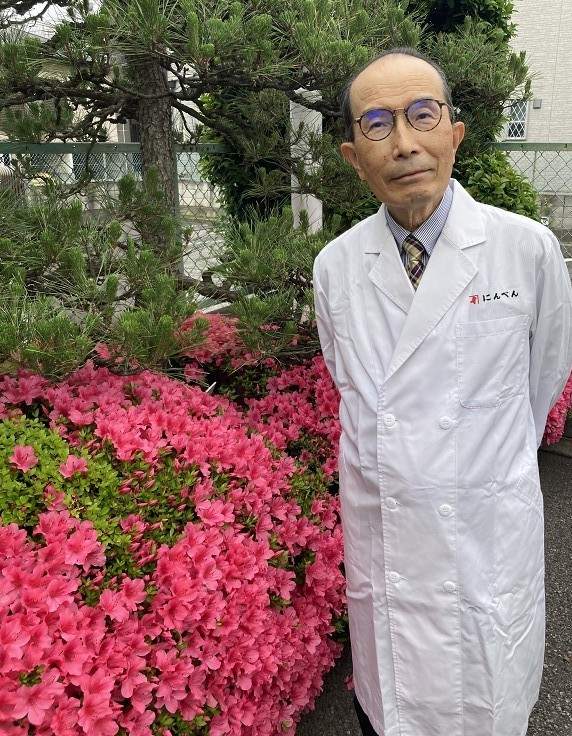
Graduated from the Department of Fisheries, School of Marine Science and Technology, Tokai University.
After joining Ninben Co., Ltd., he engaged in analysis and safety assessment of katsuobushi and new products, basic improvement research of katsuobushi and flakes, and applied research of beneficial katsuobushi molds at the R&D department. Engaged in development of new seasonings. Chief engineer in quality control and sterilization control.
Took office as executive officer, head of R&D Department in 2003 and left office in March 2012. Left the company in March 2026. Organized katsuobushi food education class for young children to adults. Former director of the Japan Soysauce Technology Center, former Japan Katsuobushi Association expert member.