
Japanese traditional sake brewing inscribed as a UNESCO Intangible Cultural Heritage
-Functions and importance of koji mold
Japanese traditional sake brewing inscribed as a UNESCO Intangible Cultural Heritage
-Functions and importance of koji mold
1)Inscription of traditional sake brewing on the UNESCO Intangible Cultural Heritage list
Following the registration of washoku as a UNESCO Intangible Cultural Heritage in 2013, traditional sake brewing was also inscribed on the list in 2024. Careful preparations were made for the application through the registration, including procedures in Japan.
First, registration as a registered intangible cultural property of Japan was needed. To that end, the Preservation Society of Japanese Koji-based Sake Making Craftsmanship (president: Shinemon Konishi) was established in April 2021. On October 15, 2021,the Council for Cultural Affairs submitted a report to the Minister of Education, Culture, Sports, Science and Technology and recommended that the traditional sake brewing, i.e., brewing technology using Japan’s traditional koji mold, should be registered as a registered intangible cultural property of Japan. In the meantime,the National Tax Agency was conducting research on sake brewing using Japan’s traditional koji mold. The agency announced the result in December 2021 (https://www.nta.go.jp/taxes/sake/koujikin/pdf/0021012-102_01.pdf). The report was supervised and contributed by Eiji Ichishima (Professor Emeritus at Tohoku University and the Tokyo University of Agriculture and Technology), Noritake Kanzaki (former director of the Institute for the Culture of Travel), Katsuhiko Kitamoto (Professor Emeritus at the University of Tokyo and Research Professor at Nihon Pharmaceutical University), Takeo Koizumi (Professor Emeritus at the Tokyo University of Agriculture), Nami Goto (former president of National Research Institute of Brewing), Yoshihiro Sameshima (Former professor at Kagoshima University), John Gauntner (Sake World),and Kenjiro Monji (former UNESCO Ambassador). The report was compiled in a short time, but it goes into detail about traditional sake brewing, including the importance of koji.
On February 25, 2022, “Traditional knowledge and skills of sake-making with koji mold in Japan” was selected as a candidate to propose for the inscription on the UNESCO’s Intangible Cultural Heritage list by the Intangible Cultural Heritage Subcommittee of the Council for Cultural Affairs. However, it was not examined because the number of nomination files submitted by Japan exceeded the limit for that year.
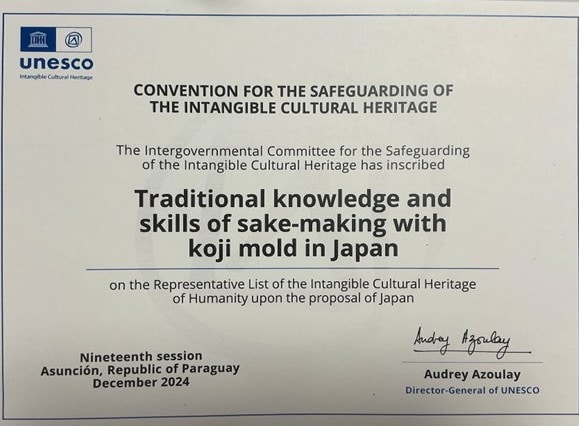
On March 8, 2023, the Intangible Cultural Heritage Subcommittee held a meeting and selected “traditional sake brewing” again to propose for the Representative List of the Intangible Cultural Heritage of Humanity. A nomination of the proposed element was submitted and, after a one-year examination, the Evaluation Body of the Intergovernmental Committee for the Safeguarding of Intangible Cultural Heritage recommended “inscription”on November 5, 2024. The Intergovernmental Committee decided to inscribe the element on the Representative list at its 19th meeting held in Paraguay on December 5,2024 (Figure 1). This decision on the inscription was extensively covered by TV and other media in Japan. I recall that sake breweries across the country appeared repeatedly on TV. The project was completed about five years after the preparations were first made with the National Tax Agency and the Agency for Cultural Affairs playing a central role.
2)Three types of koji
When the sake brewing was nominated, there were three UNESCO Intangible Cultural Heritages related to alcoholic beverages: Georgian wine (2013), Belgian beer culture (2016), and Mongolian airag (fermented mare milk) (2019). Something was needed to differentiate sake from these beverages. It was “sake-making with koji mold in Japan.” In Japanese koji is written in hiragana, which seems strange to a koji mold researcher. In technical terms, kanji 麹 is used. In fact, koji , long used for sake,miso, and soy sauce, is written in several different ways. Besides 麹, another kanji 糀 is also used.
The character 麹 comes from China. It is pronounced “koji” in Japanese reading and “kiku” in Chinese reading. As it has Japanese reading, it is considered that koji was already used in Japan when this kanji was brought from China in the 7th century. Some kanji, such as 茶 (tea) and 菊 (chrysanthemum), do not have Japanese reading. This indicates that they didn’t exist in Japan when these kanji were introduced. The kanji like 糀 were created in the Edo period. They are called kokuji (national character). Naturally, they have only Japanese reading. The radical of 糀 is 米 (rice) whereas that of 麹 is 麦 (wheat). It makes sense because rice is used for Japanese koji.
Figure 2 shows the photos of barakoji (loose koji ) used for Japanese sake brewing and mochikoji (caked koji ) used for Chinese Shaoxing wine. Koji for Shaoxing wine is produced using wheat not rice. The reason why koji is written in hiragana in the title for the inscription seems to be that hiragana is used instead of kanji 麹 in the Japanese Liquor Tax Act. In this article, 麹 is used as it is the most commonly used character.
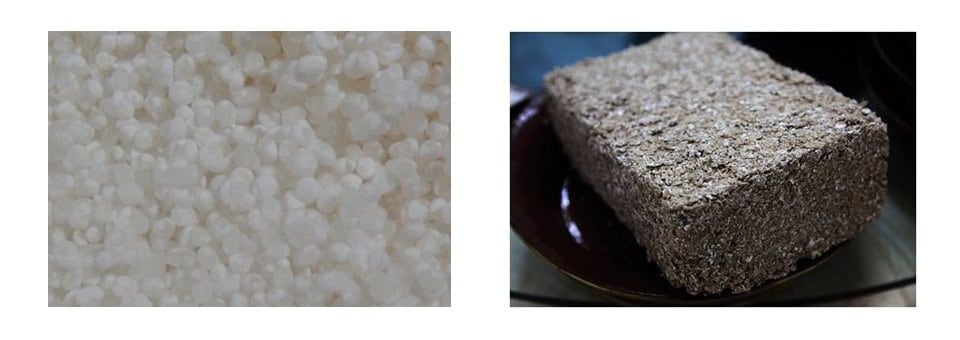
【right】Mochikoji : Koji used for Shaoxing wine, also called bakkyoku (wheat koji ) (Provided by Mr. Ryokon Natsu, Guyue Longshan)
3)Roles of koji
Umami (savoriness) of washoku is imparted by miso,soy sauce, mirin, vinegar, sake and other food made with koji. You could say koji mold is a key player that determines the taste of washoku. Shiokoji (salt koji), a relatively recent fad in Japan, is now attracting attention across the world. Koji mold has also been used for other purposes besides food for a long time. A typical example is Takadiastase, a digestive enzyme preparation put to practical use by Jokichi Takamine in 1894. This preparation is still widely used as a component of digestive medicines.
Koji mold is also used for production of useful proteins as the host for genetic engineering. An example is an enzyme preparation added to a detergent. This is alkaline lipase produced from Humicola lanuginosa, a filamentous fungus, using koji mold. Humicola lanuginosa normally produces only a small amount of lipase, but the production is increased by introducing its gene into koji mold.
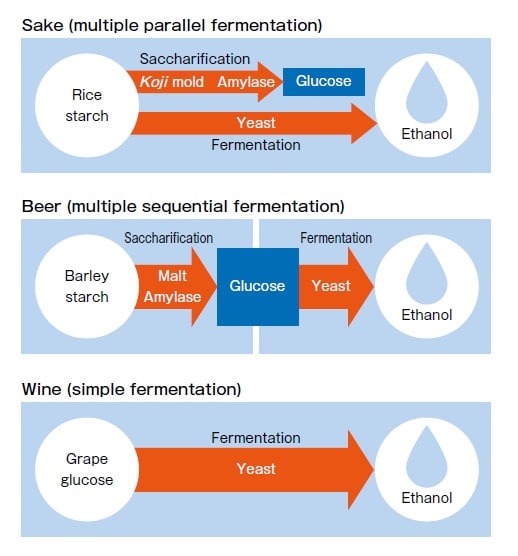
Alcoholic beverages are produced in various traditional processes across the world (Figure 3). The simplest example is wine making. Sugar in grapes is fermented directly by yeast to produce alcohol. Most of alcohol drinks in the world are made from staple grains, such as sake and Shaoxing wine from rice and beer from barley. Yeast cannot directly ferment starch contained in grains and needs a process of converting starch to sugar. Specifically, starch is decomposed into glucose or other sugars by amylase (saccharification enzyme) and then alcohol is produced by yeast. In this saccharification process, mold amylases are used in Eastern countries and barley amylase in Western countries. Kuchikamizake (mouth-chewed sake) has been made around the world. Kuchikamizake is made by chewing a grain or any other starchy material, spitting it into a container, and allowing it to ferment naturally. Amylase in saliva breaks down starch into sugars. While kept in the container, the sugars are fermented by yeast and alcohol is produced. Kuchikamizake is found in Southeast Asia, the South Pacific region, South America, and other parts of the world.
There is a theory that a verb kamosu (brew alcoholic beverages) is derived from kamu (chew) of kuchikamizake. Another theory suggests that it comes from kabu meaning to grow mold (kabi). It might have changed from kamu to kabiru (kabu) and then to kamosu.
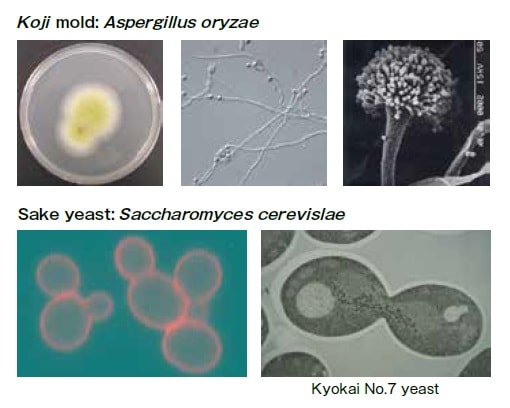
The scientific name of koji mold used for sake is Aspergillus oryzae. It is a type of filamentous fungus forming hyphae made of long thin cells connected. It is different in shape from sake yeast, which is oval. As the mold grows, a stalk called a sporagiophore rises and forms spores (Figure 4). Oryzae means rice and thus A. oryzae is a mold species of the Genus Aspergillus that grows on rice. Spores are called a koji starter or moyashi in sake making.
Koji serves the following functions in sake brewing. First, koji is made by spraying a koji starter over steamed rice and culturing for 44 hours. Koji contains various hydrolytic enzymes, including amylase and protease. In particular, amylase is the most important. It converts rice starch to glucose. Glucose is then converted to alcohol by yeast, which makes sake. Protease functions to produce umami components, such as amino acids and peptides. Koji also has functions to supply nutrients like vitamins and minerals to yeast to help yeast to multiply. Genome information of koji mold indicates that it can produce more than 100 kinds of hydrolytic enzymes. Besides amylase and protease, many other enzymes, although limited in quantity, also have effects on the flavor of sake. In fermented mash, glucose made with saccharification by koji is converted by yeast into alcohol. Koji includes protease besides amylase. Amino acids and peptides produced in this process multiply yeast and greatly inf luence the f lavor of sake. Two totally different processes, saccharification and fermentation, take place simultaneously in mash. This is called multiple parallel fermentation. It is the reason why sake has nearly 20% Alcohol By Volume, the highest among all the fermented beverages in the world.
4)Types of amazake and health benefits
Amazake (sweet sake) has two types. They are koji amazake and sake lees amazake. Koji amazake does not contain alcohol, but sake lees amazake contains a small amount of alcohol (below 1%).
Koji amazake has been around for a long time. In the Edo period, amazake was popular and amazake vendors were a common sight of summer. People had amazake particularly in summer because probably they knew that nutritious amazake prevented summer fatigue and that it was an energy boost.
Recently research into the functional components of amazake has made progress and it is now known that sake lees and rice koji contain a lot of components good for health and beauty care as listed below. As to antioxidant (anti-aging) effects, antioxidant activity of amazake was reported (Sojo University in 2007, Kanazawa Institute of Technology in 2009, Kanazawa University in 2011) and ergothioneine was found as an antioxidant of amazake (Hakkaisan Brewery in 2016). Reports on improvement to digestion and gut flora include bifidogenic growth stimulating oligopeptide in rice bran koji (Kikkoman in 1991), an increase in beneficial gut bacteria by intake of acid protease of rice koji mold (Hiroshima University in 2016), gut microbiome improvement by glucosylceramide contained in koji (Saga University in 2016). Ergothioneine, often called longevity vitamin, is now in the spotlight from its high antioxidant activity. There are also moisturizing components, including glucosylceramide contained in koji (Saga University in 2016) and α-ethyl glucoside produced by α-glucosidase of koji (Kanazawa Institute of Technology in 2018).
Amazake is also called a drinkable Instravenous drip. Enzymes of koji mold break down starch in rice into glucose and protein into amino acids. Amazake is rich in glucose, essential amino acids, B vitamins (e.g., vitamins B1, B2 and B6, folate, biotin, niacin, and pantothenic acid) and good for recovery from fatigue. No amazake claimed to be functional food was on the market as its functionality research was lagging behind unlike yogurt until Hakkaisan Amasake was launched as the first kojiderived functional food in 2024. The label states that Aspergillus oryzae strain HJ1 koji mold improves the intestinal environment and bowel movements and the koji-derived glucosylceramide helps keep moisture in the skin. It is expected that many more functional amazake products will be launched just like yogurt.
The amazake market expanded explosively from 11.9 billion to 16.7 billion yen in 2015, and to 24.6 billion yen in 2017. The Consumption has recently begun to rise again from expectations for an immunity boost and some believe that the second boom has come.
5)History of amazake
Nihon Shoki (the Chronicles of Japan) compiled in the Nara period (710-784), completed in 720, states that amanotamusake was brewed by a goddess Konohananosakuyabime. Amanotamusake is considered to be something similar to present-day amazake. Yoro Ritsuryo Yoro Rei (administrative code in the Yoro Ritsuryo Code) in the Nara period shows that mikinotsukasa (bureau of sake brewing) was set up and 醴 (pronounced kosake or amazake in Japanese reading and rei or rai in Chinese reading) made in a similar way to amazake was brewed. Engishiki (detailed procedures for enforcing ritsuryo codes) compiled in the Heian period (794-1185) indicates that 醴 was made in June and July.
In the middle ages, large temples like Bodaisan Shoryakuji and Amanosan Kongoji began to make soboshu (temple-brewed sake) and shops brewing and selling sake emerged in town. Besides sake shops, koji makers also emerged. Among them, kojiza (koji guild) of Iwashimizu Hachimangu (Yawata-shi, Kyoto) and Kitano Tenmangu (Kamigyo-ku, Kyoto-shi) are well known. Koji was used for making not only sake but also amazake. In the Muromachi period (1336-1573), koji vendors peddled on the street in Kyoto. In the Nippo Jisho (a Japanese- Portuguese dictionary compiled by Jesuit missionaries in 1603), there is an entry for amazaqe. It says “Amazaqe: Fermented juice still bubbling and not fully changed to alcohol, or sweet sake.” This indicates that the word amazake was already used at the beginning of the Edo period. According to Chirizukadan (a collection of essays) in the mid to late Edo period, amazake was originally sold in cold winter in Edo, but it was later sold in hot summer as well. It also says that amazake shops sold throughout the year.
Morisadamanko (encyclopedia on customs and traditions) published at the end of the Edo period mentioned amazake sales by peddlers in Edo (Tokyo) and Keihan (Yodo river basin between present Kyoto and Osaka). A cup of amazake cost 8 mon (the smallest unit of old currency) in Edo and 6 mon in Keihan. Amazake was so familiar to common people that it often appeared in rakugo (the art of storytelling) stories. Especially in Keihan, amazake was popular as a midsummer drink. It was a summer delight that also helped beat the heat and supplement nutrition. It was a kigo (season word) for summer in Haiku. There are two amazake originating in the Edo period in Kanda Myojin: Myojin Amazake of Amanoya and Enju Amazake of Mikawaya Ayabe Shoten. A drawing of a koji room put up in front of Amanoya shows that koji was made in a room dug underground. An excavation survey reveals that koji was also made in a basement like this near Akamon (red gate) of the University of Tokyo on the Hongo plateau.
6)Intestinal immunity and superorganism
It is empirically known that fermented food like amazake boosts immunity. Today, it is said that Japanese people’s intestinal environment is deteriorating because of changes in eating habit and lifestyle. Some point out that one of the reasons for increases in allergic and autoimmune diseases, which were rarely reported before, is changes in the intestinal environment.
The intestinal immune system is an important system that accounts for about 70% of the whole immune system. It identifies pathogenic bacteria and eliminates them. However, in excessively hygienic conditions just as in modern Japan, immune responses become too sensitive and cause atopic dermatitis or hay fever. A human has approximately 38 trillion cells, but 70 to 100 trillion bacteria of 100 to 200 types reside in the intestine. Bacteria outnumber human cells. Nobel laureate Dr. Joshua Lederberg proposed to call human and bacteria collectively superorganism in 2000. The idea is that a human is made up of human cells and bacteria living in the body.
It is becoming clear that health of a human (host) depends greatly on the types of bacteria living in the intestine. Specifically, obesity, dementia, and even lifespan can be influenced as indicated by rat and other experiments. By the way, the word superorganism appears in a game entitled Nyanko Daisensou or The Battle Cats (a game app released in 2010). Dr. Lederberg was 10 years ahead. There is a theory about intestinal immunity called hygiene hypothesis. In 1989, David Strachan conducted a 23-year follow-up survey on 17,414 British people and suggested that lack of exposure to bacteria and viral infection in childhood, i.e., being hygienic, would lead to allergic diseases, including hay fever. This is the hygiene hypothesis he proposed. It is a hypothesis, but similar epidemiological surveys conducted in Europe, Japan and many other countries and regions indicated similar results to Strachan’s hypothesis.
According to this hypothesis, eating yogurt is considered to be effective since intake of Lactobacillus results in a virtual bacterial infection. In the environment, there are various microorganisms, such as bacteria, molds, and yeasts. Lactobacillus is a type of bacteria and is safe microorganism. As to safe microorganisms among molds, what comes to mind are molds used for food, including koji mold of miso and soy sauce and blue mold for Roquefort cheese. With amazake, you can drink koji mold as is. It may be the most ideal way to take in safe mold. Sake and miso are also rich in healthy components. However, they contain ethanol and salt, respectively, making excessive intake harmful to your health. That is not the case with amazake.
Nihon Pharmaceutical University started an amazake project in April 2016, with the aim of getting the various functions (e.g., health and beauty care) of koji mold widely known. Figure 5 shows the roadmap presented at the kick-off meeting. Although the goal for 2025 of more than 20% exceeding in production and consumption volumes of amazake over yogurt is yet to be achieved, the consumption has been steadily increasing. Perhaps “The atopic dermatitis and hay fever cases may be reduced by 10% (?)!!” is not true yet, but I hope it will be in 10 years. Then, amazake will become something that reduces national health care spending and contributes to the health and well-being of Japanese people. I am sure that findings of the functionality research of koji mold, which is still lagging behind, will help explain the health benefits of washoku.
Nihon Pharmaceutical University Amazake Project(Started in April 2016)
It is aimed at getting the various functions (e.g., health and beauty care) of koji mold widely known.
Roadmap
2016: Launch of the first amazake (amakoji - sweet koji) by Nihon Pharmaceutical University
2017: Launch of the second and third amazake. Launch of amazake by the University of Tokyo. (Research on the health benefits of amazake makes progress.)
2020: Amazake becomes so popular that leading food manufacturers begin to make and sell amazake.
2021: Food manufacturers and universities across Japan begin to report on their research on functionality of amazake (koji mold). (Scientific evidence of the functionality of koji mold accumulates.)
2025: Amazake exceeds yogurt in production and consumption volumes by more than 20%.
The atopic dermatitis and hay fever cases may be reduced by 10% (?) in Japan!! Reducing national health care spending!! Contributing to the health and wellbeing of Japanese people!! The functionality of koji mold will help explain the health benefits of washoku.
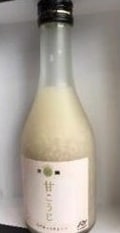

Figure 5. Nihon Pharmaceutical University Amazake Project
The University of Tokyo also started an amazake project at about the same time. Their amazake was launched in July 2020. Unlike Nihon Pharmaceutical University, which is a single-faculty college, the University of Tokyo is a large organization. It took longer than expected to go through a required process, such as product presentation at the university administrations, selection of a manufacturer, and decision on sales method, and thus their product was launched far behind schedule. They used rice produced by their Faculty of Agriculture (Tanashi farm) and koji mold isolated by Kinichiro Sakaguchi, who was called the god of sake. In 2018, Nihon Pharmaceutical University launched koji curry developed jointly with Inoue Spice Industry Co., Ltd. as a spin-off of the amazake project. The concept is Japanese-style curry. It is characterized by the use of rice flour instead of wheat flour and amazake instead of sugar to give a mellow flavor.
7)A. oryzae is a microorganism domesticated in Japan
A Japanese industry-academia-government research team completed genome analysis of koji mold in 2005. The result reveals that the genome size of koji mold is 37 megabases with approximately 12,000 genes. Its genome size is about three times as large as that of sake yeast and the number of genes doubles that of sake yeast. Koji mold is a higher microorganism than yeast with much more complex structure. On October 12, 2006, Professor Emeritus at Tohoku University Eiji Ichishima delivered a keynote speech entitled, “Koji mold is a national microbe,” at the meeting of the Japanese Society for Brewing Science, and Aspergillus oryzae was designated a national microbe. National flowers and birds are quite common, but a national microbe is the first of its kind in the world. In 2012, India designated Lactobacillus bulgaricus used for making yogurt as a national microbe. In 2013, the US state of Oregon designated Saccharomyces cerevisiae as a state microbe.
Now, where does koji mold used for sake brewing come from? Genome analysis of various molds indicates that A. oryzae is considered to be a domesticated microorganism from A. flavus. The genome sequence of A. oryzae closely resembles that of A. flavus (98% or more) but differ in the following respects. For instance, A. oryzae has three α-amylase genes while A. flavus has one. Conidia (spores) of A. oryzae are multinucleate with three to five nuclei, but those of A. flavus are uninucleate. Conidiation of A. oryzae occurs under dark condition whereas A. flavus under light condition. Moreover, it is found that A. flavus produces a f ungal toxin, aflatoxin while genes for aflatoxin production of A. oryzae are missing. It has long been known that koji mold does not produce aflatoxin. The genome information also confirmed its safety.
Based on the above, koji mold is said to be a microorganism domesticated by Japanese. A typical example of domesticated microorganisms is beer yeast. Recently some people consider cultivation and domestication as a form of co-evolution of plants and animals with humans. Based on such concept, we can call koji mold co-evolved microorganism.
8)Closing
Let’s think about the economic impact of inscription on the UNESCO Intangible Cultural Heritage list and potential of koji mold in near future.
The inscription of washoku as a UNESCO Intangible Cultural Heritage in 2013 brought about effects such as a significant increase in the number of Japanese restaurants abroad and a rise in the export of Japanese food, including sake. According to a survey by the Japan Tourism Agency, it is Japanese meals that overseas tourists look forward to most on trips to Japan. This indicates that the recent inscription is expected to boost not only the export of sake and shochu further but also sake brewing overseas, which is beginning to increase.
Japan has seen a significant increase in the export of sake in recent years. Total exports in FY2022 reached 47.4 billion yen, surpassing the previous year for 13 straight years. The export in quantity is a record high of 35,895 kiloliters. Production of sake overseas is also increasing. On the West Coast, Ozeki Sake USA, Inc. (founded in 1979), Takara Sake USA Inc. (1983), Gekkeikan Sake (USA), Inc. (1989), SakeOne Corporation (1997), and Yaegaki Corp. of USA (1999) are producing sake. In 2023, Dassai established Dassai Blue Sake Brewery in New York State and started production. Sake is also made in Korea, Taiwan, Australia, and Vietnam.
In addition, more and more sake contests are being held overseas. The one with the longest history is the US National Sake Appraisal—Joy of Sake, which has been held in Honolulu, Hawaii since 2001. The event is hosted by the International Sake Association, a non-profit organization established by sake lovers living in Hawaii. International Wine Challenge (IWC) set up in 1984 is one of the most prestigious blind tasting competitions in the world. The sake category was added in 2007. Kura Master started in Paris, France in 2017 with the judges are French and other European nationals. Sake Selection was established by Concours Mondial de Bruxelles (CMB) in 2018. Milano Sake Challenge launched in 2019 is held in Milan with the jury including Italian sommeliers.
There is also demand for tourism from overseas, the so-called inbound tourism, which is beginning to be recognized as one of key industries in Japan. The Japan Tourism Agency estimates that the number of inbound tourists will reach 40 million, exceeding expectations, in 2025. In 2030, the number is expected to climb to 60 million. Given that experiential tourism will become a dominant trend, the inscription on the heritage list may help attract more attention to tours of sake breweries across Japan. Luckily, we have more than 1,000 breweries across Japan from Hokkaido to Kyushu. While foreign tourists flocking Kyoto and Mt. Fuji are causing overtourism, sake brewery tourism will greatly help revitalize regions struggling with population decline. The inscription may not simply boost the consumption of traditional sake but also lead to rural revitalization.
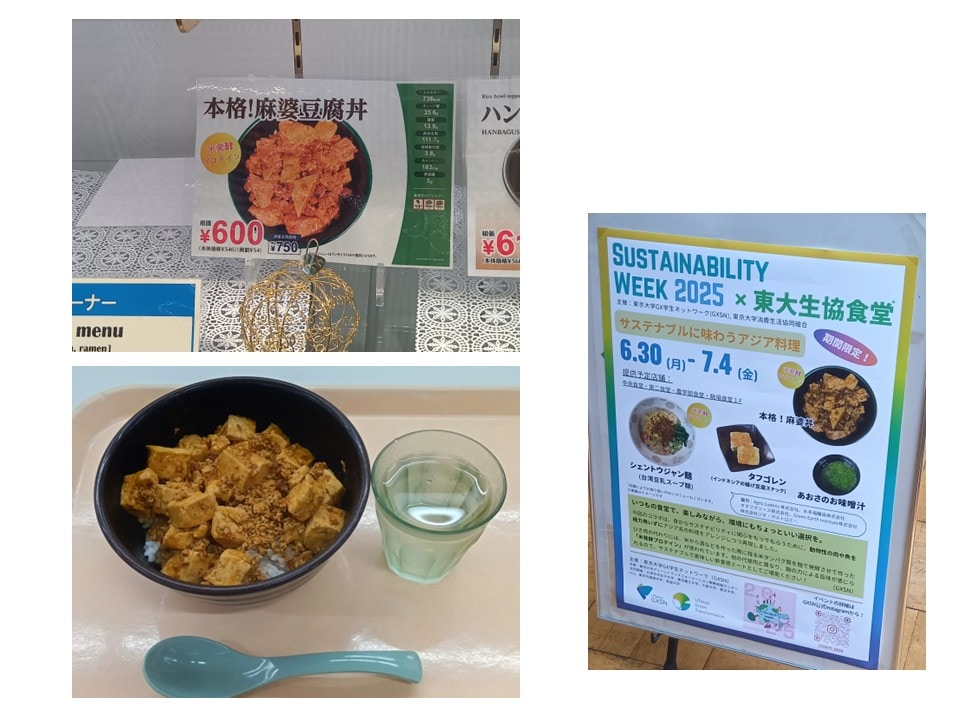
Lastly, as potential of koji mold, mycoproteins (alternative protein derived from fungi) are in the spotlight. Koji Labo, a startup founded in 2024 by associate professor Daisuke Hagiwara at the University of Tsukuba, develops koji-derived alternative meat and protein. At Agro Ludens, a startup established in 2021, Kiyotaka Saga, former assistant professor at the University of Tokyo, develops alternative meat and protein from koji mold. Agro Ludens and Otafuku Sauce started production of mycoproteins, and dishes using their products (e.g., Mapo Tofu bowl and Xian Dou Jiang noodles) were served at the campus cafeteria of Tokyo University as part of Sustainability Week 2025 in June 2025 (Figure 6). It is also said that Hieizan Enryakuji is developing the modern version of Buddhist vegetarian cuisine, modoki ryori (imitation dishes), using koji-derived mycoproteins. Koji mold used for sake brewing for a long time is now expected to be leveraged in various other fields.
This article is a summary of a lecture on “Japanese traditional sake brewing inscribed as a UNESCO Intangible Cultural Heritage—Functions and importance of koji mold” on the Kikkoman food culture course held on October 25, 2025. On that occasion, we invited the participants to make koji amazake and shiokoji and taste them. Figure 7 shows the recipes used then.
On December 20, 2025, a program called “Sake Truth” about the history of sake brewing (Host: Chris Glenn and Guests: Katsuhiko Kitamoto, Koshin Ohara (Abbot of Shoryakuji), etc.) was broadcast on NHK World. This is available to watch by video on demand (Sake Truth - Time and tide | NHK World-Japan). This can be also another effect of the inscription on the UNESCO Intangible Cultural Heritage list.
Recipe for Koji amazake
Add 300 ml of hot water (55 to 60°C) to 300 g of rice koji and mix. Keep the mixture warm for five to ten hours. (Finished amazake will keep for about a week in the fridge if heated before storage. This, however, will inactivate the enzyme. Most commercially available amazake is heated for sterilization.)
Recipe for shiokoji
- 300 g koji (250 g dry koji)
- 100 g salt (100 g for dry koji)
- 400 ml water (450 ml for dry koji)
(The perfect ratio of handmade shiokoji is 3:1:4. Source:Kojiya Honten website)
- 1Place koji in a clean storage container.
- 2Put salt on the koji and pour water.
- 3Stir thoroughly using a clean spoon.
- 4Place a cover and store in a clean place at room temperature and low humidity.
- 5Stir thoroughly with a clean spoon every one or two days.
- 6If it has thickened, stir every two to three days. It will be finished in 10 to 14 days.
Figure 7. Recipes for amazake and shiokoji
References
- Katsuhiko Kitamoto, Mystery of washoku and umami —a 1000-year story woven by Japanese koji mold, Aspergillus oryzae , Kawade Shobo Shinsha (2016)
- Katsuhiko Kitamoto, Roles and importance of koji in sake brewing, monthly magazine Cultural Properties (special feature on traditional sake brewing in July 2025 issue)
- Katsuhiko Kitamoto, Homemade amazake leveraging the power of renowned Japanese koji , monthly magazine Chichi (January 2026 issue)
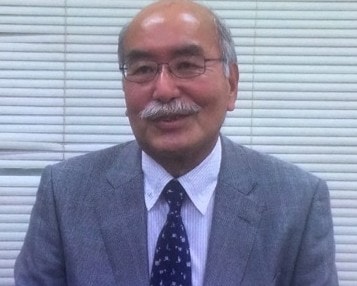
After graduating from the Faculty of Agriculture of the University of Tokyo in 1972, pursued research on sake yeast and koji mold at the National Research Institute of Brewing of the National Tax Agency and at the University of Tokyo. Currently, Research Professor at Nihon Pharmaceutical University, Professor Emeritus at the University of Tokyo, and president of the Japanese Society for Brewing Science. He has authored several books, including Washoku to Umami no Misuteri—Kokusan Kojikin Orize ga Tsumugu Sennen no Monogatari (mystery of washoku and umami —a 1000-year story woven by Japanese koji mold, Aspergillus oryzae), Kawade Shobo Shinsha (2016); Jozo no Jiten (brewing encyclopedia), Asakura Publishing (2021); 47 Todofuken Hakko Bunka Hyakka (47-prefecture fermentation culture encyclopedia), Maruzen Publishing (2021); and Hakko Jozogaku (fermentation and brewing science), Asakura Publishing (2022).