External Evaluations and Participation in Initiatives
The Kikkoman Group undergoes evaluations by external assessment organizations and participates in initiatives and industry organizations in Japan and around the world to enhance the transparency and effectiveness of its environmental efforts. Through these activities, we gain insight into societal expectations and continuously improve our initiatives addressing environmental and climate-related challenges.
External Evaluations and Certifications
CDP
The CDP, headquartered in London, is a non-profit organization whose main activities are to request disclosure of environmental impact countermeasures from companies and public authorities and promote these countermeasures through disclosure.
In 2025, after responding to questionnaires on “Climate Change,” “Forests,” and “Water Security,” the Kikkoman Group was selected for the highest rating “A List” in the categories of “Climate Change” and “Water Security.”
This marks the first time we have been included in the A List for “Climate Change,” and for “Water Security,” it is our third consecutive year and sixth time overall.
Meanwhile, our rating for “Forests” was “B.”
Kikkoman Corporation was named a Supplier Engagement Leader, the highest rating in the CDP’s 2025 Supplier Engagement Assessment (SEA).
The SEA evaluates how effectively companies collaborate with suppliers on climate-related issues, focusing on four areas: governance, targets, Scope 3 emissions, and value chain engagement.
NIKKEI SDGs Management Survey
In the 2025 survey, the Kikkoman Group received a 3.5-star rating (standard score of 59.4). Specifically, our standard score for environmental value was 59.8, with particularly high evaluations for the indicators of “Initiatives towards decarbonization” and “Monitoring and reduction of greenhouse gases (GHG)”.
Toyo Keizai Corporate CSR Ranking
In the 2026 edition of the Toyo Keizai Corporate CSR Rankings, an evaluation encompassing both financial and social responsibility (CSR) aspects, the Kikkoman Group received a score of 92.4 for the category of “Environment”, ranking 65th. Our overall CSR ranking (listed companies) was 147th, ranking 6th within the food products sector.
Certification as an “Active Water Cycle Company”
Kikkoman has once again been certified as an “Active Water Cycle Company” under the Water Cycle Company Registration and Certification System*1, administered by the Headquarters for Water Cycle Policy of the Cabinet Secretariat in Japan.
This renewed certification recognizes our efforts to maintain and achieve voluntary standards that are stricter than regulatory requirements for wastewater, as well as our initiatives to efficiently reduce water usage through reassessment of existing processes and the implementation of effective measures.
*1 A certification system established in FY2024 to further and promote corporate initiatives by actively recognizing and incentivizing company contributions to the water cycle, thereby encouraging continued and enhanced corporate efforts.

Gifu Decarbonization Excellence Certification
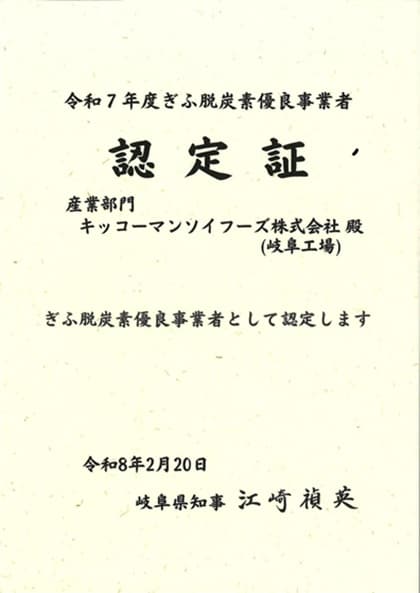
The Kikkoman Soyfoods Company’s Gifu Plant was recognized as a “Gifu Decarbonization Excellence Business Operator” for Japanese FY2025 (April 2025 to March 2026), in recognition of its outstanding performance in reducing greenhouse gas emissions under Gifu Prefecture’s evaluation program. This program requires major emitters to report their emissions reduction plans and results, and evaluates their efforts accordingly.
During the FY2021–2024 plan period under this program, the Gifu Plant set targets of a 0.5% reduction in emissions and a 3.0% reduction per unit of production. It achieved reductions of 20.3% in emissions and 6.3% per unit of production, significantly exceeding these targets.
These results and initiatives were recognized, leading to this certification.
As part of our emissions reduction efforts, we have improved the energy efficiency of HVAC (heating, ventilation, and air conditioning) and refrigeration systems, converted lighting to LED, and switched to 100% renewable electricity.
We are also working to reduce losses in steam, compressed air, heat, and water to promote more efficient energy use.
Going forward, we will continue to advance decarbonization by pursuing both energy efficiency and the use of renewable energy.
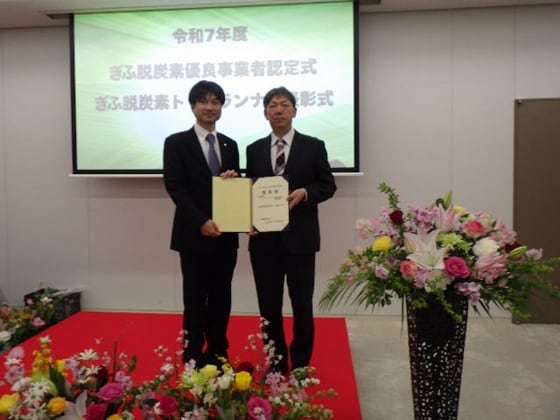
Certification Ceremony (February 2026, Gifu Prefectural Government Office)
Participation in Initiatives and Industry Organizations
Signing of the United Nations CEO Water Mandate
The Kikkoman Group was the first Japanese company to sign the CEO Water Mandate in June 2015.
Launched at the 2007 UN Global Compact Leaders Summit held in Geneva, the CEO Water Mandate is a private-public sector initiative that grew out of a collaboration among six endorsing international companies, the United Nations (UN) and the Government of Sweden. (The Kikkoman Group has been participating in the UN Global Compact since January 2001.) The Mandate is an international commitment platform for policies, practices, and information disclosure covering a wide range of activities to conserve water sustainability. By signing the Mandate, each company’s CEO clearly expresses their intent to fulfill stewardship responsibilities as part of an international partnership for water resource conservation.
Affiliation with JCLP
The Kikkoman Group has been a member of the Japan Climate Leaders' Partnership (JCLP) since May 2015. JCLP is a coalition of Japanese companies established in July 2009 to promote various inter-industry and industry-government-academia activities beyond the scope of individual enterprises, based on the recognition that industries should develop a sound sense of urgency and initiate autonomous and preemptive action, with the goal of realizing a sustainable decarbonized society. This organization facilitates information exchange and joint projects among industry, government and academia, supports initiatives including RE100, EP100, EV100, and Renewable Energy 100 RE Action, and provides recommendations on a variety of policies, such as long-term growth strategies in line with the Paris Agreement.
Participation in the Japan Climate Initiative (JCI)
Our commitment to addressing climate change led us to join the Japan Climate Initiative (JCI) in September 2021, with the aim of mitigating global warming and reducing greenhouse gas emissions.
“Decokatsu” Declaration
In February 2025, the Kikkoman Group expressed its support for the Ministry of the Environment’s national movement, “Creating a New Abundant Lifestyle that Leads to Decarbonization (coined "Decokatsu," combining "DE"-carbonization, "ECO"-friendly, and "KATSU" - the Japanese word for activity/lifestyle, by making a “Decokatsu” declaration.
The Group also joined the “Decokatsu Support Team” (a public-private partnership council), which serves as a platform for effectively implementing this initiative.
Joining the Insetting Consortium
In July 2025, Kikkoman Corporation joined in the Insetting Consortium organized by The Norinchukin Bank. The consortium serves as a framework for corporate collaboration aimed at reducing greenhouse gas emissions across the food and agriculture value chain and promoting nature‑positive initiatives. Kikkoman is advancing efforts to reduce environmental impact throughout its supply chain, including at the raw materials sourcing stage, in collaboration with relevant companies and production sites.
Participation in the Japan Project for the “10x20x30 Food Loss and Waste Initiative”
In 2019, the Kikkoman Food Products Company joined the Japan Project for the “10x20x30 Food Loss and Waste Initiative” organized by AEON Co., Ltd. About 800 million people worldwide (one in nine) are estimated to be undernourished, while about 1/3 of the food equivalent to 1.3 billion tons produced for human consumption is being wasted annually, though still edible. This is referred to as the food loss problem. Of the 27.59 million tons of food wasted in Japan during FY2016, food loss comprised 6.43 million tons (3.52 million tons generated by businesses including manufacturers, wholesalers, retailers, and restaurants, and 2.91 million tons generated by households), which is equivalent to about 1.7 times the amount of food that the UN World Food Program (WFP) donated to countries facing poverty and hunger.
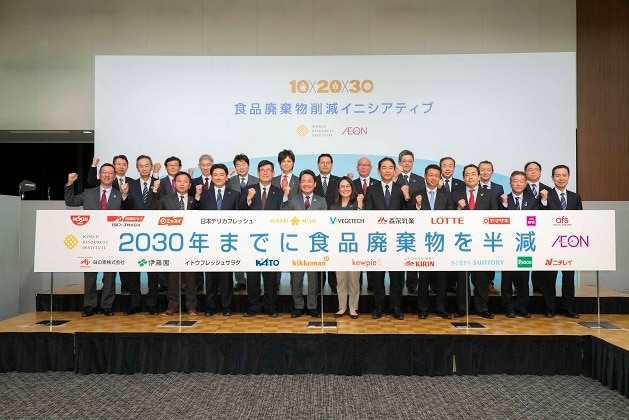
The “10x20x30 Food Loss and Waste Initiative” is sponsored by the WRI (World Resources Institute), a non-profit U.S. think tank engaged in policy research and technology development related to the global environment and sustainable development. This initiative was brought together by ten of the world's largest food retailers, each engaging with twenty suppliers to halve rates of food loss and waste by the year 2030. Following the launch of this international initiative in September 2019, WRI authorized AEON Co., Ltd. to work with 21 food manufacturers (suppliers) in Japan, including the Kikkoman Food Products Company, to begin taking action (initiating projects) aimed at decreasing food waste by half.
Participation in the Japan Clean Ocean Material Alliance (CLOMA)
In September 2021, the Kikkoman Group became a member of the Clean Ocean Material Alliance (CLOMA) to track progress in addressing the issues of marine plastic pollution, the three Rs for plastic materials, development and commercialization of environment-friendly plastics, all of which contribute to the activities of the group's environmental vision.
Participation in Marine Ecolabel Japan Council (MEL)
In June 2023, the Kikkoman Group became a full member of the Marine Ecolabel Japan Council (MEL) in support of its objectives, “to protect Japan’s diverse nature, fish species, fishing methods, processing and distribution, and diverse fish-eating culture, as well as consumption for the healthy and rich food-lifestyles of people in Japan and worldwide”.
Participation in the “Declaration of Resource Conservation Challenge”
Kikkoman Corporation is participating in the "Declaration of Resource Conservation Challenge" endorsed by nine prefectures and cities in Japan.
The challenge aims to promote the reduction and recycling of one-way plastic products, containers and packaging, and food waste in the Tokyo metropolitan area and surrounding cities.
Kikkoman's Challenge for the Declaration of Resource Conservation (FY2024)
- 1Strive to use sustainable raw materials. Also, examine feasibility and apply product designs and materials that are easy to sort and recycle.
- 2Develop products that reduce CO2 emissions, plastic usage, and other environmental impacts across the value chain, from development and raw material procurement through to end-user use.
During the fiscal year ending March 31, 2026, we implemented a range of resource-conservation initiatives, including lightweighting PET bottles, reducing paper usage through carton specification changes, and reducing material consumption through the use of thinner flexible packaging. We will continue to advance initiatives in line with this declaration.
Participation in “Declaration of Action on Plastic Recycling”
Kikkoman Corporation takes part in the “Declaration of Action on Plastic Recycling” launched by Japan’s Ministry of Agriculture, Forestry and Fisheries from November 2018. Under this declaration, the Ministry of Agriculture, Forestry and Fisheries compiles examples (activities related to reduction, reuse and recycling) of policies and initiatives for plastic waste undertaken by industry organizations and companies using plastic products, containers and packaging in the food production, food logistics, food retailer, restaurant and other related sectors. These are then showcased to highlight the various issues caused by plastic waste and the importance of methods to address those issues, aiming to extensively promote action throughout society and amongst citizens.