
Lacquerware
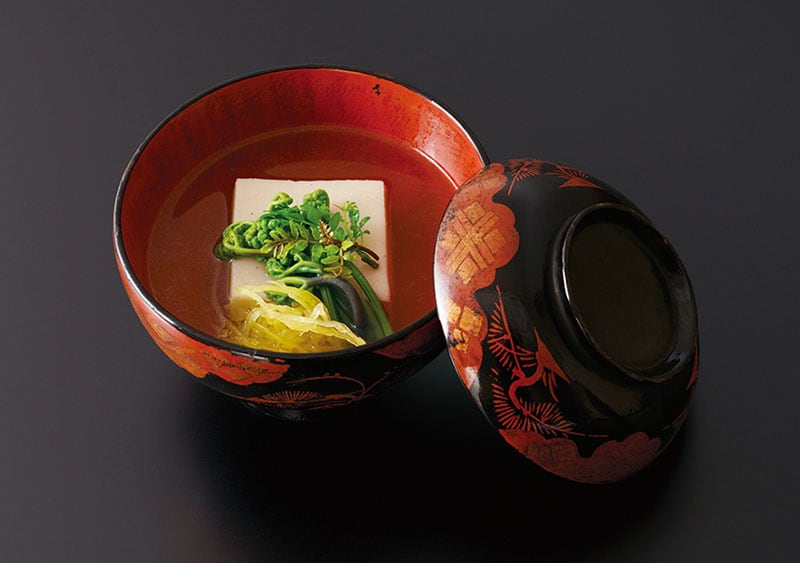
Our Feature series on Japanese Tableware continues with lacquerware.
Writer, artist and philosopher Mushanokoji Saneatsu (1885-1976), wrote: “Nature is a genius at creating all kinds of things; humans are geniuses at bringing out the best in them.”
Indeed, we are adept at discovering myriad different materials within nature and fulfilling their potential, and we Japanese have learned to coexist with nature.
One may say that Mushanokoji’s words aptly sum up the character of the Japanese and their culture, and I cannot help but relate his thoughts—not only to the traditional Japanese cuisine of washoku, which makes the most of nature’s seasonal ingredients—but to the topic discussed here: lacquerware.
Urushi lacquer
A fragment of wood from the Japanese lacquer tree urushi (Toxicodendron vernicifluum) was unearthed during the archeological excavation of a nearly 12,000-year-old site in Japan; and urushi-coated vessels dating back almost 9,000 years have been discovered. These ancient findings reveal that the Japanese have utilized urushi as an adhesive and a coating for millennia. One cannot help but admire the fact that nature produced such a plant, and marvel at the ways in which human beings recognized how its sap could be put to use.
Processing lacquer
When the outer bark of the urushi tree is cut, sap is secreted from the incised grooves as the tree attempts to repair itself. This raw, unprocessed sap (ki-urushi) has a high water content; it is absorbed easily by wood and strengthens it, so it is applied as an initial base coat when lacquering wooden vessels. To make urushi coating material, raw sap is gathered and undergoes a refining process called kurome, which involves slowly stirring and heating the sap to evaporate excess moisture, resulting in a transparent, brownish and viscous coating lacquer known as kurome-urushi, or suki-urushi (refined lacquer) that is applied to create a thicker finish while eliciting the distinctive color, shine and beauty of the wooden vessels. The further attraction of a lacquered surface is its smooth texture and warm feel, making it particularly sought-after in making tableware.
Texture and appeal
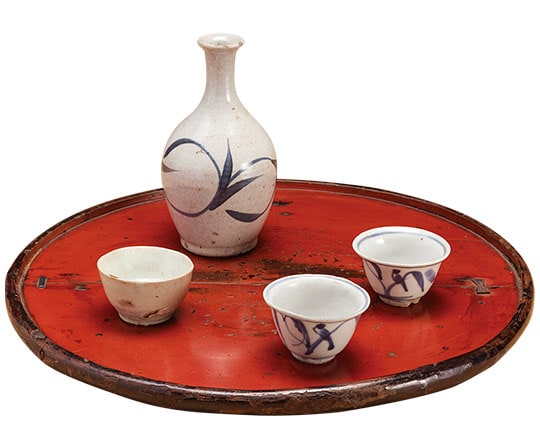
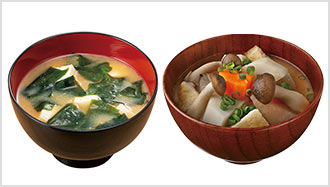
The Japanese have long been fond of lacquer’s pleasing texture. Artifacts excavated at eighth-century archaeological sites in Japan’s ancient capital of Heijo-kyo indicate that lacquer eating utensils and vessels have been used for more than one thousand years. Moreover, given that wooden lacquer vessels are light in weight and do not readily conduct heat, the practice of lifting a bowl to one’s mouth while eating likely arose naturally as a custom unique to washoku dining.
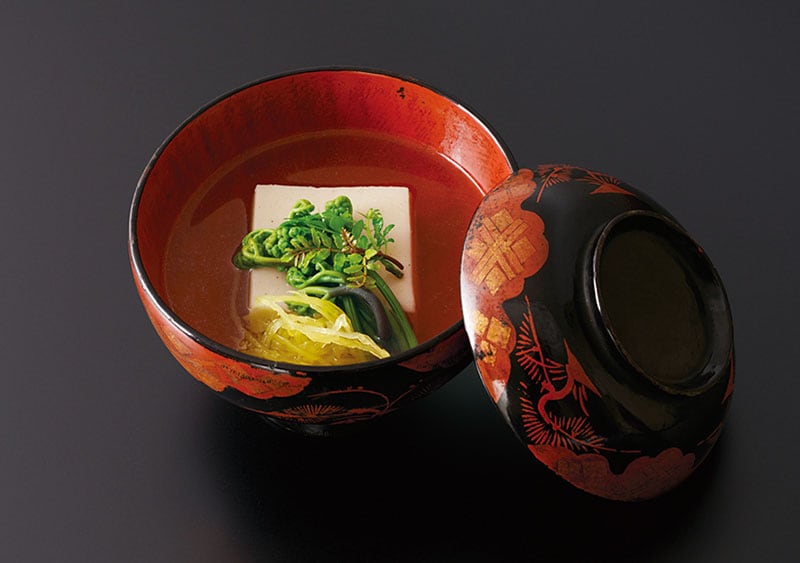
The appeal of lacquerware lies not only in the deep luster or pleasing amber color of the coated wood surface, but also in the serendipitous beauty that arises over time, thanks to the durability of the ware. Examples can be seen in the red lacquerware known as Negoro, distinguished by urushi mixed with vermilion pigment (produced by mercury sulfide). This pigment was long considered valuable, therefore only a thin layer of vermilion urushi lacquer was applied. Over long years of handling, some of this red outer layer rubbed off to expose the black urushi base coating beneath, to pleasing effect. The artisans who produced such works hundreds of years ago perhaps never imagined how treasured these pieces would be for the beauty resulting from this effect. It is a beauty that can only become revealed in a vessel that remains sturdy over a considerable length of time.
Lacquerware artistry
Maki-e “sprinkled-picture” lacquer presents another form of beauty that makes use of the special qualities of urushi. The urushi coating process is described as “drying,” but as no solvent is involved, it is more accurate to say “hardening.” In a normal environment, urushi lacquer coating does not harden, thus it is placed for several days in a high-humidity cabinet called an urushiburo (urushi-bath).
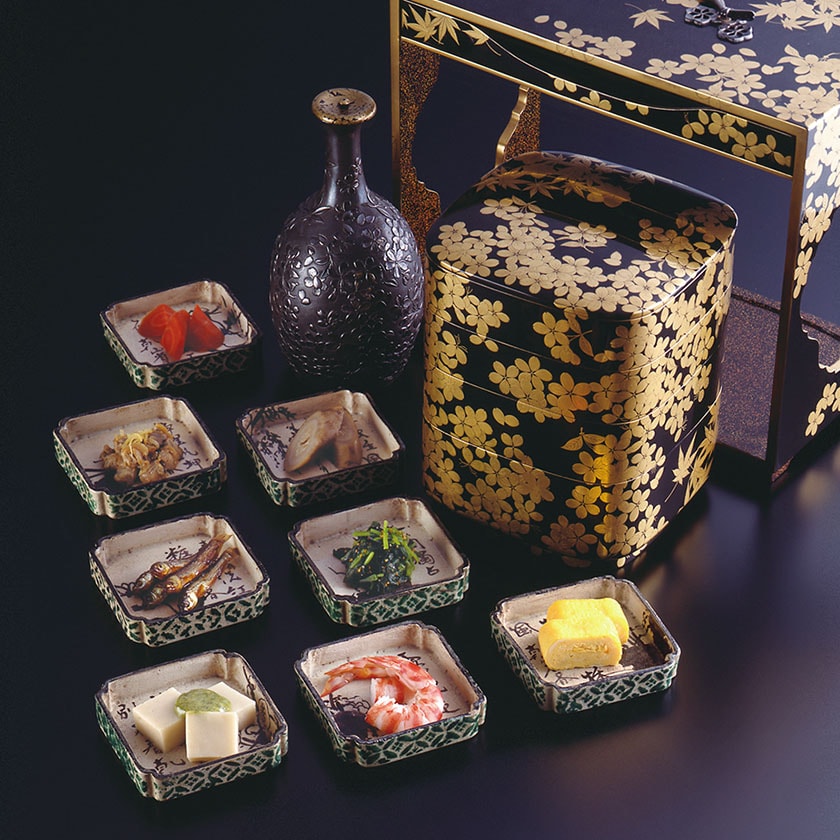
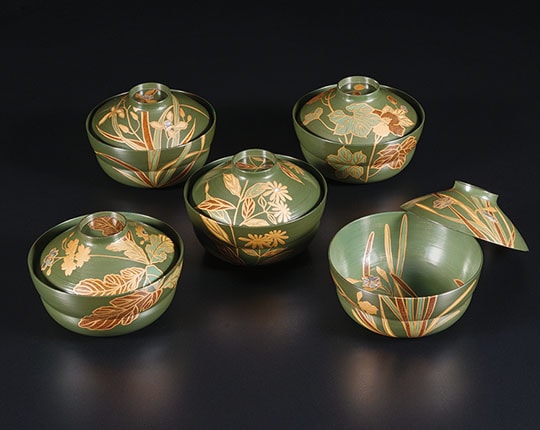
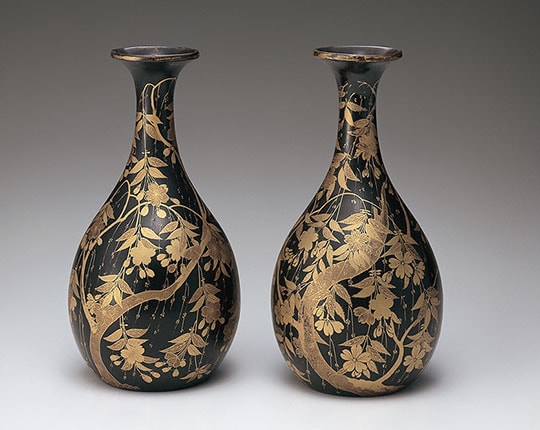
The maki-e technique takes advantage of this characteristic of lacquer, wherein the timing of the drying can be controlled: a picture is drawn using urushi on a lacquered surface and gold powder is sprinkled over it; the vessel is then placed in the urushiburo to fix the design. If urushi were to have the innate property of hardening naturally, the gold powder could not adhere. The lacquer artist can therefore harness the properties of lacquer through a variety of maki-e techniques—by applying different purities of gold to change color, or adjusting size, shape and density of sprinkled gold powders, or incising fine lines into the surface prior to drying. This expressive, rich artistry reveals maki-e as a unique art form in its own right. Further decorative practices emerged in the form of urushi-e lacquer paintings, where lacquer is incorporated with red and yellow pigments, or with indigo to create green hues.
Future of urushi
The Japanese have a unique connection with urushi lacquerware that has endured for over ten thousand years. Throughout the centuries, as washoku cuisine has advanced, its associated lacquered vessels have been elevated as an esteemed form of art. Today, the overall industry of lacquerware production is declining steadily; yet at the same time, new applications for urushi and maki-e are being explored and attracting attention as decorative elements for items such as fountain pens, watches and other luxury goods, as well as in contemporary crafts and artistic media. Such novel and innovative applications reflect the trends of our times and should be regarded as a natural extension and evolution in the history of urushi artists, who have always adapted their craft in response to the changing needs of clients.
Alongside such innovations, it is hoped that urushi lacquerware will continue to be used for tableware—particularly for those items that come into direct contact with the mouth, such as chopsticks, spoons, soup bowls and so on—allowing diners to experience and share with others the pleasant and unique sensibility that lacquerware brings to washoku cuisine.
Yasuo Kuwabara was born in 1967. Chief curator at the MIHO MUSEUM, Shiga Prefecture, he is a specialist in lacquer craft, including maki-e and Negoro ware, as well as the performing arts of Noh and Sarugaku. He has overseen numerous special exhibitions at the museum, including “Lacquer Craft Legend Sano Chokan” (2025) and “The Maki-e Masters: Their Edo-period Flowering” (2023). He is closely involved with the surveying and conservation of cultural properties in Shiga Prefecture.