
Biodiversity
Biodiversity plays an important role in supporting the natural environment. The various ecosystem services it generates, such as supplying resources, climate mitigation, cultural value, and water cycles, are essential to our lives. Yet at the same time, the rapid loss of biodiversity around the world is a cause for concern.
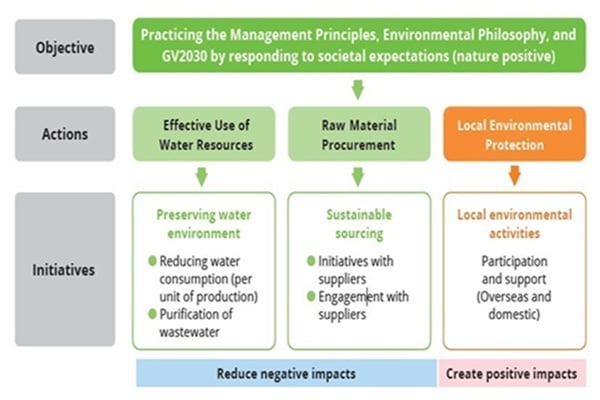
Going forward, the Kikkoman Group will seek to identify impacts on natural capital and nature-related risks with a focus on biodiversity, in addition to biodiversity conservation.
Through these efforts we aim to ensure that the positive impacts of our business activities on biodiversity outweigh the negative, in turn helping to realize “Nature Positive,” in which nature recovers to beyond its 2020 state by 2030.
Disclosures Based on TNFD Recommendations
The Kikkoman Group recognizes that, alongside climate change, biodiversity is one of the most important social issues. Working to conserve biodiversity is, in addition to reflecting our Management Principles, the practical embodiment of our environmental philosophy of “Corporate Activities Respecting the Workings of Nature and Harmonizing with the Environment.” Our Group’s businesses are sustained by the blessings of the planet, including resources such as soybeans, wheat, and water; therefore, we regard these efforts as important elements that underpin our business foundation.
Accordingly, we support the TNFD, an international task force on natural capital and biodiversity, and we will evaluate risks and opportunities based on the TNFD framework and advance disclosures regarding governance, strategy, risk management, and metrics and targets.
Governance
Governance Structure for Natural Capital
Our Group has established a Sustainability Committee chaired by the CEO. The Sustainability Committee sets company-wide policies for initiatives, identifies risks and opportunities including natural capital, and determines how to respond to them.
Respect for Human Rights Across the Entire Supply Chain
-
As a member of the global corporate community, our Group is committed to respecting human rights throughout the entire supply chain.
Strategy
Based on the LEAP approach*1, we evaluated dependencies, impacts, and risks and opportunities, and examined key measures.
*1 LEAP approach: A four-step process recommended by the TNFD (Taskforce on Nature-related Financial Disclosures) for companies to assess and disclose nature-related risks and opportunities: Locate, Evaluate, Assess, and Prepare.
Scoping of the Assessment
In selecting the scope for the LEAP assessment, we depicted the Kikkoman Group’s Value Chain and decided to focus our review on procurement/purchasing and production, which are presumed to have strong relationships with natural capital (under the LEAP approach, assessed as Procurement / Purchasing (agriculture) and production (processing)).
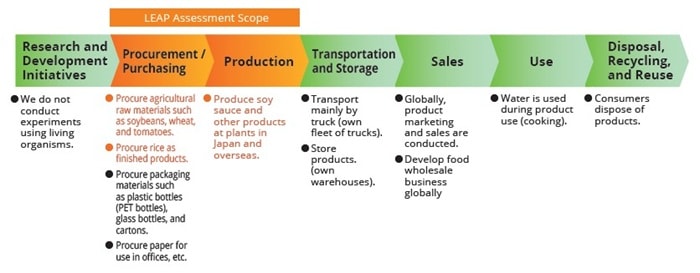
- Locate: Identify Points of Contact with Nature
Using ENCORE*2, a sector-specific tool for assessing nature-related dependencies and impacts, we examined the dependencies and impacts on natural capital within the sectors related to the Kikkoman Group’s Value Chain.
*2 ENCORE: a global tool developed by the United Nations Environment Programme World Conservation Monitoring Centre and others that assesses corporate dependencies and impacts on nature and identifies nature-related risks and opportunities
The ENCORE analysis of procurement/purchasing (agriculture) and production (processing) was conducted in 2022, and we evaluated the Consumer Staples Sector and selected the Sub-industry Agricultural Products and Packaged Foods and Meat (reflecting the ENCORE assessment as of 2025 in the Evaluate process).
- Evaluate:Diagnose Dependencies and Impacts
Based on ENCORE’s dependency and impact assessment, we mapped procurement/purchasing (agriculture) and production (processing) to the Kikkoman Group’s Value Chain and examined the impacts and dependencies in detail. In conducting the analysis, we also consulted the 2025 edition of ENCORE as appropriate. The results of the assessment are as follows.
We found that, for impacts on natural capital, the significant factors in procurement/purchasing are water use,use of terrestrial and freshwater ecosystems, and water and soil pollutants, while in production, water use is significant.
We found that, for dependencies on natural capital, procurement/purchasing relies significantly on groundwater and surface water, and on soil quality and soil maintenance; production relies significantly on groundwater and surface water, and on water quality and flow regulation.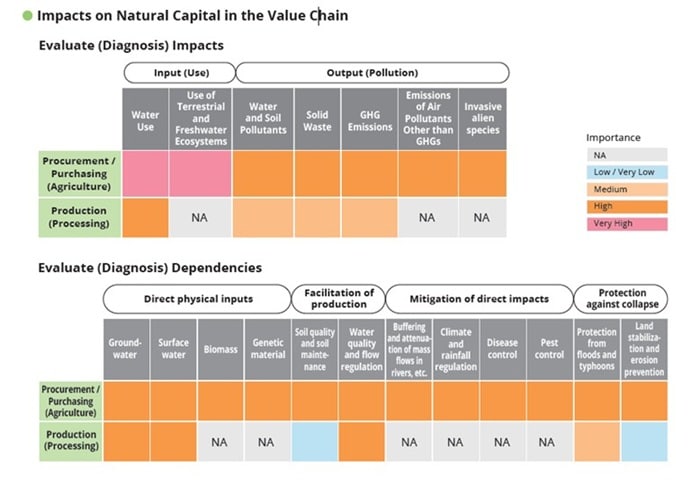
- Assess:Evaluate Risks and Opportunities
For both impacts and dependencies in procurement/purchasing (agriculture) and production (processing), we comprehensively organized items rated high or above across transition risks (policy / market / technology /reputation / liability), physical risks (acute / chronic), opportunities for corporate performance (market / capital flows and financing / resource efficiency / products and services / reputation capital), and opportunities for sustainable performance (sustainable use of natural resources / protection, restoration, and regeneration of ecosystems), and identified material risks and opportunities.
For procurement/purchasing (agriculture), transition risks include regulations on water use and land use and the associated market responses and reputational effects; physical risks include reduced yields due to declining irrigation water in rice and tomato producing areas, and damage to crops caused by natural disasters such as floods. For production (processing), transition risks include restrictions on water use and associated market responses and reputational effects; physical risks include procurement difficulties caused by depletion of groundwater and rivers and deterioration in water quality and flow functions.
-
Prepare:Preparation to Respond and Report
For the main measures addressing the key risks and opportunities in procurement/purchasing (agriculture) and production (processing) identified in Assess, SBTN*3 ’s AR3T Framework*4 was used to comprehensively organize them, and we identified the higher-priority items as follows.
*3 SBTN (Science Based Targets Network): an international collaborative network that enables companies and cities to set science-based targets related to the natural environment
*4 AR3T Framework: an action framework that guides companies in achieving nature-related targets (SBTs for Nature), prioritizing and structuring corporate actions toward target attainment (in the order of Avoid > Reduce > Restore & Regenerate)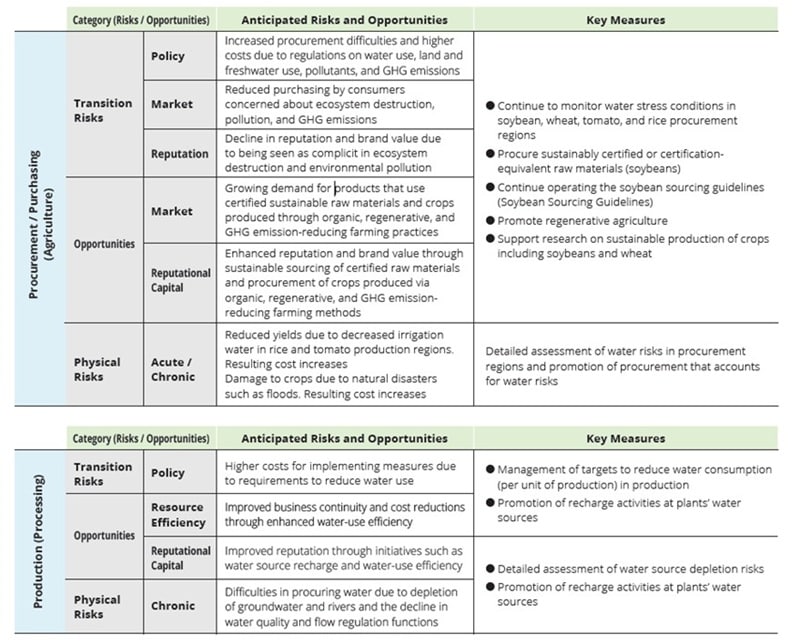
Managing Risks and Impacts
Our Group is advancing initiatives to prepare for risks surrounding our Group’s activities in order to achieve stable business development and fulfill our responsibilities to stakeholders. Given that the Kikkoman Group operates numerous businesses globally, to identify and manage a wide variety of risks and opportunities, each executive officer also directs the subsidiaries and divisions they are in charge of and works to prevent risks from materializing.
Metrics and Targets
-
TNFD Global Core Disclosure Metrics
-
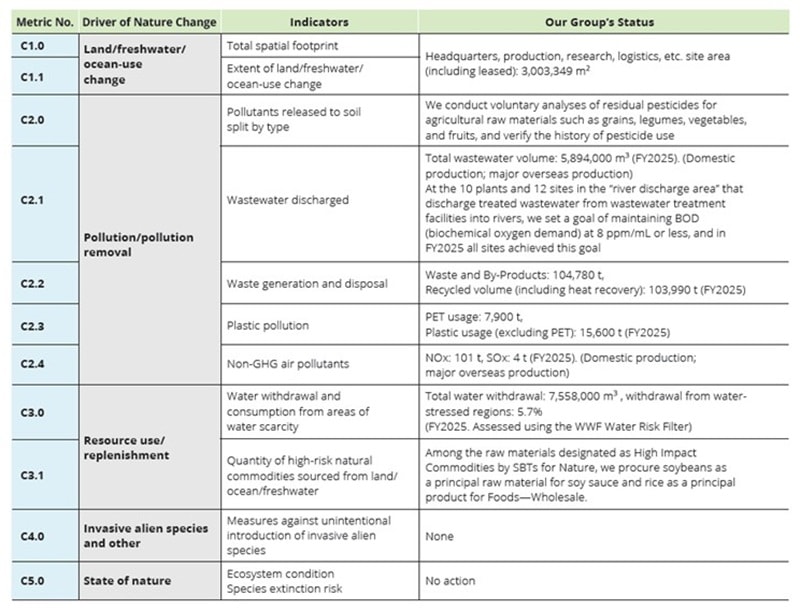
Current Status Regarding TNFD Global Core Disclosure Metrics on Nature-Related Dependencies and Impacts
-
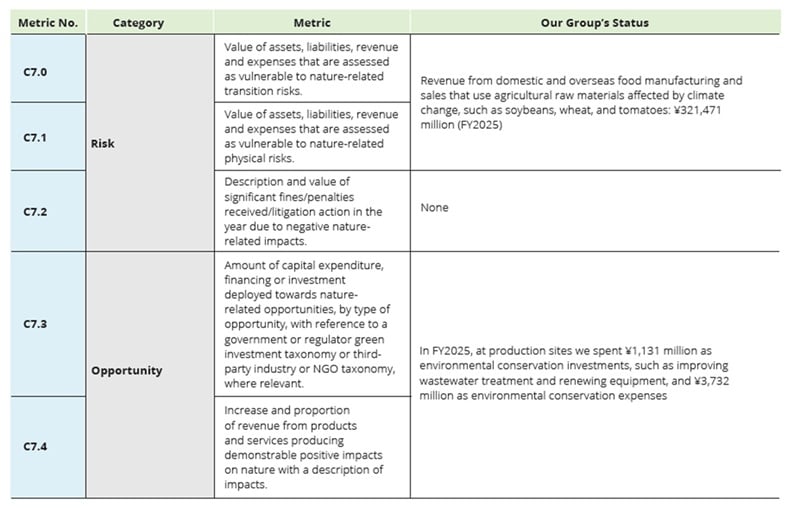
Current Status Regarding the TNFD Global Core Disclosure Indicators for Nature-Related Risks and Opportunities
- Long-Term Environmental Vision
-
Our Group has formulated the Kikkoman Group Long-Term Environmental Vision toward 2030. To help achieve a sustainable society, we have set out the fields, themes, and targets for our long-term efforts, and we continue to strengthen the Group’s environmental activities, including those related to natural capital.
-
Last updated: October, 2025
-